
0
Product added

Just like cars, watches need energy to run - and they can store it in a variety of ways. But few things are more frustrating than taking a watch out of its box only to find it has completely stopped.
To solve this problem and help enthusiasts get the most from their timepieces, watchmakers developed a dedicated display: the power reserve complication. It lets you see at a glance exactly how much energy your watch has left. So sit back and get comfortable - today, we're breaking down everything you need to know about this function you've almost certainly heard of!
Sometimes also referred to as an "energy reserve indicator," the power reserve indicator shows how much energy remains in the mainspring barrel of a mechanical watch. A quick reminder for those less familiar with the term: the barrel is a small circular container housing a coiled spring known as the "mainspring," which stores the energy needed to power the watch.
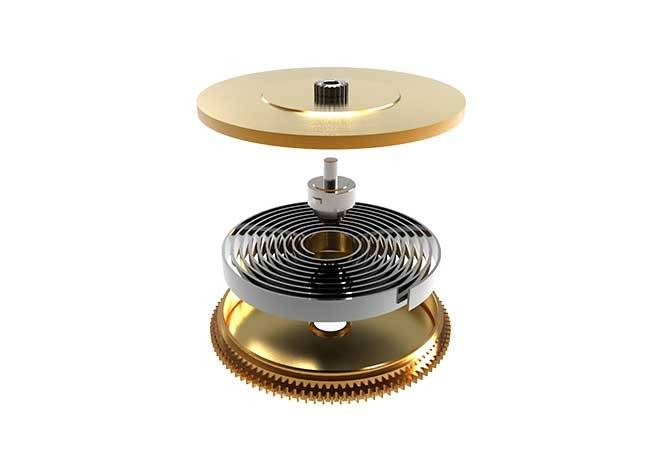
Exploded view of a watch mainspring barrel (Source: Générale Ressorts)
While this complication is most commonly found in mechanical watches, it is worth noting that certain hybrid watches can also feature it…
In general terms, a watch's mainspring barrel works much like the fuel tank of a gasoline-powered car. If the barrel is the tank, the power reserve indicator plays the role of the fuel gauge. The reserve graduation is typically expressed in hours, though on particularly long-running watches it may be expressed in days.
On a watch, this indicator most often takes the form of a hand pointing to graduations arranged in an arc - a layout that immediately calls to mind an automotive dashboard.
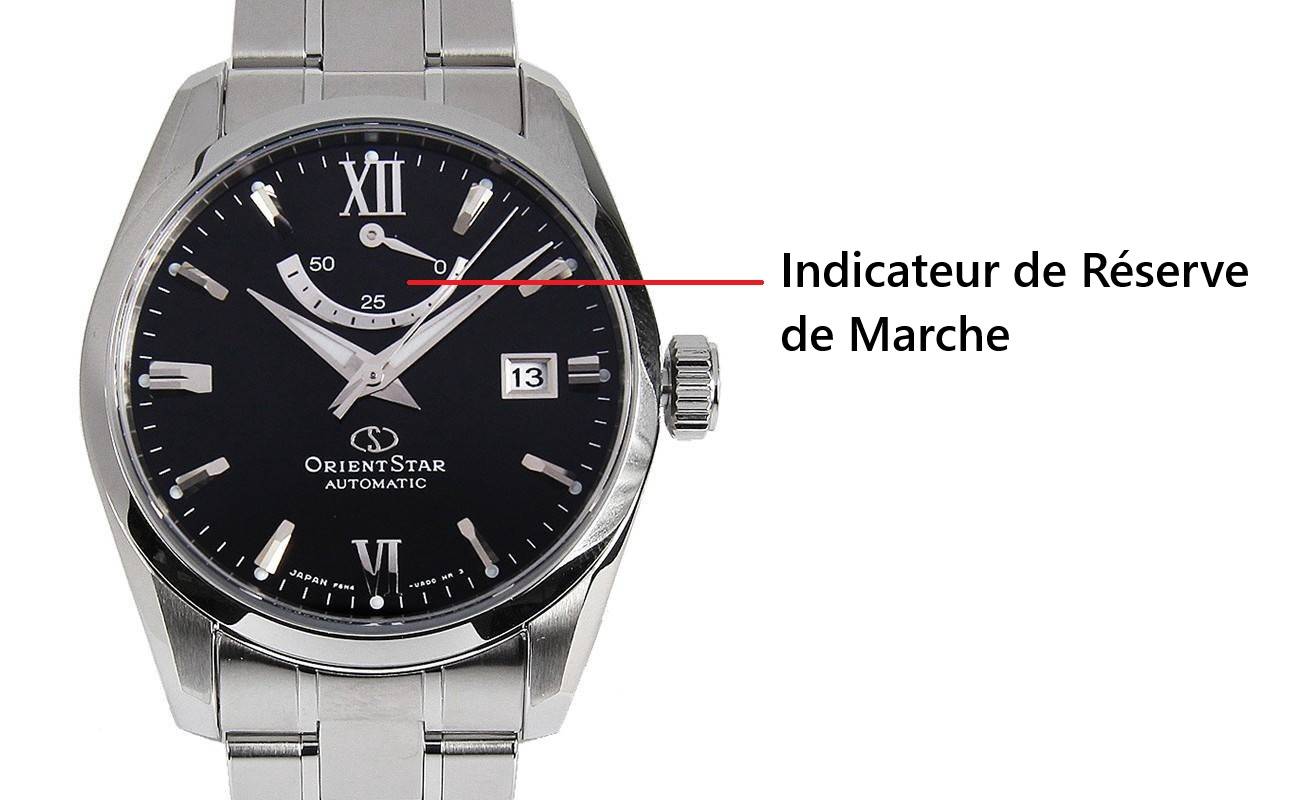
Power Reserve Indicator Placement on the Dial
While the indicator is often positioned at the top of the dial, it can also appear at 6 o'clock, 9 o'clock, or elsewhere - depending on the model and the manufacturer!
On certain watches, the power reserve indicator can also be displayed as a graduated rotating disc, or even as a linear scale.
Depending on the watch, the power reserve indicator can convey different information. In that sense, it can be said to serve several functions…
This distinction may seem subtle, but it is essential!
You might think the complication is less useful on an automatic watch, which winds itself through the motion of the wrist. In reality, if you spend your workday sitting at a desk, your watch may not be getting enough movement to stay fully charged. In that case, the power reserve indicator lets you know whether your timepiece needs a quick manual wind to keep you on time throughout the day.
The history of the power reserve is, in watchmaking terms, relatively undocumented… That said, the earliest traces appear to date back to the 18th century, when marine chronometers first came into use. These remarkably precise instruments were essential to navigation. As we discussed in our guide to the history of watchmaking, sailors' lives depended quite literally on their reliability.
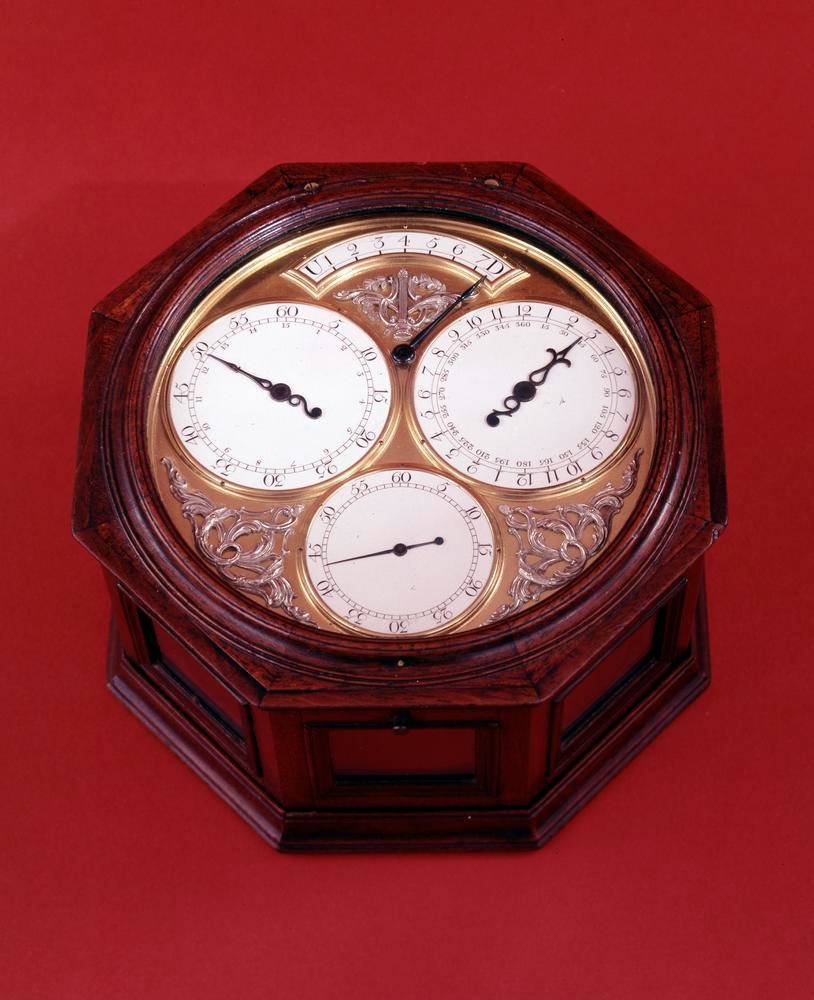
Marine chronometer by Thomas Mudge, circa 1774 (Source: British Museum)
A landmark example is the marine chronometer built in 1774 by English watchmaker Thomas Mudge. It already incorporated a power reserve indication, expressed in days. The display appeared through an arc-shaped aperture at the top of the dial, where a slender hand pointed to a scale running from 1 to 7. Thanks to this system, navigators knew precisely when it was time to wind their instrument.
Several years later, in 1794, the first pocket watch fitted with a power reserve indicator made its appearance.
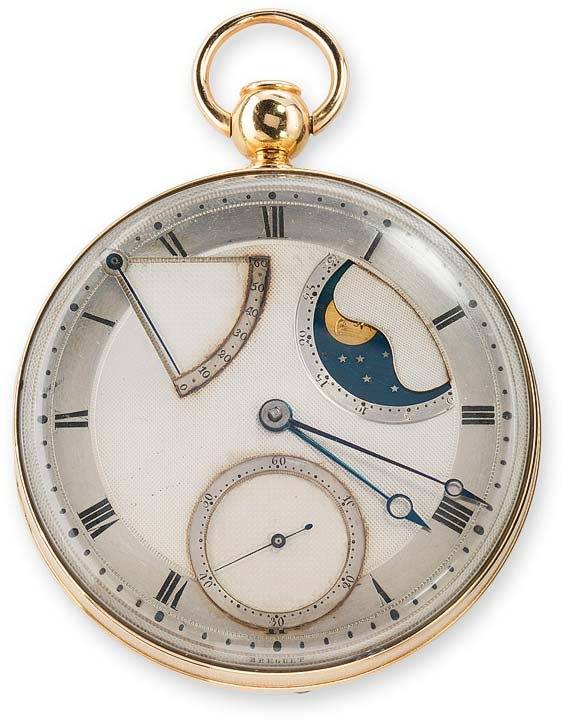
Breguet pocket watch with power reserve indicator, circa 1794 (Source: Montres Breguet SA)
Made by Breguet, this yellow gold piece combined two functions: a moon phase complication and a power reserve. Both were positioned in the upper section of the dial, with the reserve expressed over a 60-hour duration.
It would take many more years for this complication to make its way into a wristwatch. It was not until 1933 that Breguet unveiled the first wristwatch prototype incorporating a power reserve - though this creation was not intended for series production.
The true first commercially available wristwatch with a power reserve complication debuted in 1957 with the LeCoultre reference 8986.
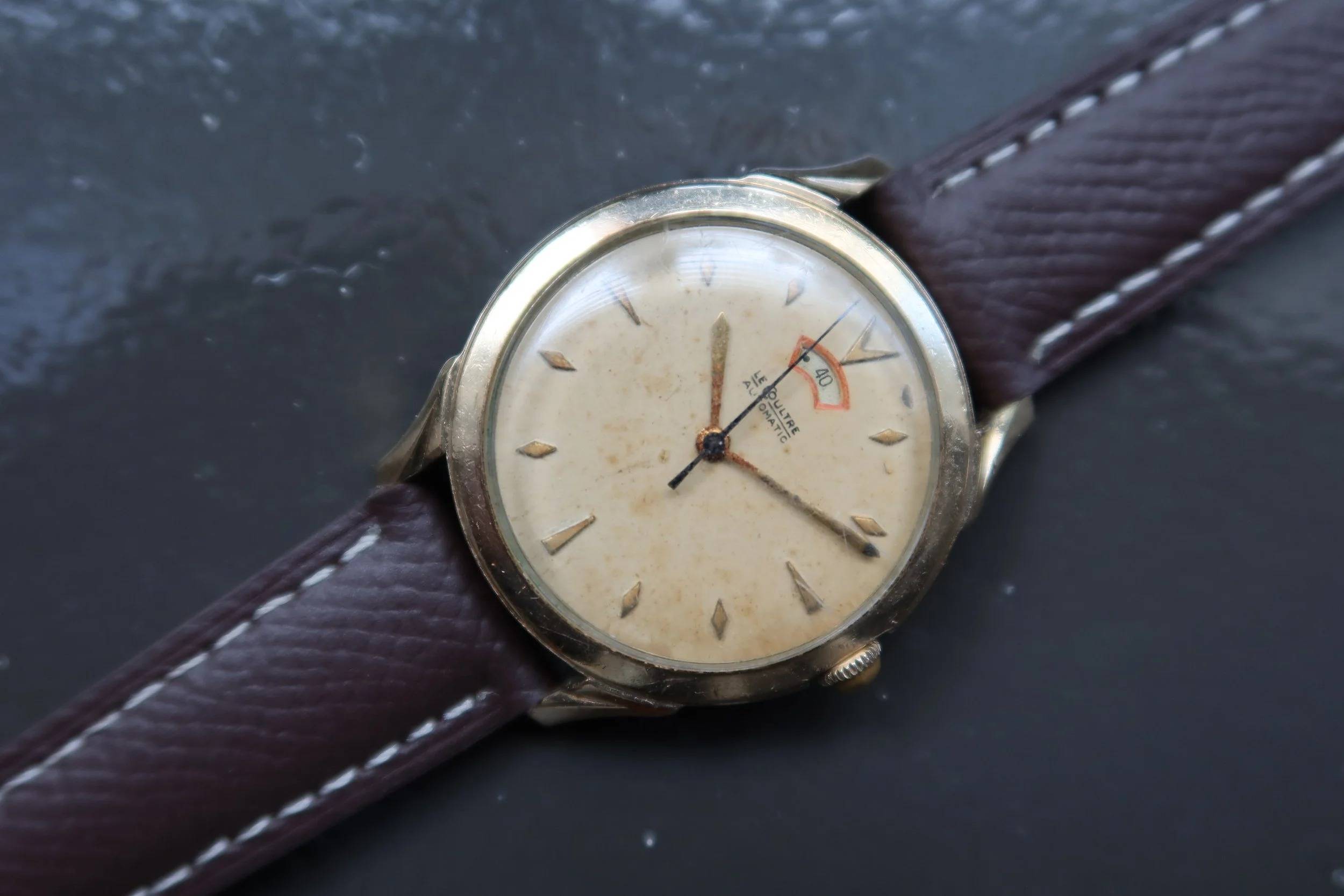
LeCoultre watch ref. 8986, circa 1957 (Source: Life on the Wrist)
The LeCoultre reference 8986 was powered by caliber 481, a movement derived from caliber 476 - the first automatic movement of a rather particular kind designed by the manufacture. Particular, you ask? Because its rotor did not spin freely: it swept a 270-degree arc before hitting a small spring-loaded metal stop.
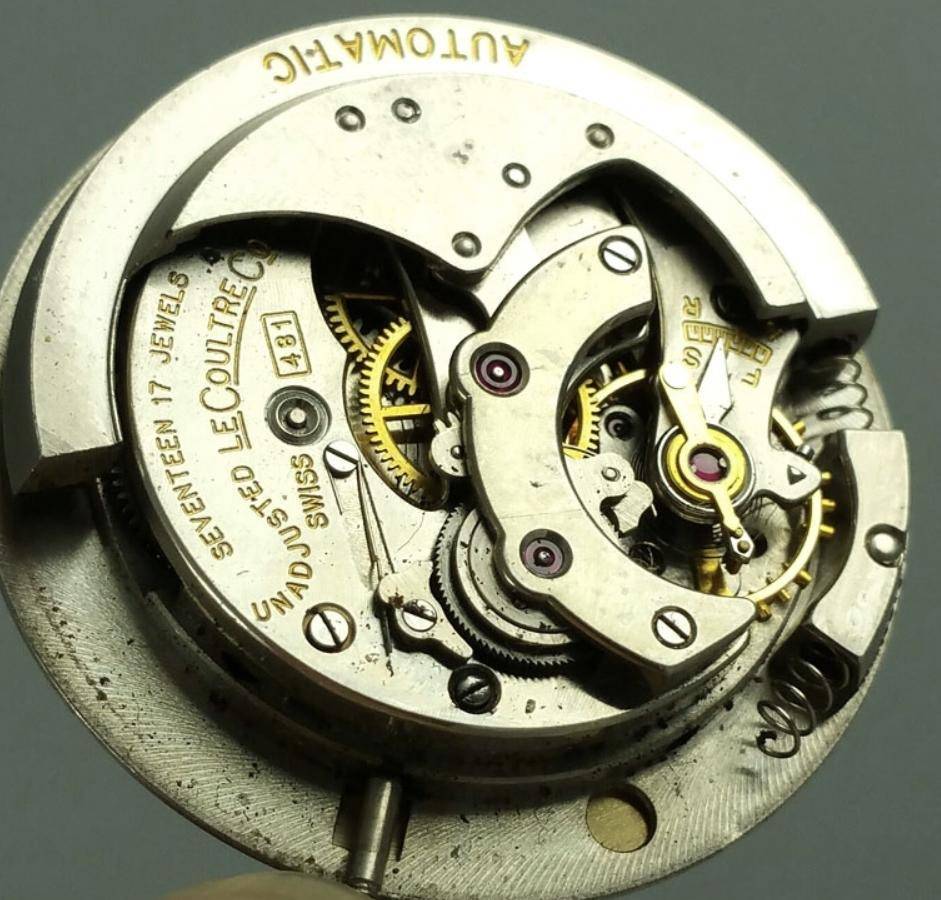
LeCoultre caliber 481 (Source: suissemontre.com)
If you are an enthusiast - or have simply read our guide to mechanical and automatic watches - you will know that this type of mechanism is called a "bumper movement." As a reminder, this mechanism represents the very first form of automatic movement in watchmaking history.
From an aesthetic standpoint, the power reserve indicator on this LeCoultre was defined by its understated elegance and efficiency. An arc-shaped window sat on the dial between the brand's logo and the 12 o'clock index. Behind it, a disc graduated over 40 hours rotated continuously, displaying the available reserve in real time. A particularly clever touch: a red zone allowed the wearer to tell at a glance whether the watch was running low on energy.
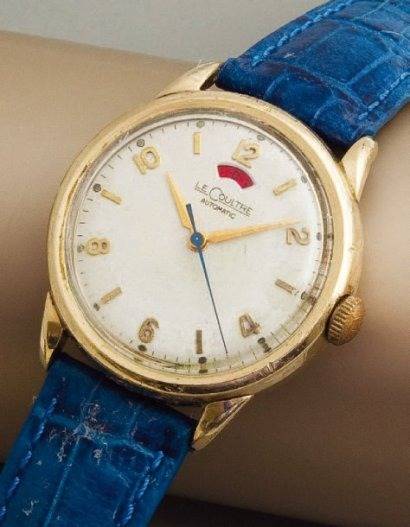
LeCoultre watch ref. 8986 with power reserve disc in the red zone (Source: Collector Square)
Reference 8986 holds a special place in Jaeger-LeCoultre's history, as it marks the starting point of several collections that have since become legendary among vintage enthusiasts, including the Powermatic and the Futurematic.
From the 1950s onward, several other houses joined the race and entered the field of watches equipped with the power reserve complication. Among them: Enicar, Baume, Paul Perregaux, and Zodiac, which developed a line called Autographic. In this series, certain watches featured a reserve graduation running from 0 to 36, displayed in a convex or concave arc. The dials gave the impression of smiling - or, conversely, of frowning! Collectors have affectionately nicknamed them "Happy Dial" watches, as the models seem to wear a cheerful expression.
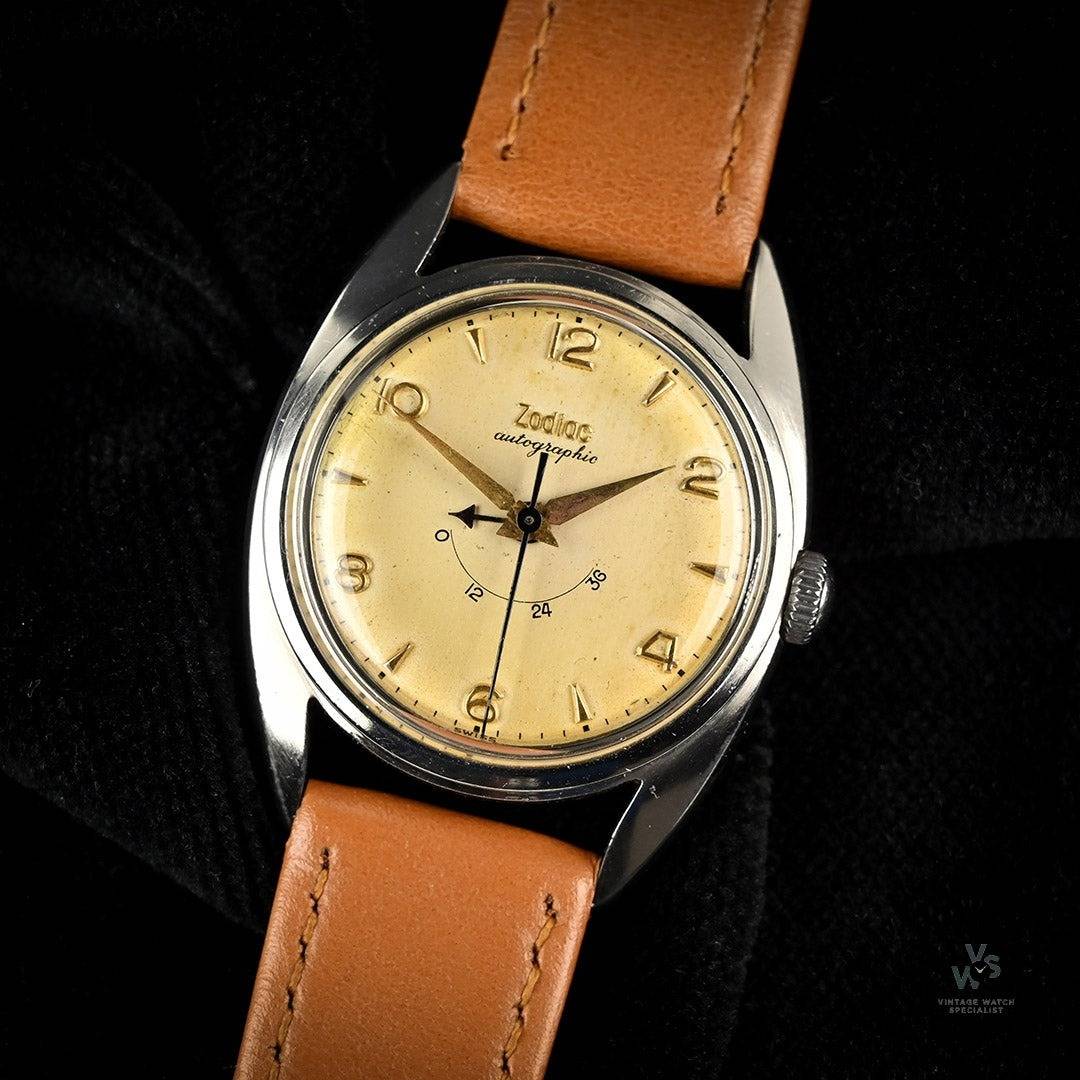
Zodiac Autographic 686 "Happy Dial," circa 1950 (Source: Vintage Watch Specialist)
Record pushed the boundaries with a particularly original dial design. Its power reserve indicator appeared in the form of a small counter positioned in the upper section of the dial.
This unusual layout almost gave the impression that the watch was fitted with a built-in pressure gauge!
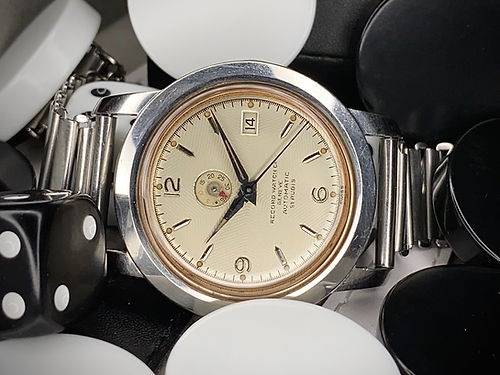
Record watch with power reserve, circa 1950 (Source: Bold Timepieces)
In the late 1950s, it was Longines' turn to surprise enthusiasts with a variant of its celebrated Conquest collection. This model stood out first for its date complication, unusually positioned at the top of the dial, and above all for its central disc serving as the power reserve indicator - a distinctive feature that earned it its nickname among English-speaking collectors: "Longines Conquest Central Power Reserve."
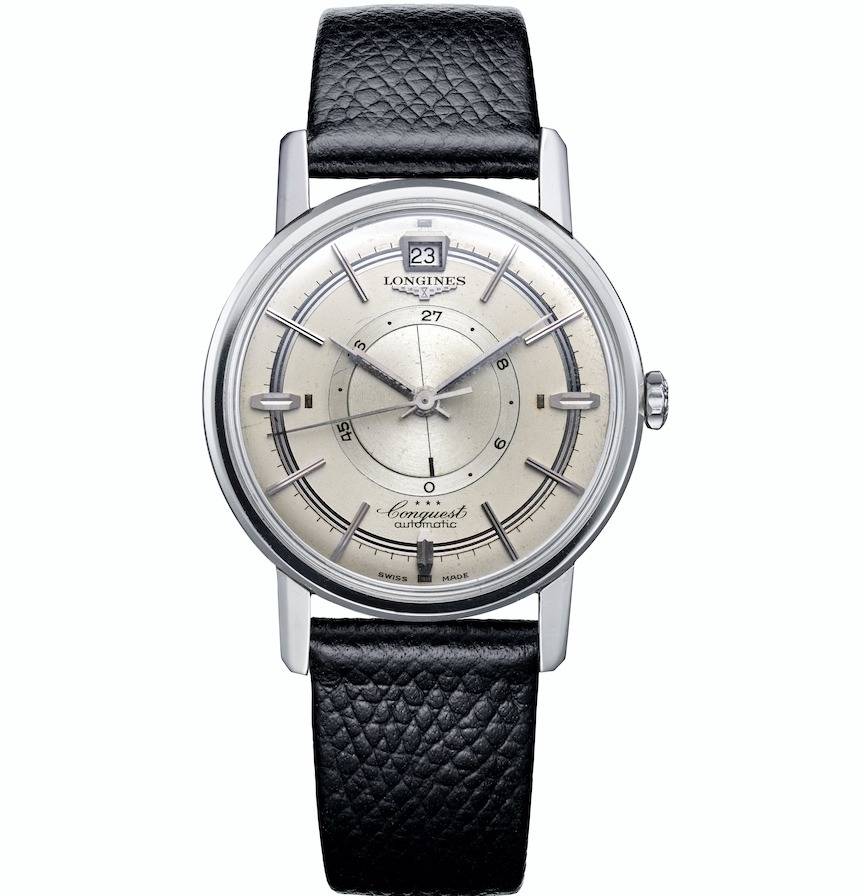
Longines Conquest Central Power Reserve ref. 9028, 1959 (Source: Ouest France - The Watch Observer)
This beautiful automatic watch with a 35mm diameter, powered by the Longines caliber 292, was sold in many countries - as evidenced by the stunning period advertisements promoting the model in various languages.
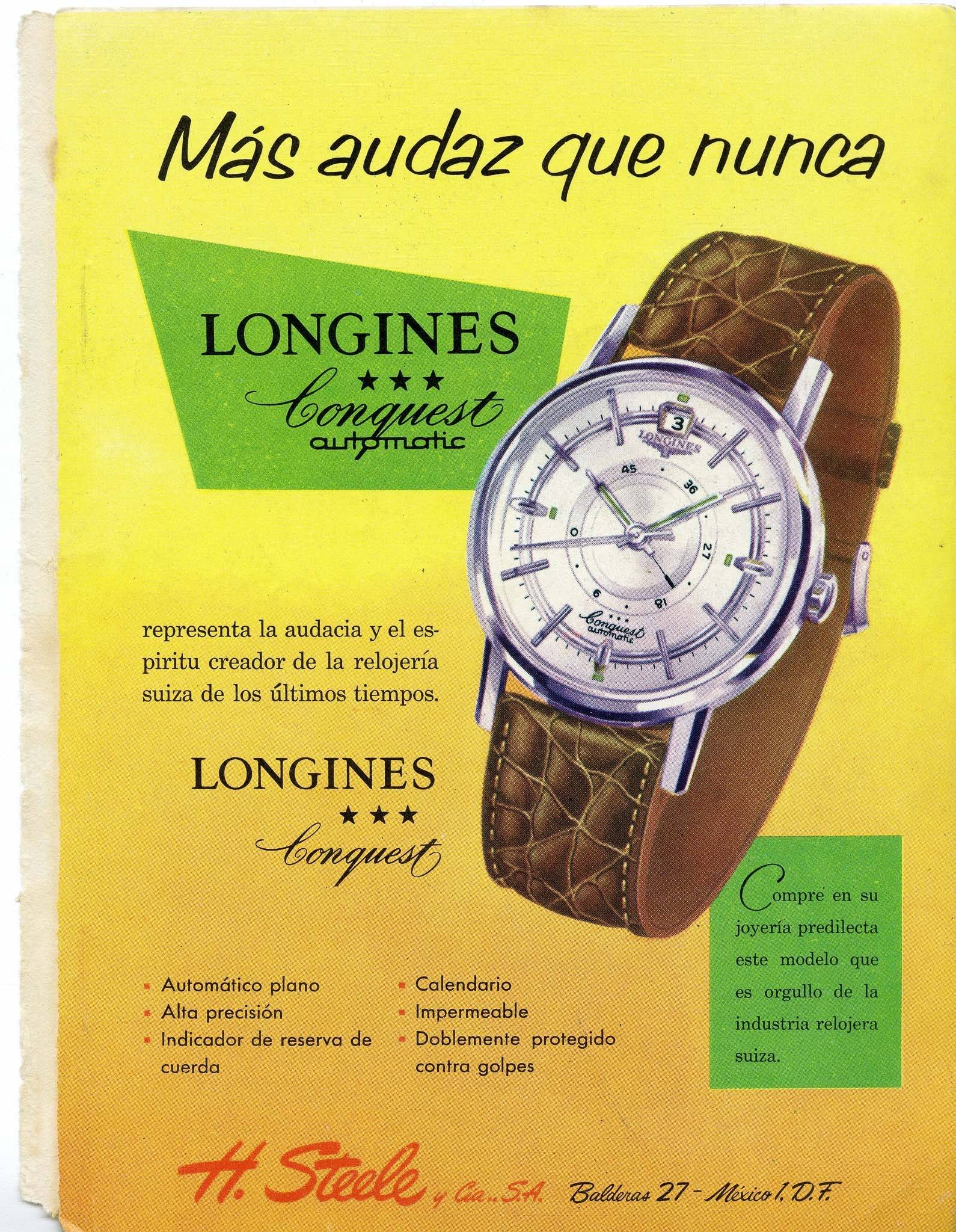
Vintage Mexican advertisement for the Longines Conquest with power reserve (Source: Les Rhabilleurs)
This iconic model was recently reissued by Longines as part of its Conquest Heritage collection - a wonderful way to experience this historic piece without the headaches that vintage watches can sometimes bring!
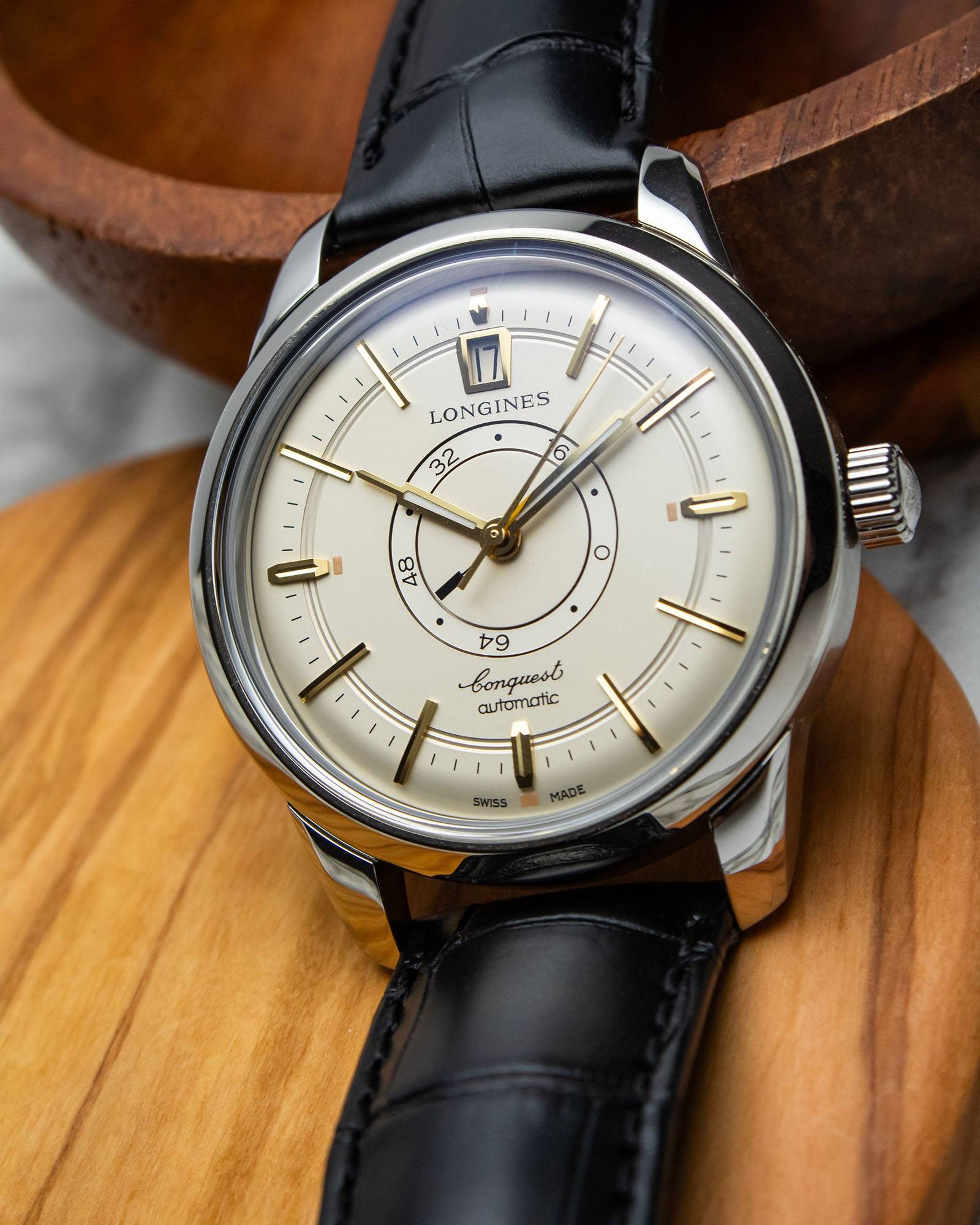
Longines Conquest Heritage Central Power Reserve (Source: aBlogtoWatch)
During the 1960s, many manufacturers offered watches featuring a power reserve function. Yet the complication gradually fell out of fashion in the decades that followed, before staging a genuine comeback in the 1990s - a period when watch complications began capturing the public's imagination once again.
Houses such as Breguet, Chaumet, Universal Genève, and Zenith helped bring this indication back into the spotlight - a display that, while seemingly straightforward, remains genuinely useful in everyday life!
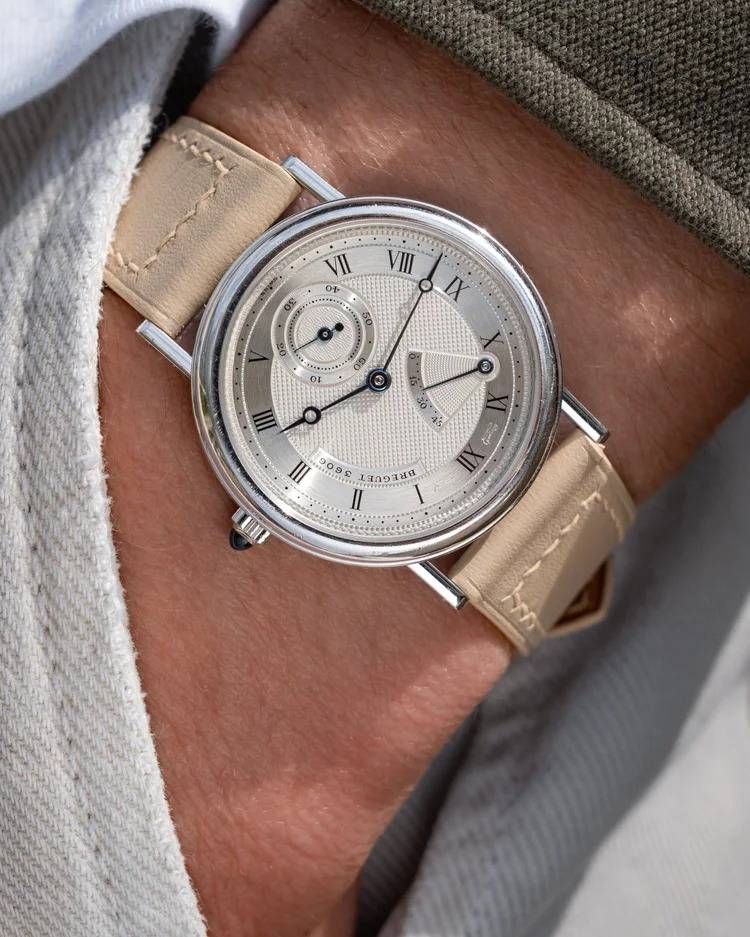
Breguet Classique watch with power reserve, circa 1990 (Source: Watch Brothers London)
Seiko also played a key role in this revival. In the 1990s, the brand spotlighted the complication on select models in its Kinetic line - hybrid watches whose power reserve stood out thanks to color-coded graduations (in red, yellow, or blue) that gave the display a more graphic, contemporary look.

Seiko AGS 5M23-6B70, circa 1994 (Source: Chrono24 - @Vintage Watch Place)
No discussion of Seiko would be complete without mentioning Citizen, which made the power reserve a signature feature of its solar-powered Eco-Drive watches.
On some models, the indicator takes center stage, while on others it blends seamlessly into a dial packed with multiple complications.
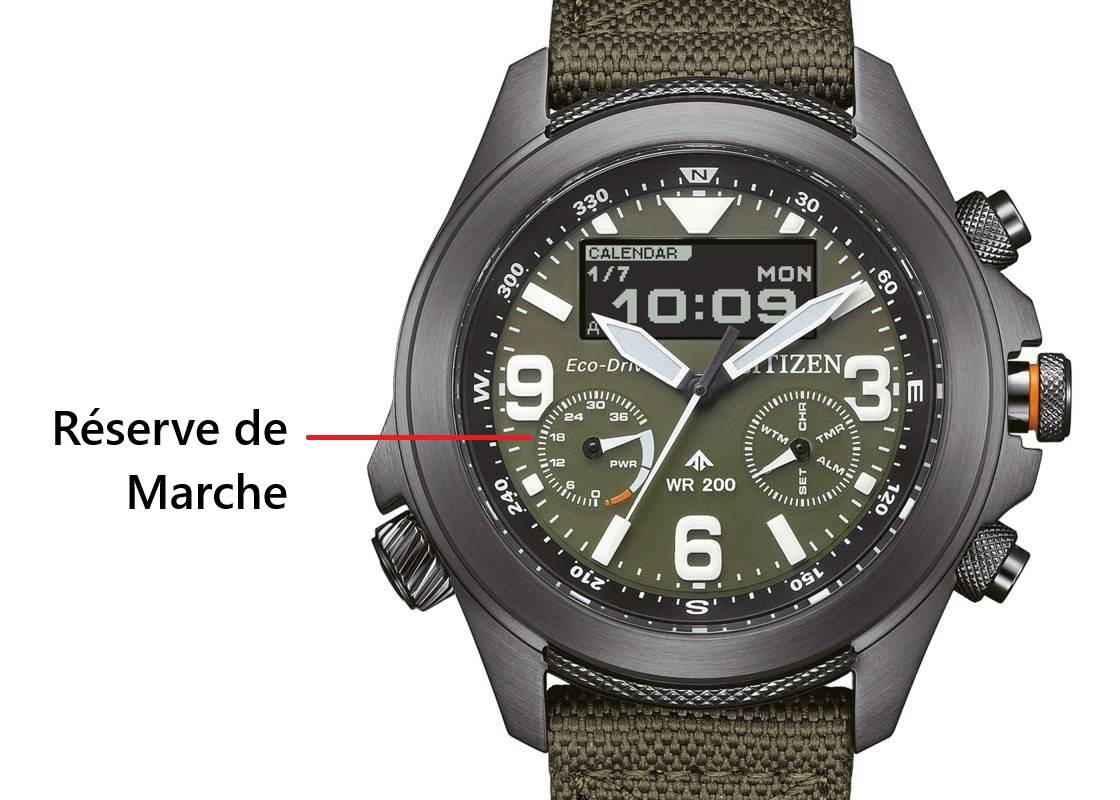
Citizen Promaster JV1005-02W with power reserve indicator
Today, the power reserve complication has become widely accessible and can be found across all price ranges.
Brands such as Seiko, Orient Star, Citizen, The Citizen, Tissot, Bauhaus, and Pequignet offer a wide range of models - from clean, minimalist designs to more striking pieces - all showcasing a complication that is as visually appealing as it is practical.
From a technical standpoint, several mechanical solutions exist for capturing and displaying the watch's remaining energy level on the dial…
In this configuration, a small gear train known as the "power reserve differential" calculates the difference in rotation between the mainspring arbor (the cylindrical shaft visible vertically) and the barrel wall. This value is then transmitted to the indicator hand, which advances or retreats based on the state of the mainspring's wind - that is, its tension.
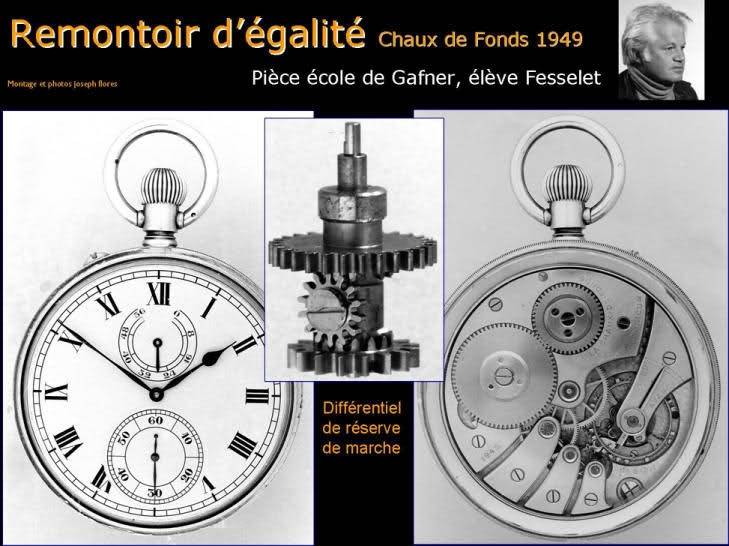
Power reserve indicator with constant-force mechanism (Photo credit: Joseph Flores)
While this system may appear simple at first glance, it is in reality remarkably precise, capable of faithfully reflecting the tension of the mainspring. That accuracy, however, comes at a price - the power reserve differential remains exclusive to high-end watchmaking. Its relatively bulky architecture makes it difficult to integrate into ultra-compact watches, which limits its use.
As a historical footnote, this mechanism was already in use in 18th-century marine chronometers as well as in antique pocket chronometers, a testament to its enduring effectiveness and reliability.
At the heart of this system is a "cam" - a snail-shaped component that is solidly connected to the mainspring arbor. As the mainspring winds or unwinds, the cam shifts position. A spring presses a feeler against this cam, and that motion is transmitted to the power reserve hand. This chain of actions allows the watch to display its power reserve.
This system's architecture is both robust and compact, while remaining straightforward in design. These qualities led Jaeger-LeCoultre to rely on it throughout the last century, and it has since become something of an industry standard. So when you spot a high-end mechanical watch with a power reserve indicator, there is a good chance it uses exactly this system! The one caveat: accuracy can fall slightly short, particularly at the extremes of the reserve - that is, when the watch is fully wound or on the verge of stopping.
These systems are a bit more particular…
Some watchmakers use a simplified differential that does not calculate the power reserve on a continuous basis. This component then transmits an approximate reading, which is subsequently corrected by a cam. This is how watches fitted with this mechanism manage to display their power reserve.
In some cases, the reserve hand is driven directly by a gear train linked to the mainspring arbor, with no differential whatsoever.
These hybrid and simplified solutions offer a more compact, more basic design and are, as a result, less expensive to integrate into a watch. They allow manufacturers to offer models with a simple yet functional power reserve complication.
These solutions are more recent and were developed with cost reduction in mind. Movement manufacturers such as ETA and Soprod even went so far as to design what are known as "add-on modules," which can simply be integrated into existing calibers. As a result, this type of configuration is often found in the most accessible power reserve watches on the market!
Now you know everything there is to know about the power reserve complication - from its origins and how it works to why it matters. From now on, you'll appreciate that behind a seemingly simple function can lie a surprising level of complexity…
Share :