
0
Product added
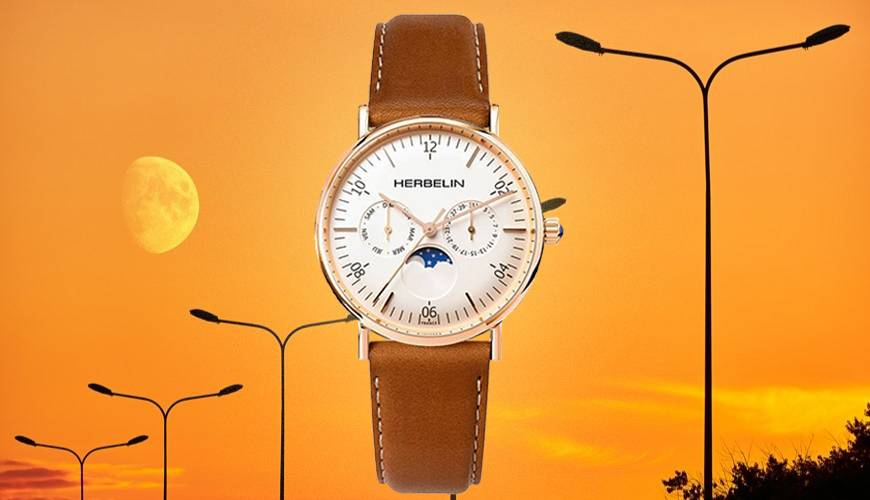
While some watchmaking complications can seem rather obscure due to their technical-sounding names, others are far more self-explanatory. The moon phase clearly falls into the second category. Poetic, charming, elegant… There's no shortage of words to describe this function - just spend a few minutes on any watch enthusiast forum and you'll see exactly what we mean.
Want to learn everything about this dreamy complication? You've come to the right place!
In watchmaking, "moon phase" (or "Moonphase," "Moon Phase," "Moon-Phase" in the language of Shakespeare) refers to a complication that displays the current phase of the Moon. Before diving in, however, a brief but important clarification is in order…
Unlike the Gregorian calendar we use every day - which is based on the solar cycle - the phases of the Moon are governed by the lunar cycle. This cycle lasts exactly 29.53 days, which equals (we'll spare you the math) 29 full days, 12 hours, 44 minutes, and 2.9 seconds. Now that's precision!
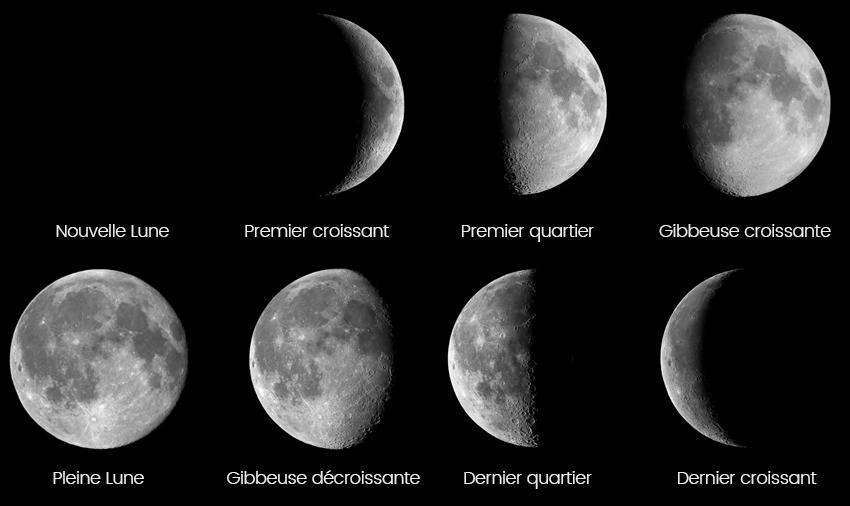
The 8 Moon Phases (Source: Kronos 360)
Contrary to what you might think, the phases of the Moon are not that difficult to understand. They simply reflect the way we perceive the Moon from our planet Earth. This visual phenomenon depends largely on light - a particularly decisive factor here.
In watchmaking, the moon phases are typically displayed through an "aperture" or "calendar window." This is an opening - most often crescent-shaped - found directly on the watch dial. Through this cutout, you can observe a rotating disc featuring a Moon, sometimes surrounded by stars.
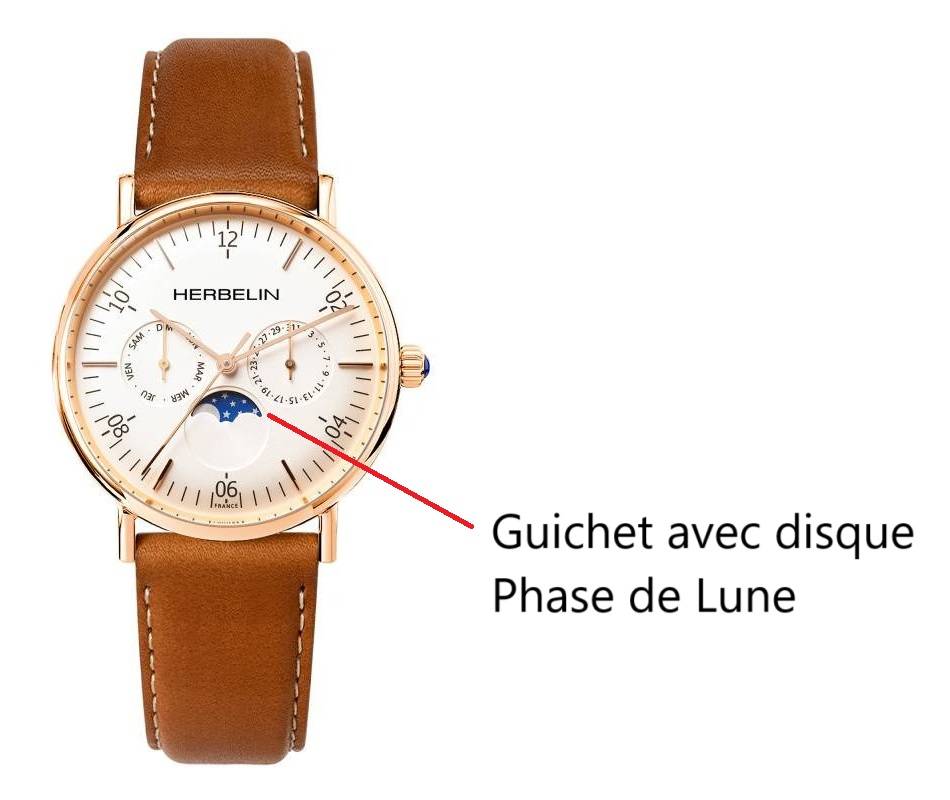
Moon phase aperture positioning on a Herbelin watch
A fun detail worth noting: depending on the model, the Moon can appear as a simple minimalist circle, or it can be depicted with a face - eyes, a nose, and a mouth. This "humanoid" representation was once highly fashionable and still lends an exceptionally charming character to this watchmaking complication today.
With that established, a moon phase watch is, by definition, a timepiece that must display this information. Some models, however, go even further - offering additional indications such as the age of the Moon or the precise moment when the next full Moon will be visible.
A word of caution, though - don't be fooled. There are watches on the market that look very much like moon phase watches but aren't. These timepieces are actually equipped with a day/night complication, a function that shows the progression of the day through a small aperture.
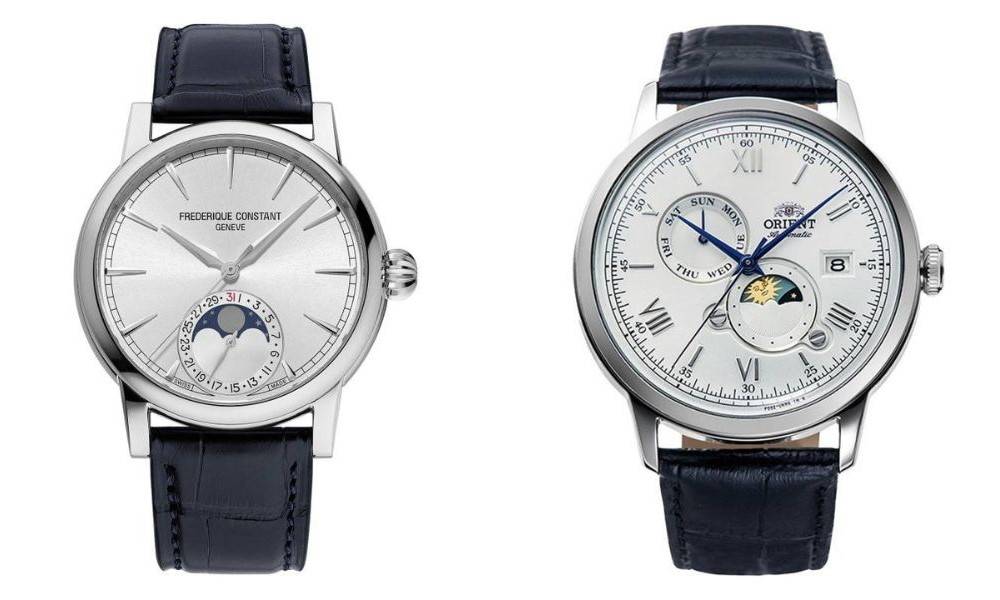
Moon Phase Watch vs. Day-Night Complication Watch
As you can see, the resemblance between some of these models can be striking! That's exactly why it pays to do your research - especially if you're planning to purchase a genuine moon phase watch.
Finally, keep in mind that on specialized forums, watch enthusiasts often use the abbreviation "PDL" to refer to the "Phase De Lune" complication. Worth remembering if you're searching for information online.
Now that you know what a moon phase watch is, let's dive into the fascinating history of these timepieces - a story that began several centuries ago…
As you've probably noticed while reading our watch guides… watchmaking complications of all kinds were first incorporated into ancient timekeeping instruments long before making their way onto wristwatches. Our ancestors were remarkably talented!
The moon phase complication follows the same logic. That's how we see it appear, as early as the 17th century, on small wall clocks as well as on table clocks.
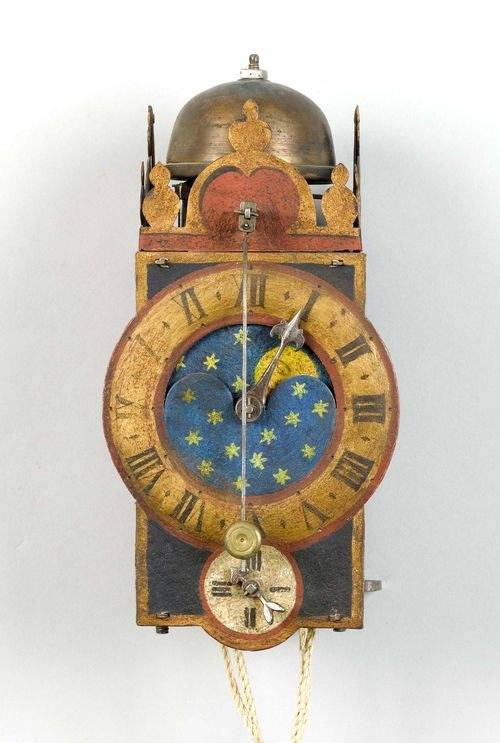
German moon phase clock, 17th century (Source: Koller Auktionen)
Often built on a metal base, these models were then painted and decorated in the style of their era. Looking at them today, one thing immediately stands out: these objects were the product of true craftsmanship, and it was precisely their imperfections that gave them their charm. At this stage, we were still a very long way from the mass-produced clocks we know today.
In the 17th century, watchmakers took a major step forward by miniaturizing the moon phase complication with the goal of incorporating it into pocket watches. These portable timepieces were enormously popular at the time!
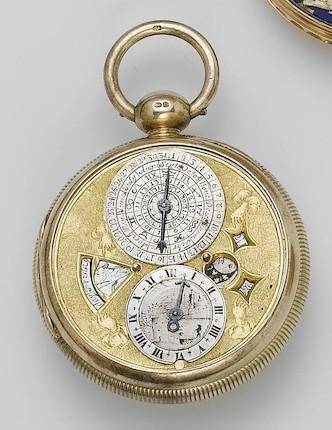
Moon phase pocket watch, 17th century (Source: Bonhams)
Indeed, at that moment in time, they were the wristwatch equivalent of what we all use in the 21st century - except that these earlier versions were carried in a waistcoat pocket. And that is how the first moon phase pocket watches came to be!
The example currently on your screen is a perfect case in point. It's remarkably complete: in addition to displaying the moon phases, it also shows the age of the Moon, along with a host of other useful information - all entirely mechanical. Impressive, isn't it?
On that note, curious about how these timepieces work with their tiny parts and gears? Check out our guide to mechanical and automatic watches!
One surprising detail about the model shown in this image: while its movement was made in the 17th century, its 44 mm diameter case crafted in gold-plated solid silver appears to have been fashioned somewhat later. Indeed, the engravings on its surface suggest it was made in 1819, in England - more specifically, in the city of London.
In the 18th century, the moon phase complication began appearing on large floor clocks. These models looked very much like the grandfather clocks most of us remember from our grandparents' homes!
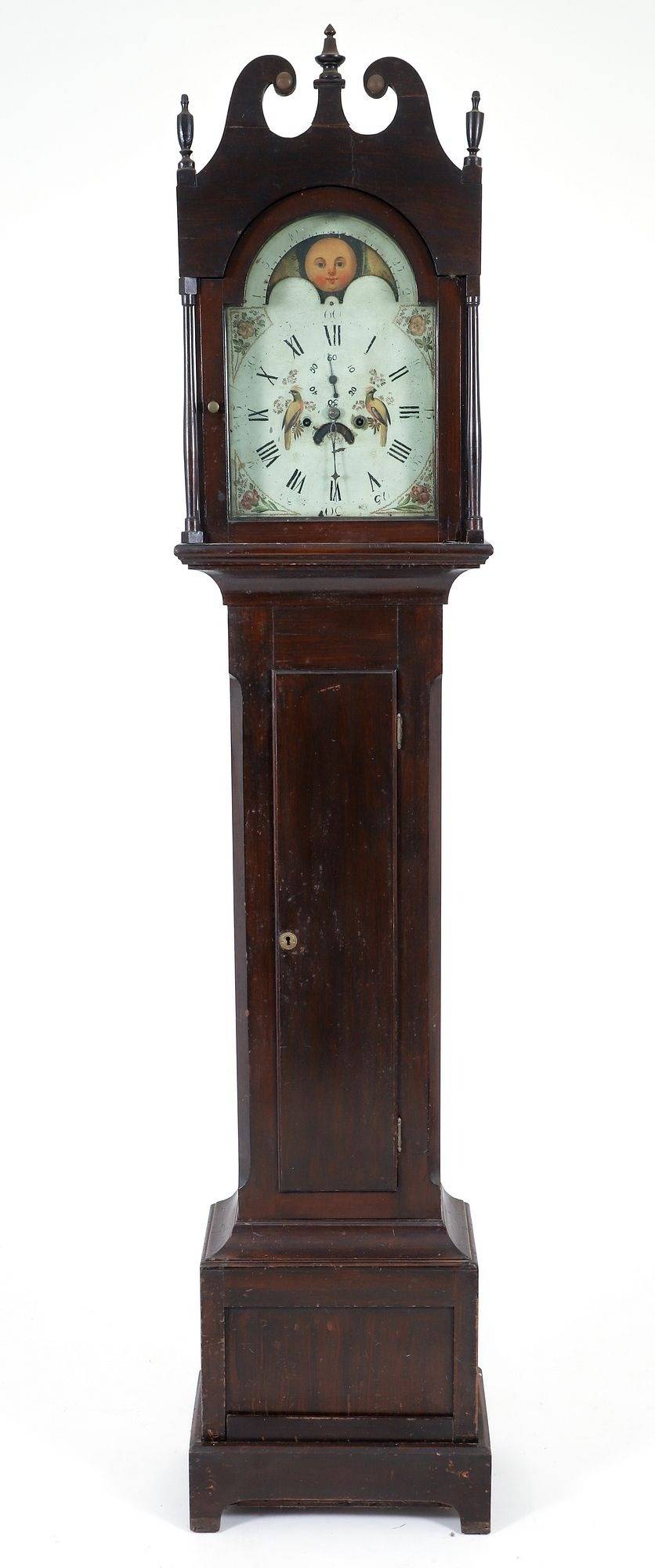
James Wilson Clock with Moon Phase, 18th Century (Source: Concept Art Gallery)
They were fairly imposing, crafted from high-quality solid woods such as oak or mahogany, and featured a large window designed to display the current moon phase.
These clocks came in every shape and size! But keep in mind that a good number of them originated in England. The disc used to display the different moon phases was often artistically crafted and resembled, in many ways, masterpiece paintings.
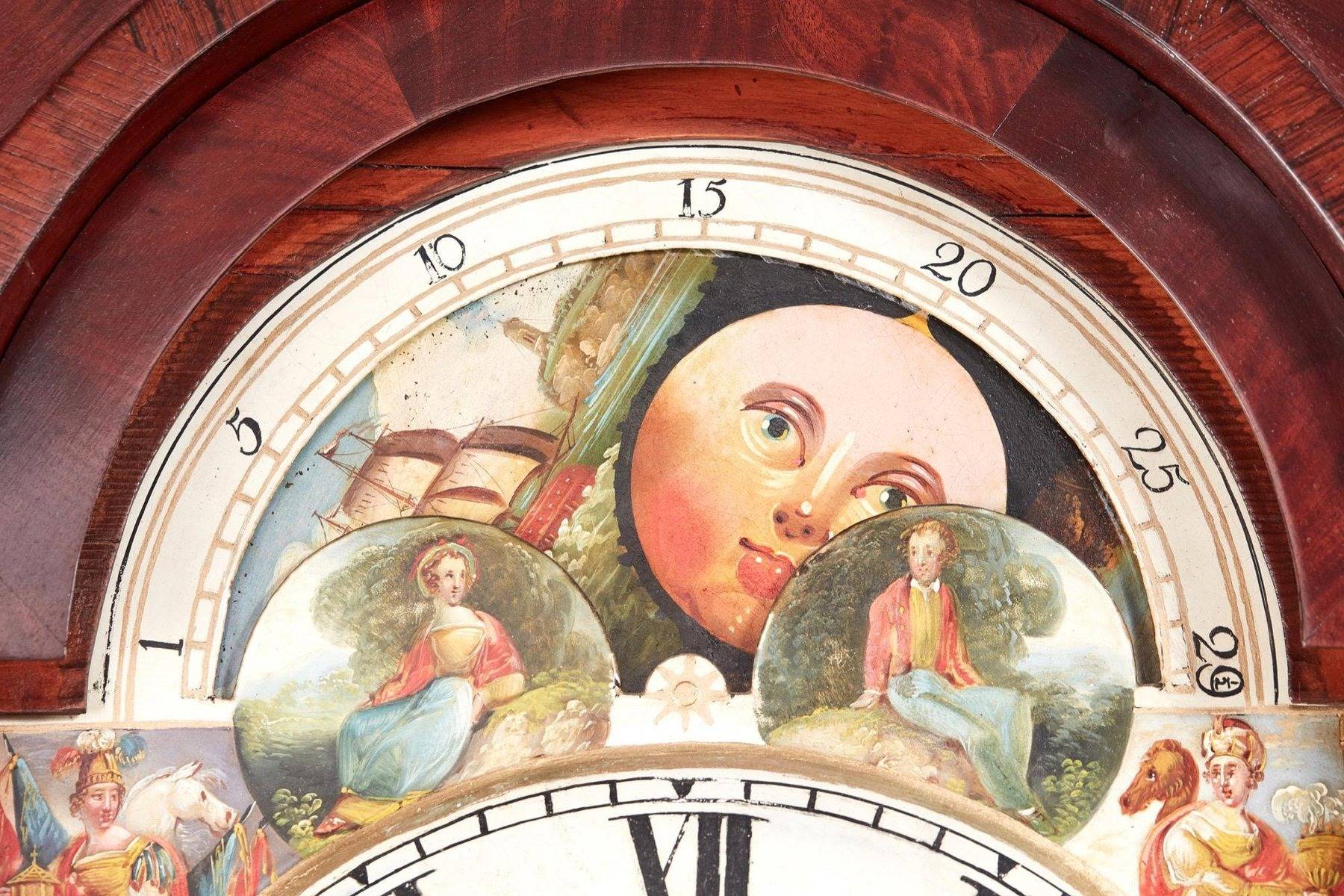
Moon phase disc from an antique mahogany clock, circa 1860 (Source: Pamono - Seller 5034)
When you take in the level of detail these clocks achieved, you can't help but be in awe of the craftsmanship. These were artisanal pieces, true expressions of expertise - in short, genuine works of art.
If you're looking to get one of these models, they can be found on sites specializing in antique decorative objects, as well as at auction. This style certainly won't be for everyone, but it makes a bold statement and fully embraces its own aesthetic!
Models developed during the 19th century often displayed - in addition to the moon phase - what is known as a "perpetual calendar," another watchmaking complication. Some even featured a minute repeater complication. In short, these were timepieces driven by an extraordinarily complex mechanism!
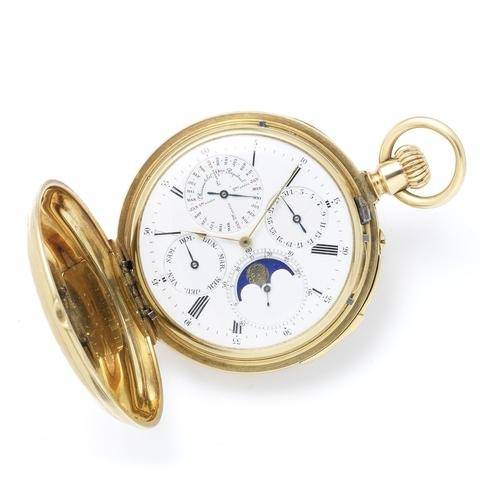
Patek Philippe moon phase pocket watch (Source: Bonhams)
In keeping with the tastes of the era, these watches often featured a case crafted in 750/1000 yellow gold (18 karats). Mostly made in Switzerland or England, these pieces bore no particular brand name on their dials. However, great names in watchmaking such as Patek Philippe, Le Phare, and Gubelin also offered models of this type in their catalogs, particularly toward the end of the 19th century.
If you know the history of watchmaking, you know that the first wristwatches arrived on the market at the beginning of the 20th century. It was Patek Philippe that made headlines in 1925 by unveiling the very first wristwatch equipped with a moon phase complication - the Patek Philippe 97975. An exceptionally elegant piece, it is also considered the first wristwatch ever to incorporate a perpetual calendar complication. Now that's killing two birds with one stone!
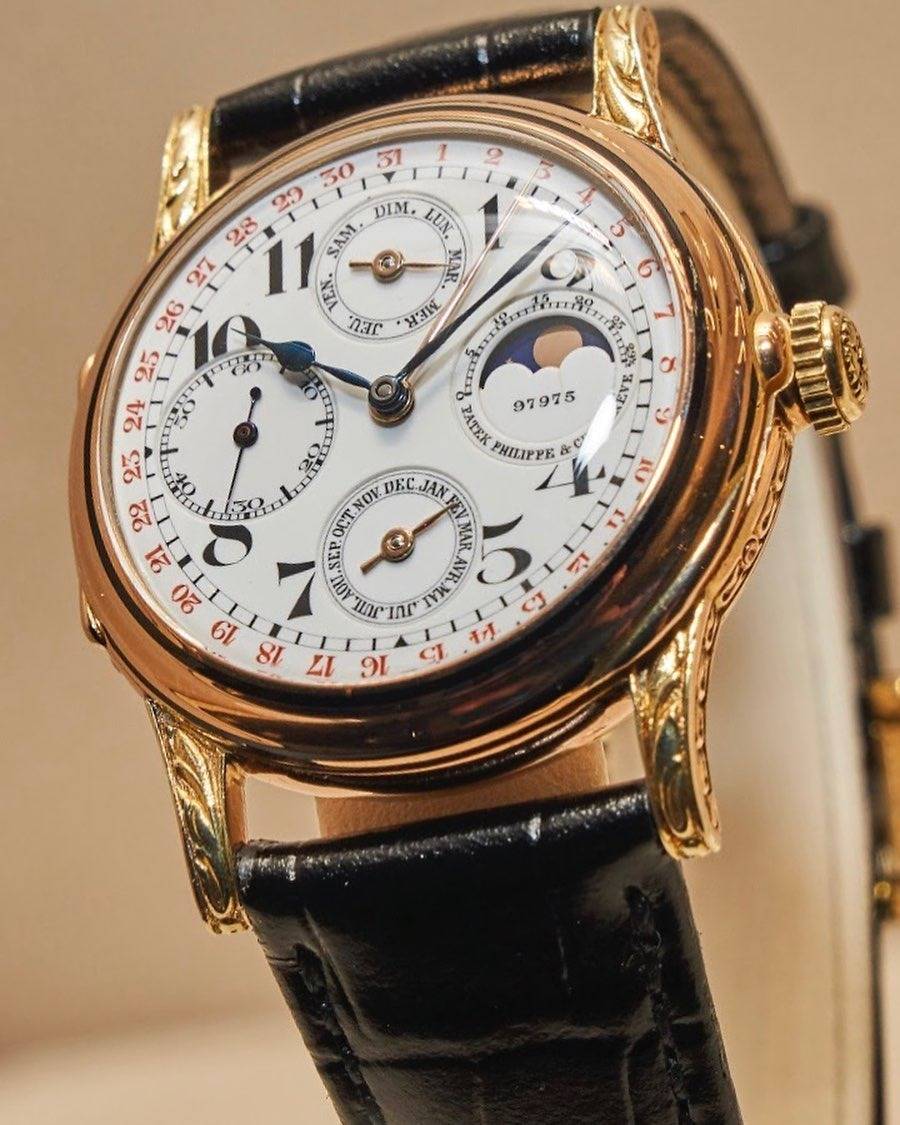
Patek Philippe watch reference 97975, 1925 (Source: Revolution Watch)
With this watch showcasing the full extent of its watchmaking expertise, Patek Philippe made a bold statement in the 1920s. And when you consider the size of the piece, the feat becomes even more impressive - it measures just 34 mm in diameter! For its time, this watch was a true marvel of technical achievement.
During the first half of the 20th century, many brands offered watches featuring a moon phase complication. Among them were major names such as Universal Genève, Jaeger-LeCoultre, Omega, Movado, Leonidas, and Angelus, as well as more niche brands like Herala, Giroxa, Le Phare, and Henri Duvoisin.
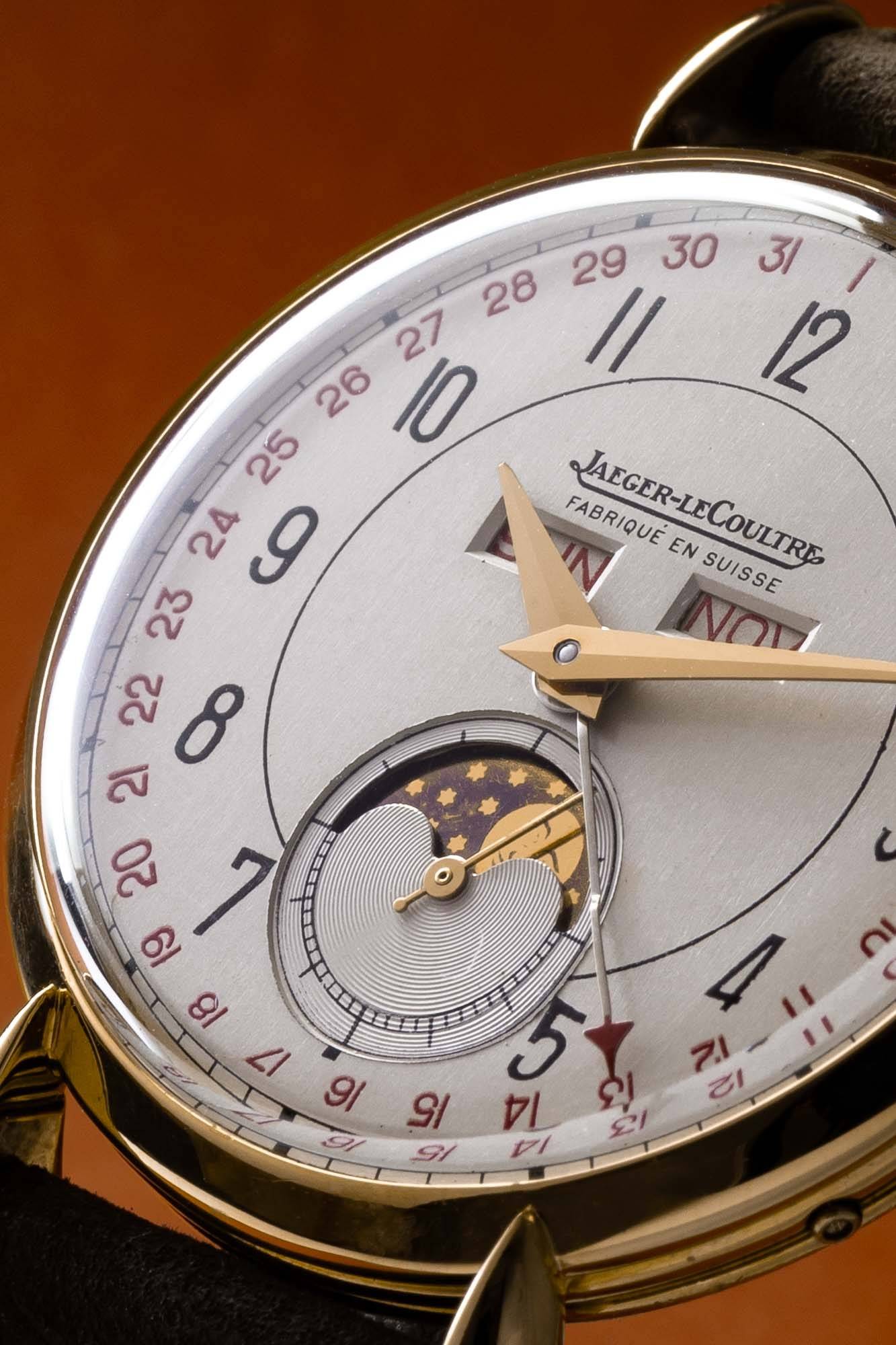
Jaeger-LeCoultre triple date Moonphase watch, circa 1950 (Source: Amsterdam Watch Company)
These watches often combined the moon phase complication with one or more additional complications, such as a chronograph or a triple calendar (also known as a triple date), further enhancing their complexity and prestige.
Rolex also entered the arena in 1949 with its reference 8171. Produced over a very short window of just 3 years, this watch was later nicknamed the "Rolex Padellone" (or "frying pan" in French) by Italian collectors, owing to its 38 mm diameter - considered particularly large for the late 1940s. Although produced in very limited numbers, it was made in several versions: yellow gold, rose gold, and even stainless steel.
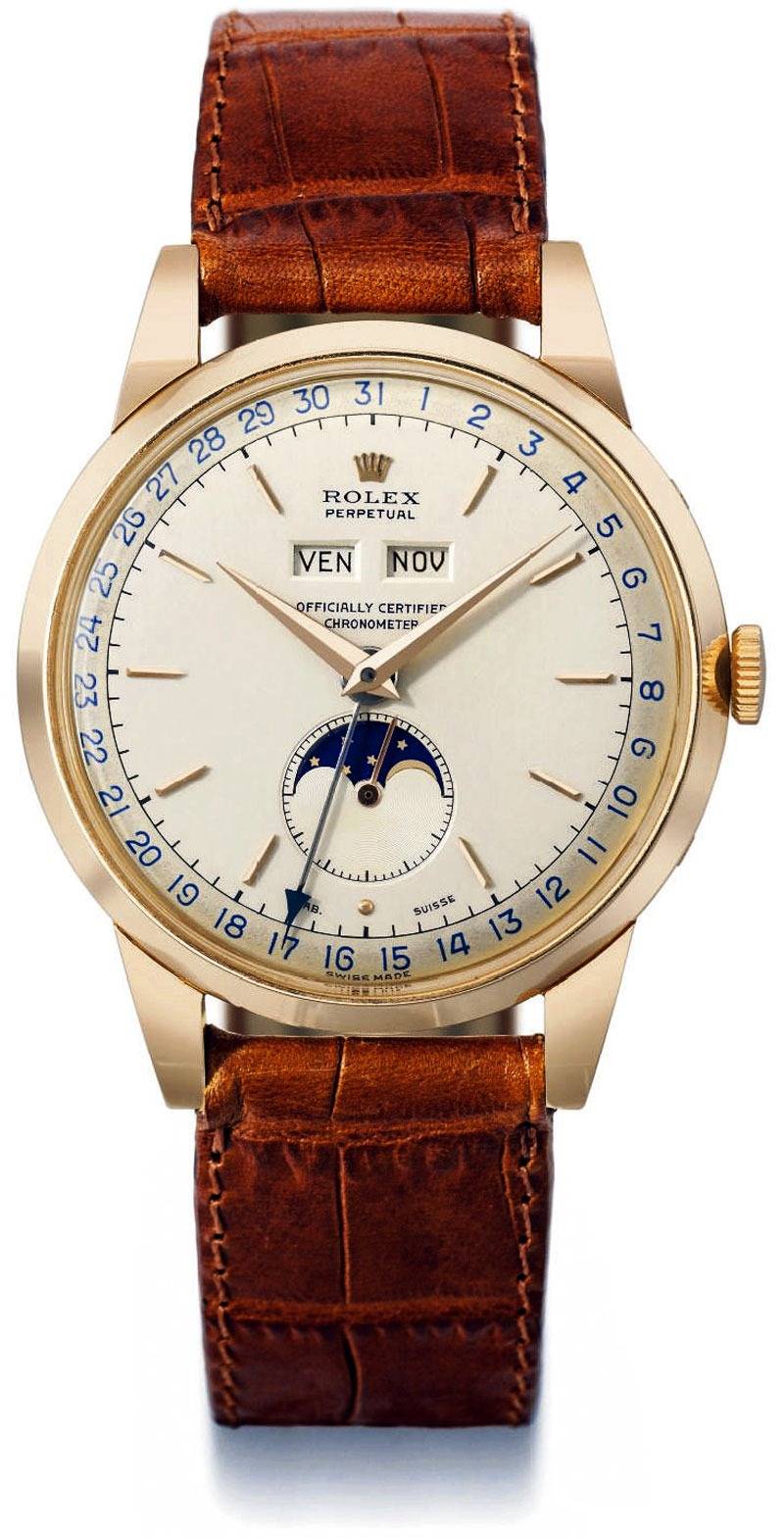
Rolex reference 8171, known as the "Padellone," 1949 (Source: Rolex Magazine)
A yellow gold example offered by the renowned auction house Christie's in late 2008 - estimated between 150,000 and 250,000 Swiss francs - ultimately sold for 294,000 Swiss francs.
During the second half of the 20th century, several well-known watch brands chose to incorporate a moon phase complication into their flagship models. Zenith was one of them, releasing in the 1970s a highly complete variant of its famous El Primero called the "Espada."
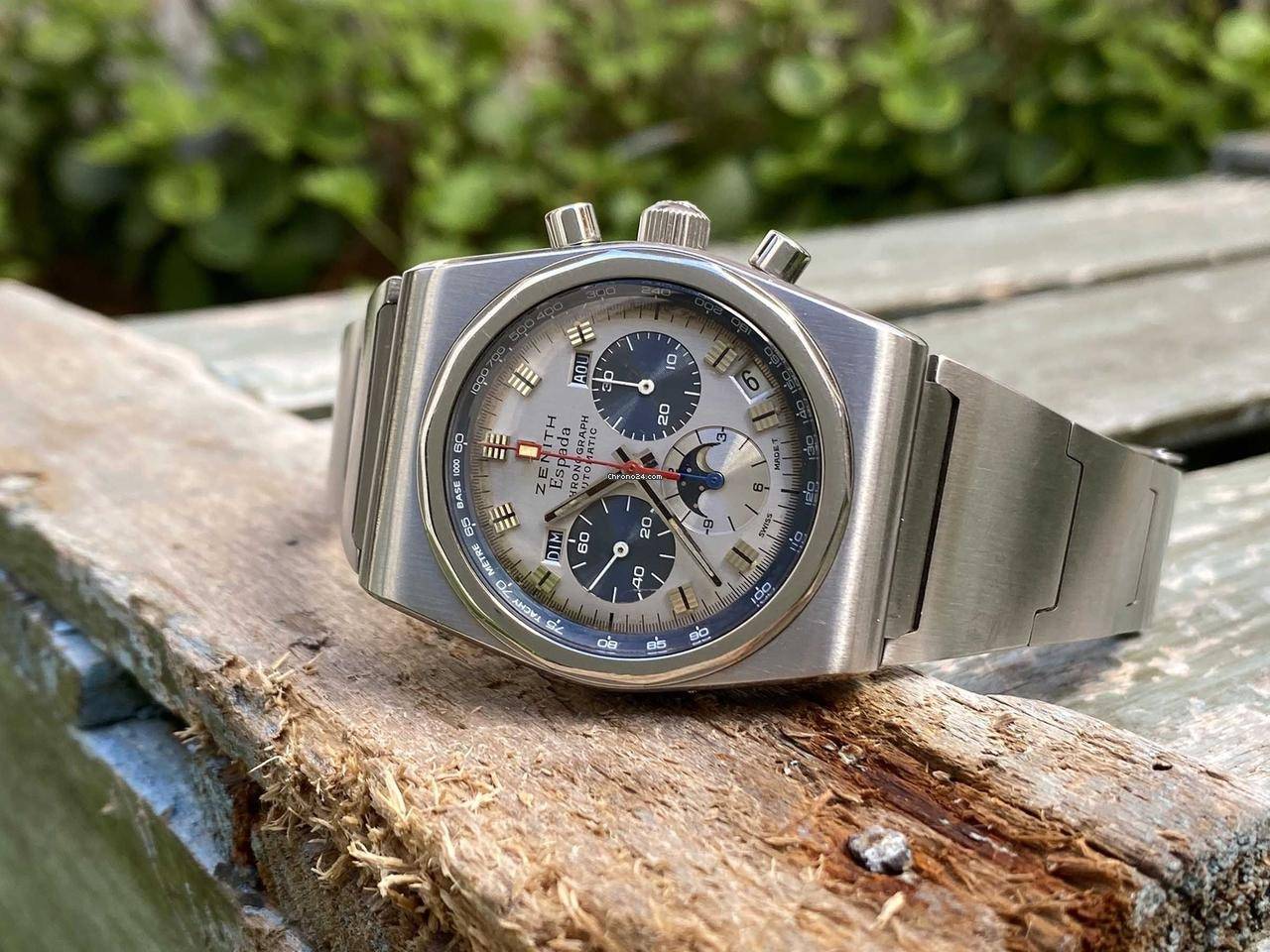
Zenith Espada reference 01.0040.418, circa 1970 (Source: Chrono24 - @Watches83)
This model, reference 01.0040.418, featured a moon phase complication, a triple-date calendar, and a chronograph - making it a highly capable timepiece packed with watchmaking complications. In the mid-1980s, Omega offered its customers a revised version of its iconic Speedmaster with a moon phase. A must-have for a watch that astronauts actually wore on the Moon!
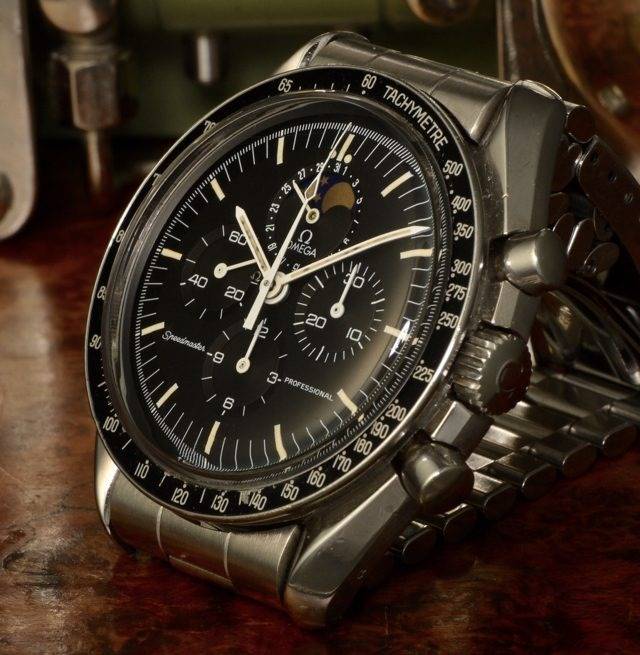
Omega Speedmaster Moon Phase reference ST 345.0809, 1985 (Source: Timeline Watch)
In the 1990s, Breitling released very special versions of two of its iconic watches: the Chronomat and the Navitimer. The point is clear - even the biggest names got in on the act!
These models are relatively rare today, especially compared to the more conventional watches that the same Houses were producing at the time.
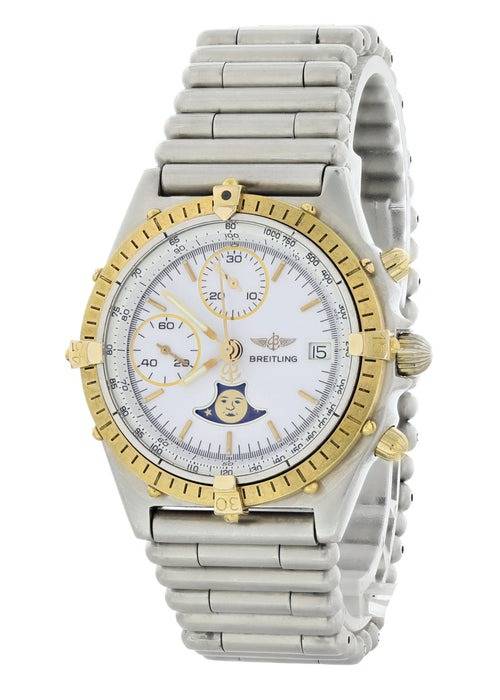
Breitling Chronomat Moon Phase reference 81.950, circa 1990 (Source: Phigora)
It was also during these years that the first quartz watches equipped with a moon phase complication appeared on the market. Seiko, Zenith, Cartier, and Jaeger-LeCoultre all developed interesting models whose designs reflected the trends of the era.
While moon phase watches may not be considered a trending complication today, several brands continue to offer them in their catalogs. Browse the major retail sites and you'll find moon phase watches available across every budget. Quartz models are naturally more accessible than those with mechanical movements, but there are plenty of brands in this space worth exploring.
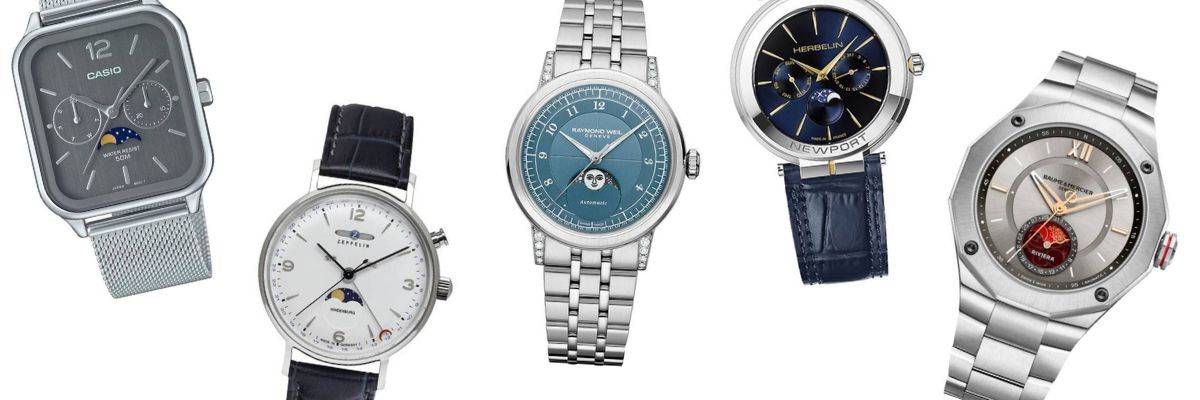
Quartz and Automatic Moon Phase Watches
Casio, Zeppelin, Citizen, Tissot, Herbelin, Mido, Baume et Mercier, Frédérique Constant, and Raymond Weil are Houses from very different backgrounds, all united in their commitment to delivering quality timepieces!
The moon phase complication is built around a rotating disc that advances once per day. Viewed through a small aperture on the watch dial, it always features 2 Moons - so when the first Moon disappears, the second one comes into view and takes over.
Note: if this disc were decorated with only a single Moon on its upper portion, we'd only be able to see it for a certain period - then it would vanish for many days... In short, adding a second Moon solves that problem, and as you'll see, that wasn't the only challenge that gave watchmakers a headache!
It's worth knowing that the rotation of this disc is driven by several gears that are invisible when you look at the watch from the front, but reveal themselves once you venture inside the movement.
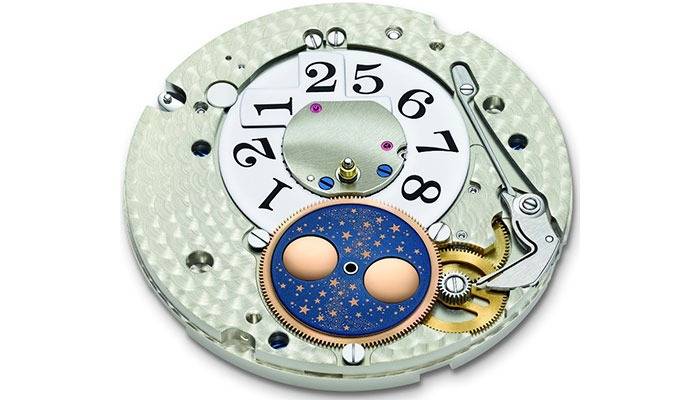
Moon phase complication movement (Source: Siam Watch Club)
In the very first section of this guide, we learned that a lunar cycle lasts exactly 29.53 days. And it's precisely because watchmakers were faced with this far-from-round number that they ran into a roadblock - one that prevented them from achieving ultimate precision… That most coveted goal in the world of watchmaking!
Why? Simply because while it's possible to create a disc with 1 tooth, 2 teeth, 29 teeth, or even 29.5 teeth, it is impossible to produce one with 29.53 teeth. As a result, watchmakers had to settle for a lunar phase disc made up of 29 teeth + 1/2 tooth. But concretely, what are the consequences of this technical limitation for our beloved watches?
This results in a slight loss of precision, meaning moon phase watches are not 100% accurate. They will drift by approximately 1 day every two and a half years. So if you want your watch to always be perfectly in sync with the Moon, you'll need to manually adjust the complication every two and a half years. A minor inaccuracy, admittedly - but one that remains entirely acceptable!
If you're looking for a watch with an ultra-precise moon phase complication, the answer might lie in quartz watches with a digital display…
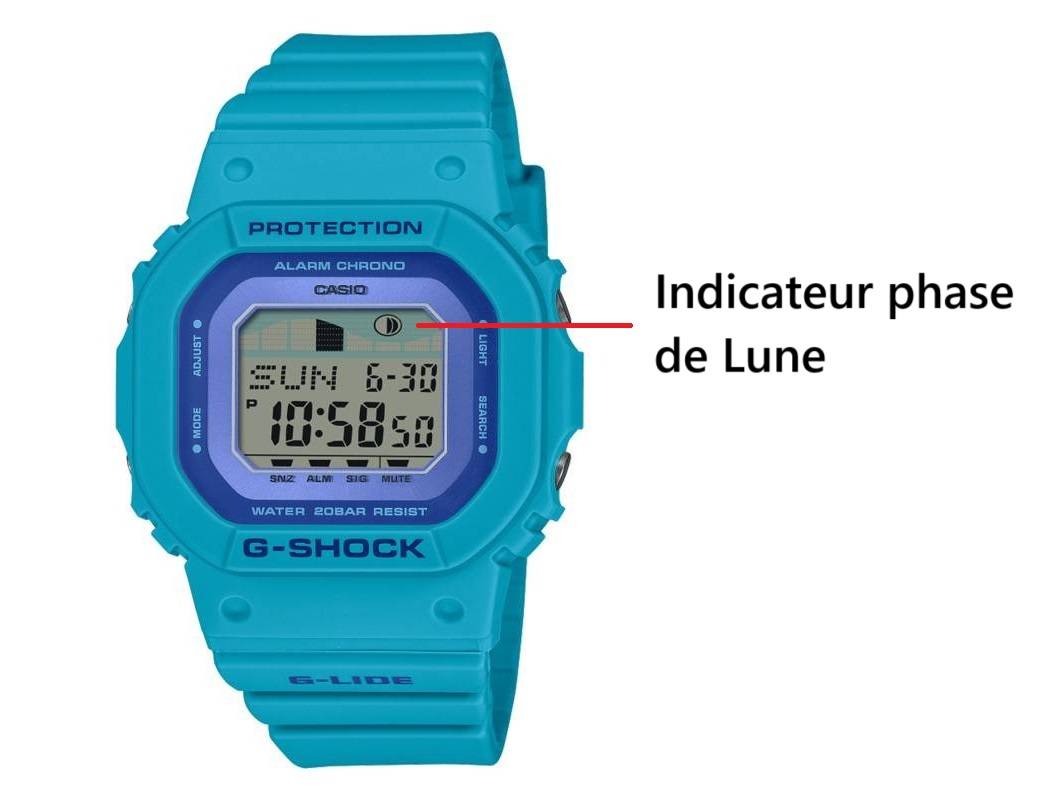
Casio G-Lide GLX S5610 2ER watch with moon phase function
Certain Casio models - particularly those from the G-Shock line - feature a lunar phase display. And the cherry on top: these references are often available at very accessible price points.
Now that you know how the moon phase complication works, how about learning how to set it?
The moon phase complication stands apart from other watch complications in that it isn't necessarily adjusted the same way. If you're a regular reader of our watch complication guides, you probably know that in watchmaking, setting a function is almost always done via the crown.
Well, that logic doesn't always apply to the moon phase - it really depends on the model!
You may have noticed, if you've ever looked at moon phase watches, that these timepieces often feature a small hidden button on the case. Hidden - why? Simply because, rather than sitting proud like the pushers you'd normally find on a watch case, this one is recessed into the case.
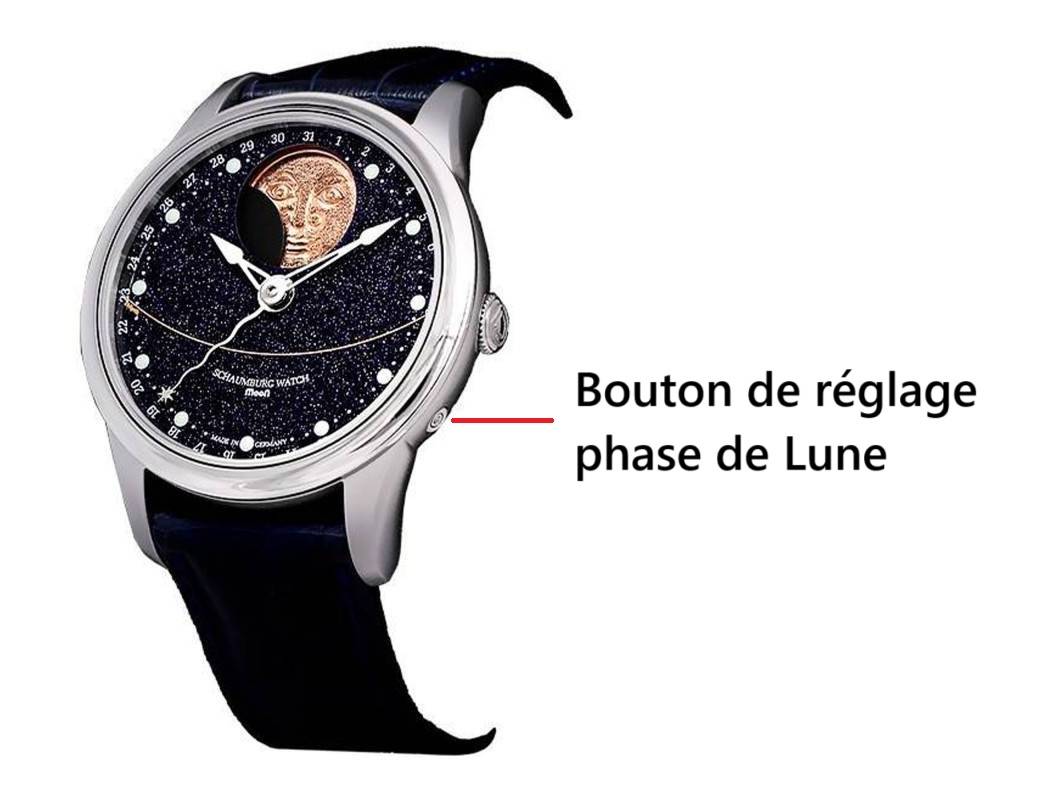
Moon phase complication adjustment button on a Schaumburg Watch
This discreet dedicated button is what lets you set the watch's moon phase. The process is simple: just press it to advance the disc. That said, this button is intentionally very small - and for good reason! It prevents you from accidentally pressing it and unknowingly throwing your watch out of sync. Think of it as a built-in safeguard.
To press that tiny button effectively and set your moon phase watch without frustration, here's a tip: use a thin, pointed object. Wooden toothpicks are perfect for this - the natural material won't scratch your watch.
On certain watches, the moon phase complication is adjusted directly via the crown. As a reminder, the "crown" is the button (typically located on the right side of the case) that allows you to set the time on your timepiece.
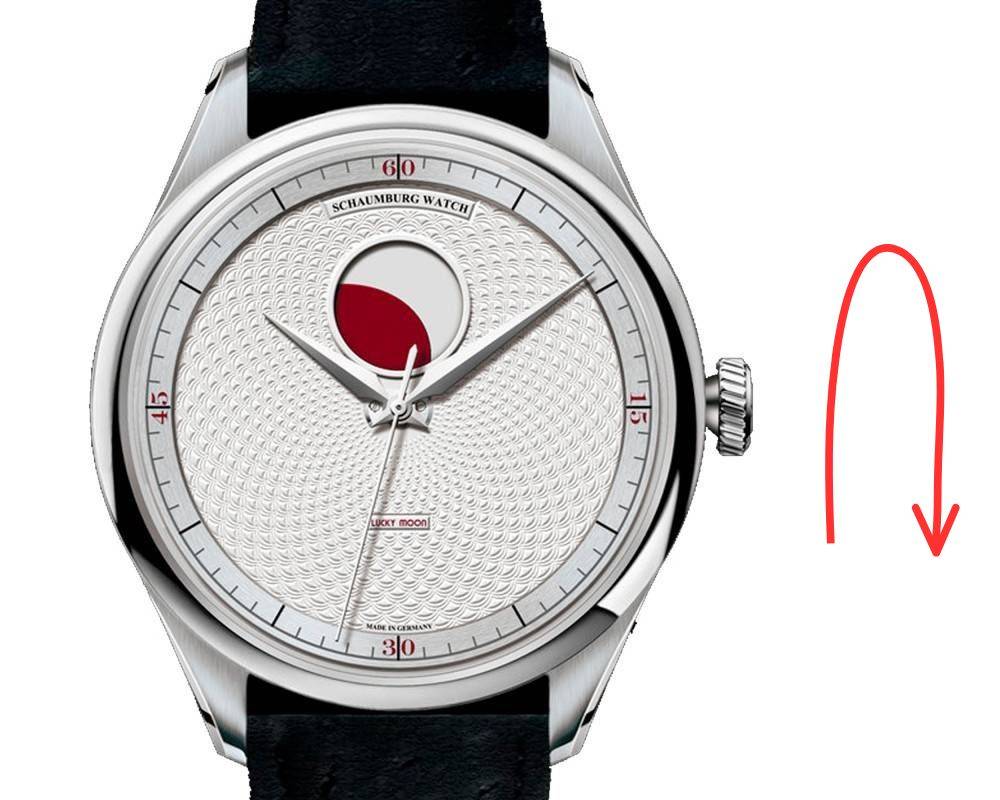
Adjusting the moon phase complication via the crown on a Schaumburg Watch
To set the moon phase on your watch, pull out the crown and find the position dedicated to that function. Once you've located the right notch, simply turn the crown clockwise or counterclockwise - depending on the model.
Knowing how to set a moon phase watch is great - knowing how to set it correctly using the current moon phase is even better!
Websites like the Patek Philippe manufacture's own site let you find the exact moon phase for today - or any date of your choosing. It's all done online through a calculator: simply enter the date you're interested in and the corresponding moon phase is displayed.
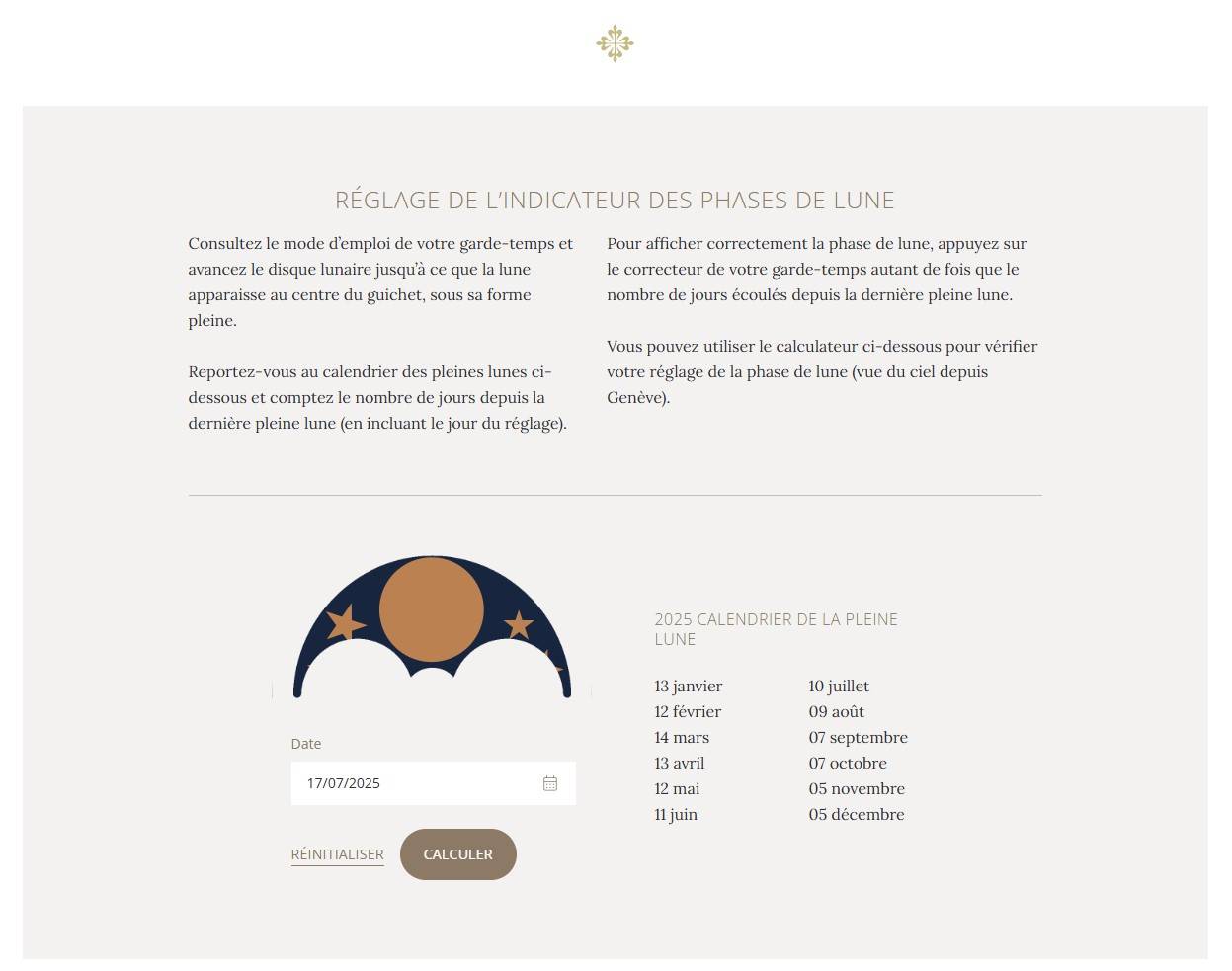
Moon phase calculator, Patek Philippe website
Set your moon phase watch accordingly and you're ready to enjoy this complication every day. And don't forget - the complication will need to be adjusted every two and a half years to stay accurate. To make sure you never miss it, simply set a reminder on your phone.
From its integration into 17th-century mantel clocks to today's wristwatches - by way of pocket watches - the moon phase is truly a complication in a class of its own. Its display surprises, its reading intrigues, and it's precisely that blend of emotions that leaves us, as watch enthusiasts, dreaming.
Whether displayed in a small aperture, a large window, or via an LCD screen, this is one complication that shows no signs of fading away!
Share :
Official European Union notice on your rights in the event of a product's lack of conformity.