
0
Product added
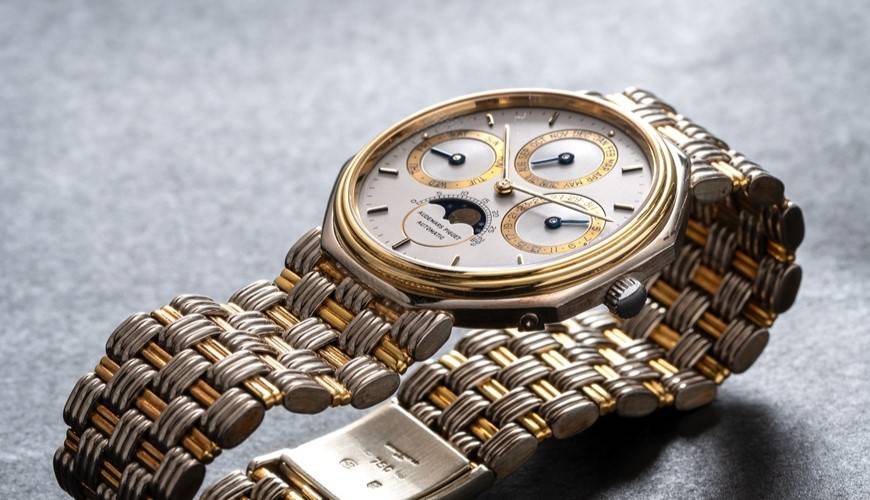
The perpetual calendar is a sophisticated complication rarely seen on enthusiasts' wrists. Its remarkable complexity makes it a feature of only the most high-end watches (if not outright ultra-luxury models). But that does not stop us from dreaming. Quite the opposite…
Want to learn more about this remarkable watch complication? This illustrated guide is for you!
Sometimes shortened to “QP” on watch enthusiast forums, the perpetual calendar is a watch complication that enables a watch to display the correct date, day and month.
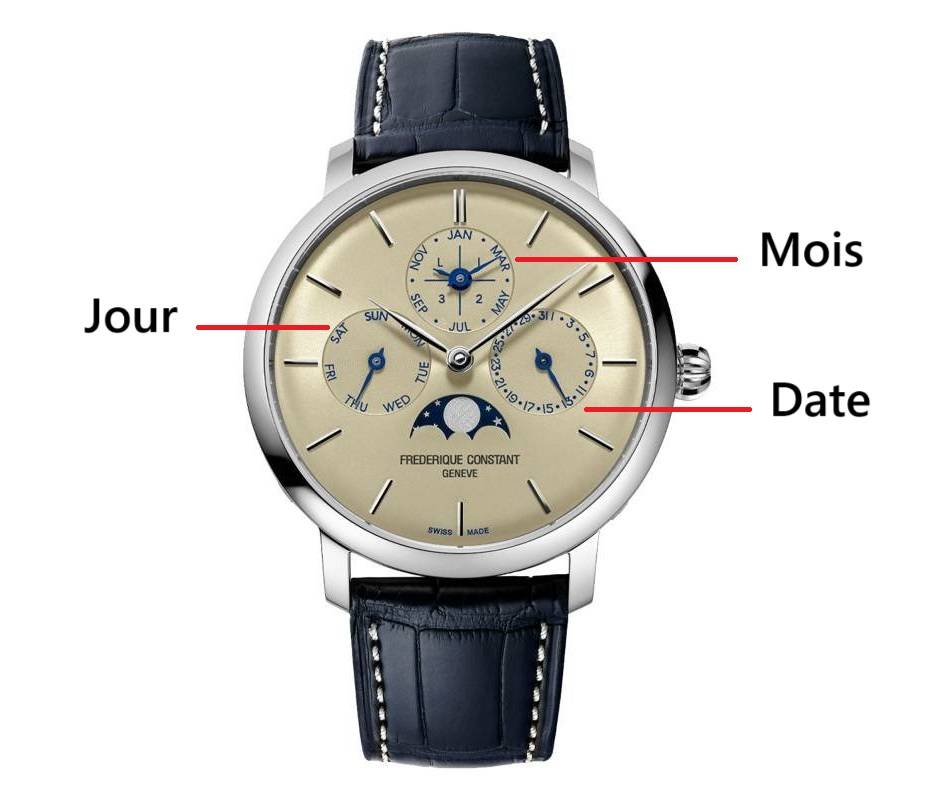
What a Perpetual Calendar Watch Always Displays
But what does “correctly” mean? Simply that the mechanism recognizes months with 28, 30 or 31 days and accounts for leap years. A perpetual calendar watch is therefore far more accurate than a conventional watch, which treats all twelve months as though they have 31 days.
The day, date and month can be displayed in different ways. Some watches use small hands, others use windows built into the dial, and some combine both approaches.
Perpetual calendar watches available today can display an accurate calendar (without any correction) until 2100. At that point, a manual adjustment will be needed to keep the display accurate. The same adjustment will be required in 2200 and 2300, since those years are not leap years under the Gregorian calendar, which we have used since 1582.
Note that watches described as having an “annual calendar” differ slightly from perpetual calendar watches: they need to be adjusted manually once a year, at the end of February!
As if they weren't complicated enough… perpetual calendar watches often also feature a moon phase complication and an indicator showing the year's position in the four-year cycle (1, 2, 3 or L for “Leap Year”). Because leap years occur every four years, this indicator tells us whether the current year is one or when the next will arrive.
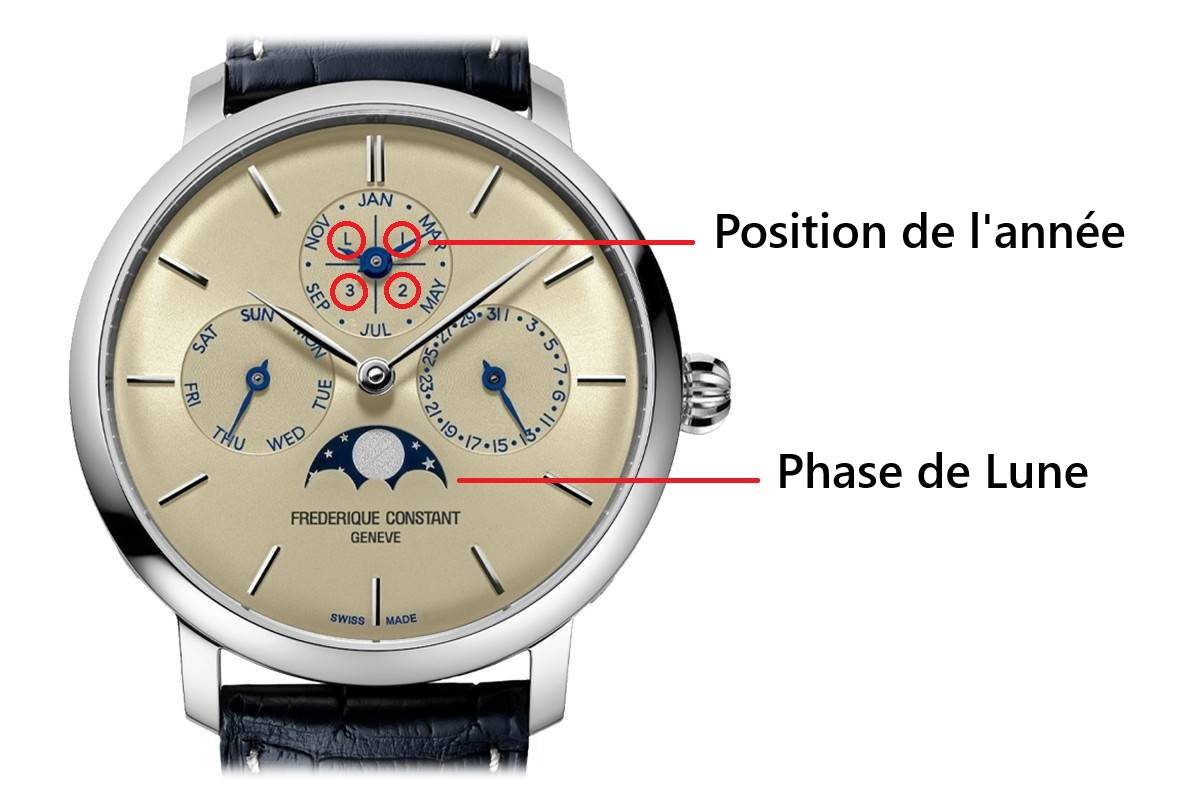
Frederique Constant watch with a perpetual calendar, moon phase and year indicator
Here's a fun fact: do you know why leap years have 366 days instead of 365? The answer lies in astronomy. Earth actually takes precisely 365.2421875 days to complete one orbit around the Sun. To keep the seasons from gradually drifting out of sync with the calendar, the civil calendar has 365 days, with an extra day added every four years. This compromise keeps the calendar easy to use while staying reasonably close to astronomical reality.
The perpetual calendar complication may be extraordinarily complex, but it's hardly new… not by a long shot! Its origins go back to the mid-18th century, when the idea occurred to an English watchmaker named Thomas Mudge. Picture the scene: it's 1762, the washing machine hasn't been invented and neither has Camembert cheese. Yet an extraordinary pocket watch appears, housing an exceptional mechanical movement.
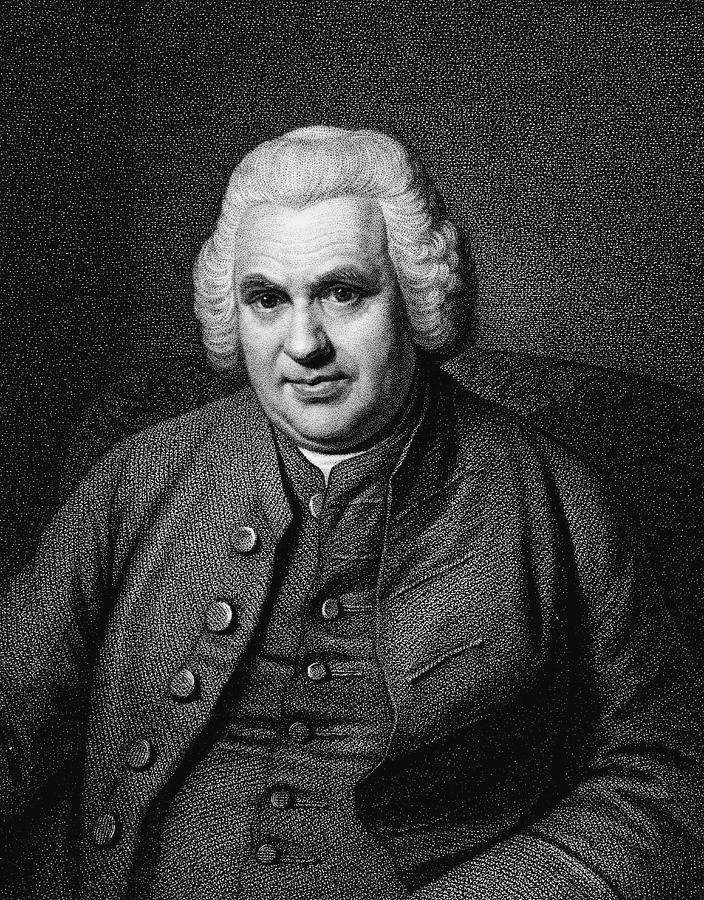
Portrait of Thomas Mudge (source: Science Photo Gallery)
This mechanism keeps the watch's calendar accurate at all times, accounting for months with 28, 29 and 31 days, as well as leap years. Even more remarkably, Thomas Mudge's “no 525” also displays the phases of the moon. In short, it was unlike anything else in watchmaking at the time… And so the perpetual calendar complication was born.
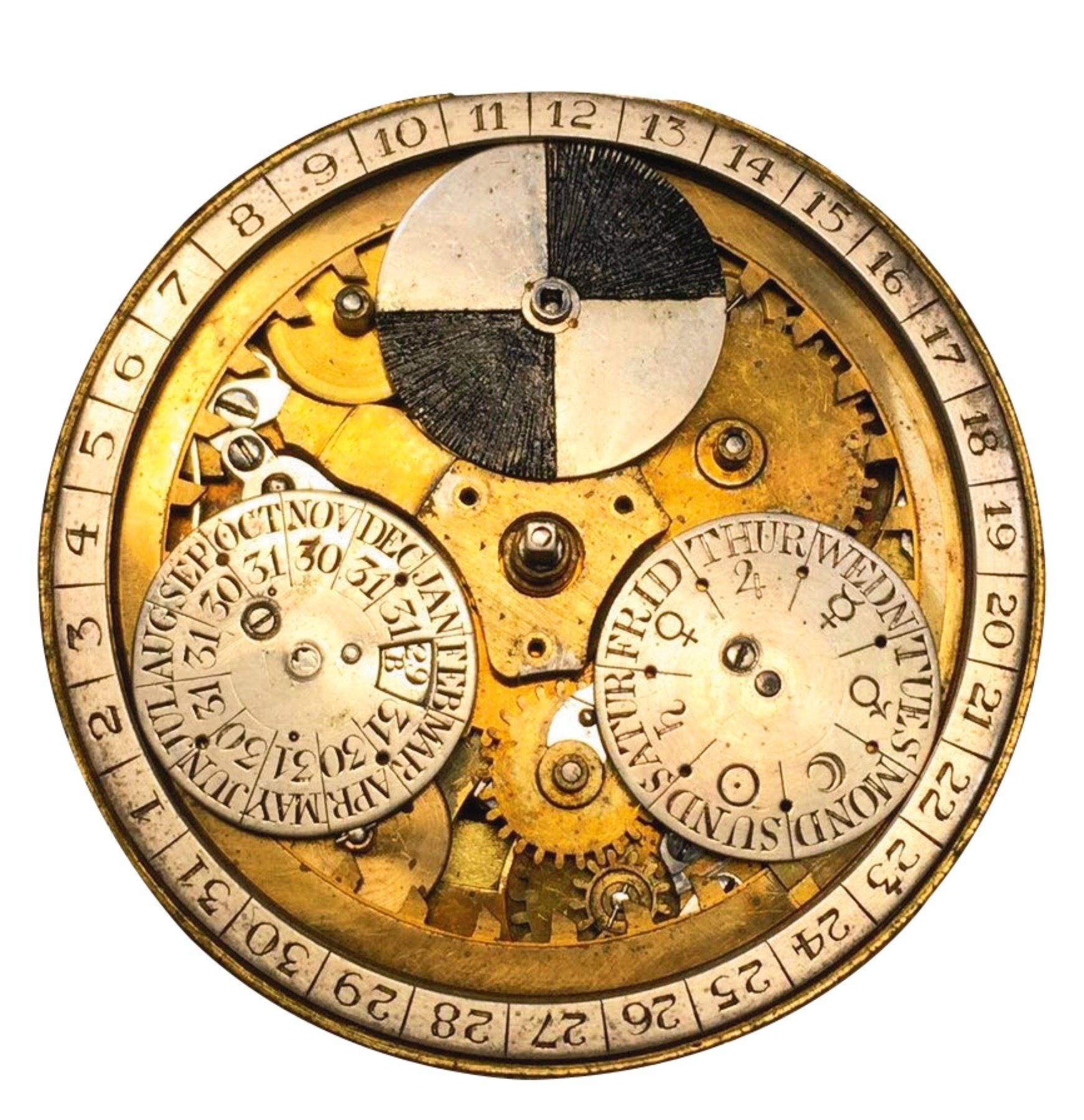
Gears of Thomas Mudge's “no 525” perpetual calendar watch (source: Monochrome Watches)
Good news for enthusiasts: you can see this historic watch today! It's on display in Switzerland at Geneva's Patek Philippe Museum (the Patek Philippe Museum). Another interesting detail: the company acquired it at a Sotheby's auction in 2016 for 62,500 British pounds.
In 1765, just three years after the “no 525” appeared, watchmaker Thomas Mudge unveiled his “no 574,” a broadly similar watch built around the perpetual calendar concept!
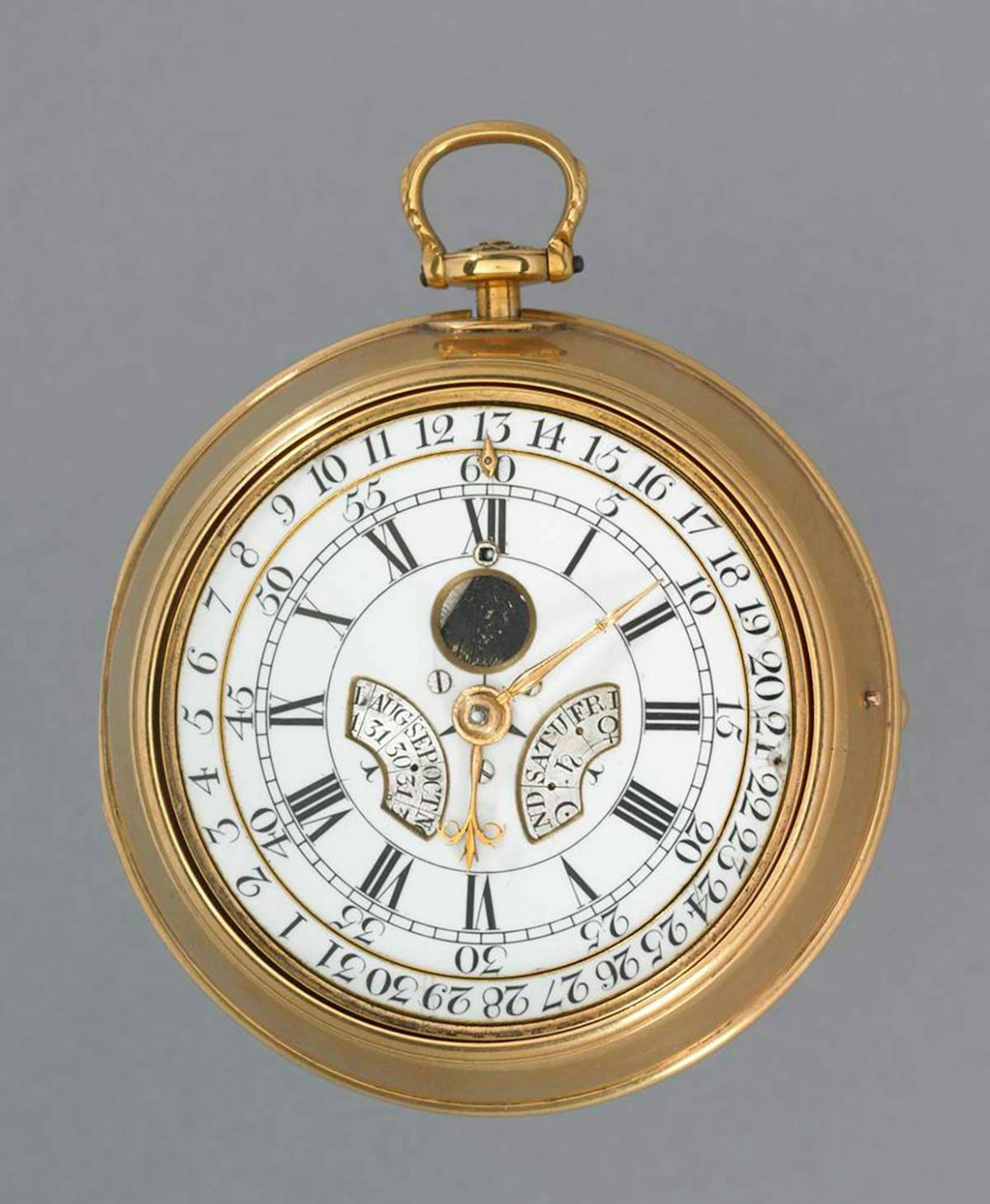
Perpetual calendar pocket watch “no 574” by Thomas Mudge, 1764 (Source: British Museum)
Thomas Mudge's no 574 watch has also been carefully preserved, this time in London at the British Museum. If you're planning a trip to the British capital, it's well worth stopping by to see this historic watch.
In the early 19th century, perpetual calendar pocket watches began to proliferate, produced by prestigious watchmakers such as Breguet, Audemars Piguet, Patek Philippe, Gübelin and Charles Frodsham.
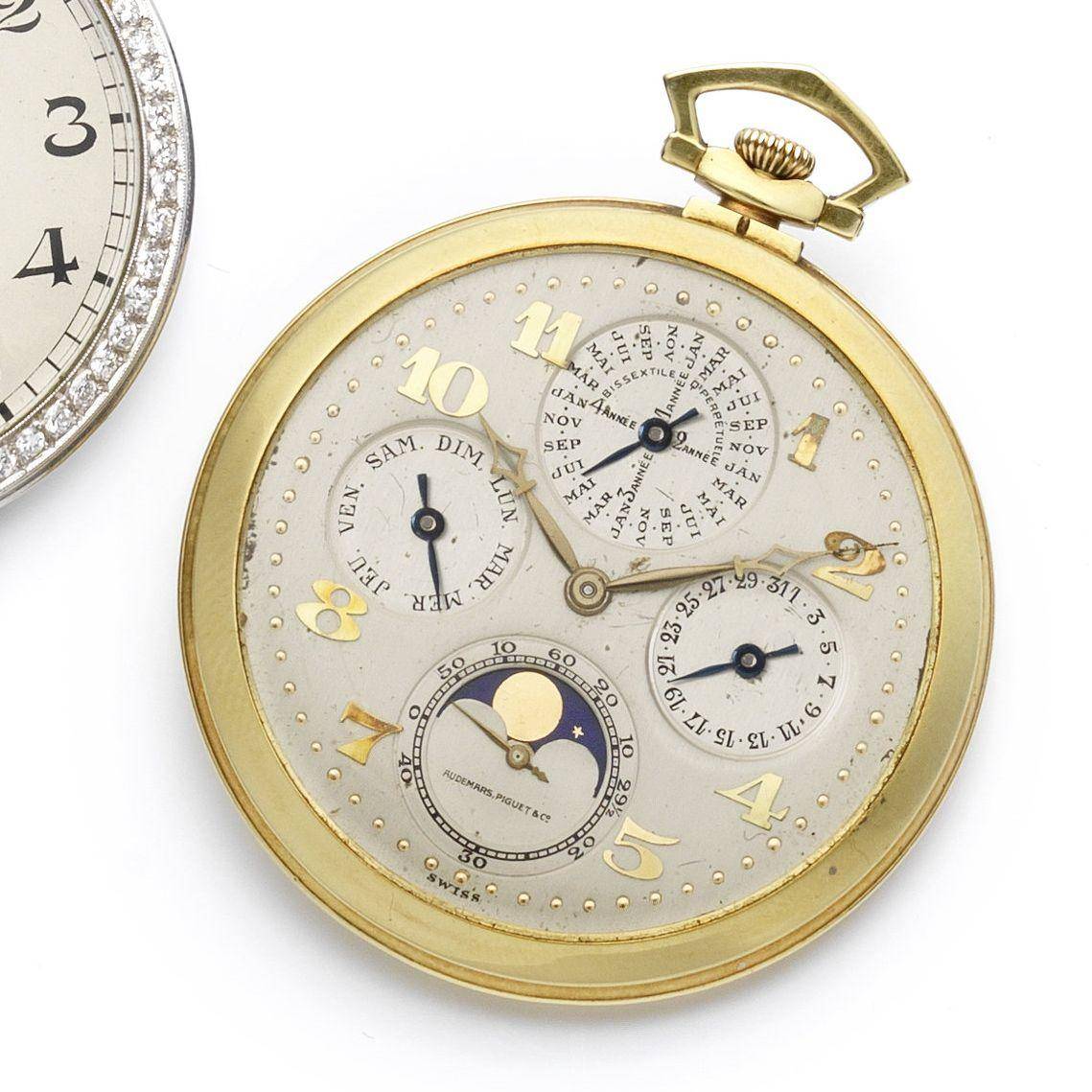
Audemars Piguet perpetual calendar pocket watch, early 20th century (source: Bonhams)
Almost always housed in a 750/1000 yellow gold case (18 karats), these pieces represented the pinnacle of watchmaking craftsmanship in their day and were naturally reserved for wealthy clients.
Then, during the Art Deco period (1910-1930), some models evolved to reflect the tastes of the day. To appeal to customers seeking a modern look, watchmakers introduced cases made from white metals such as sterling silver, white gold and even platinum. These perpetual calendar watches became pieces of jewelry in their own right, pairing technical achievement with contemporary elegance!
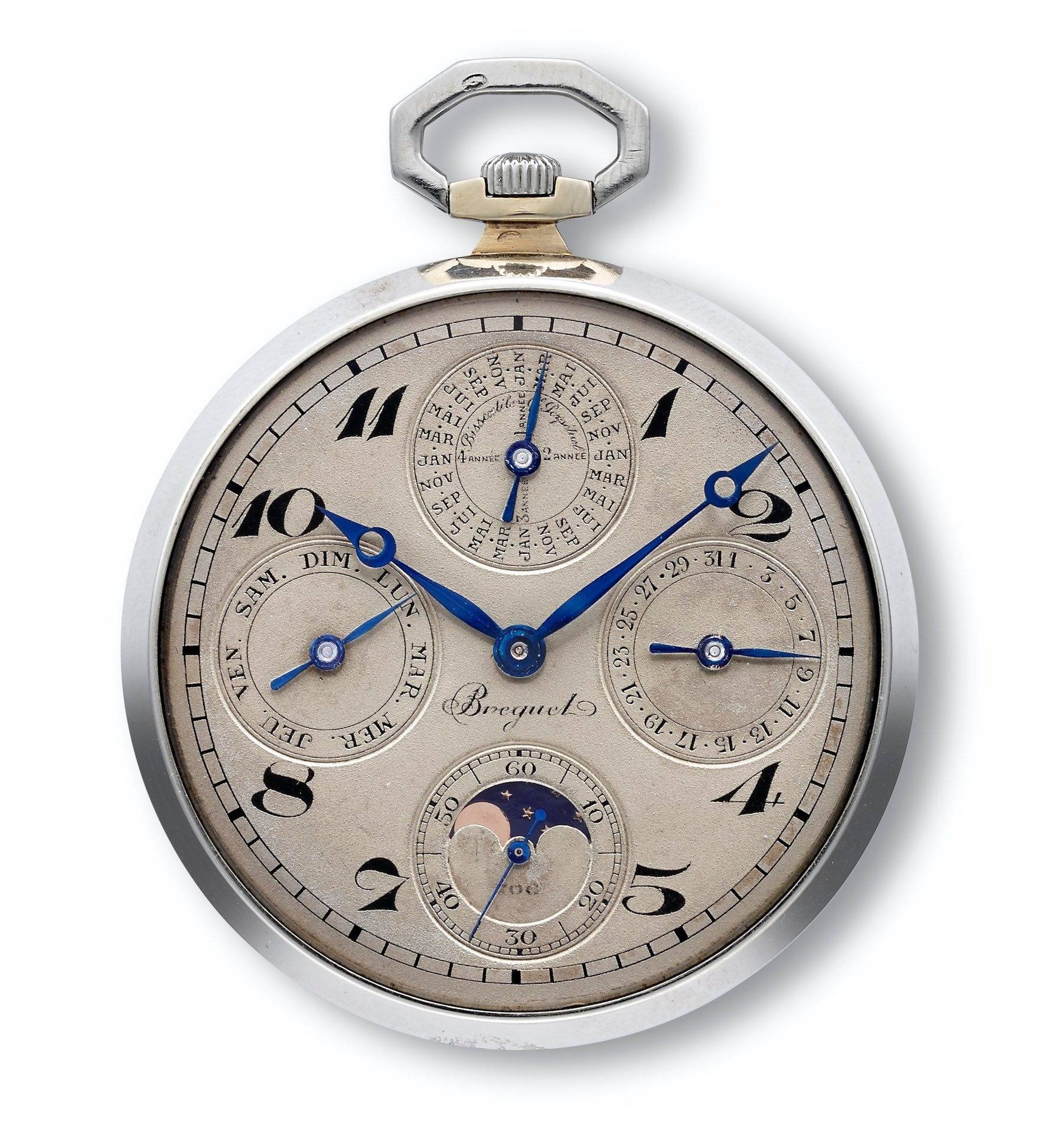
Breguet no 706 perpetual calendar pocket watch, 1925 (source: Monochrome Watches)
It was also during this period, in 1925, that the first-ever wristwatch with a perpetual calendar complication appeared, made by a name you almost certainly know: Patek Philippe. Crafted in gold, this watch was the culmination of nearly sixty years of painstaking work to make the complication small enough to fit on the wrist. It was not intended for mass production, however, but was a one-of-a-kind piece specially commissioned by Thomas Emery.
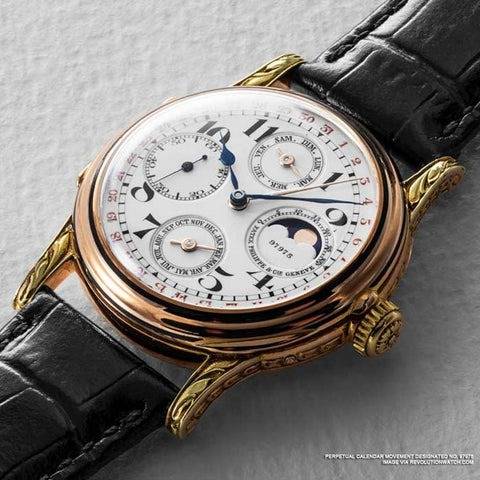
Patek Philippe perpetual calendar watch, 1925 (source: Revolution Watch)
Just four years later, in 1929, another major name entered the picture: Breguet. The watchmaker unveiled reference no 2516, a watch with a 750/1000 white gold (18-karat) tonneau case measuring 26 x 29 mm. Its design was perfectly in step with the tastes of the time!
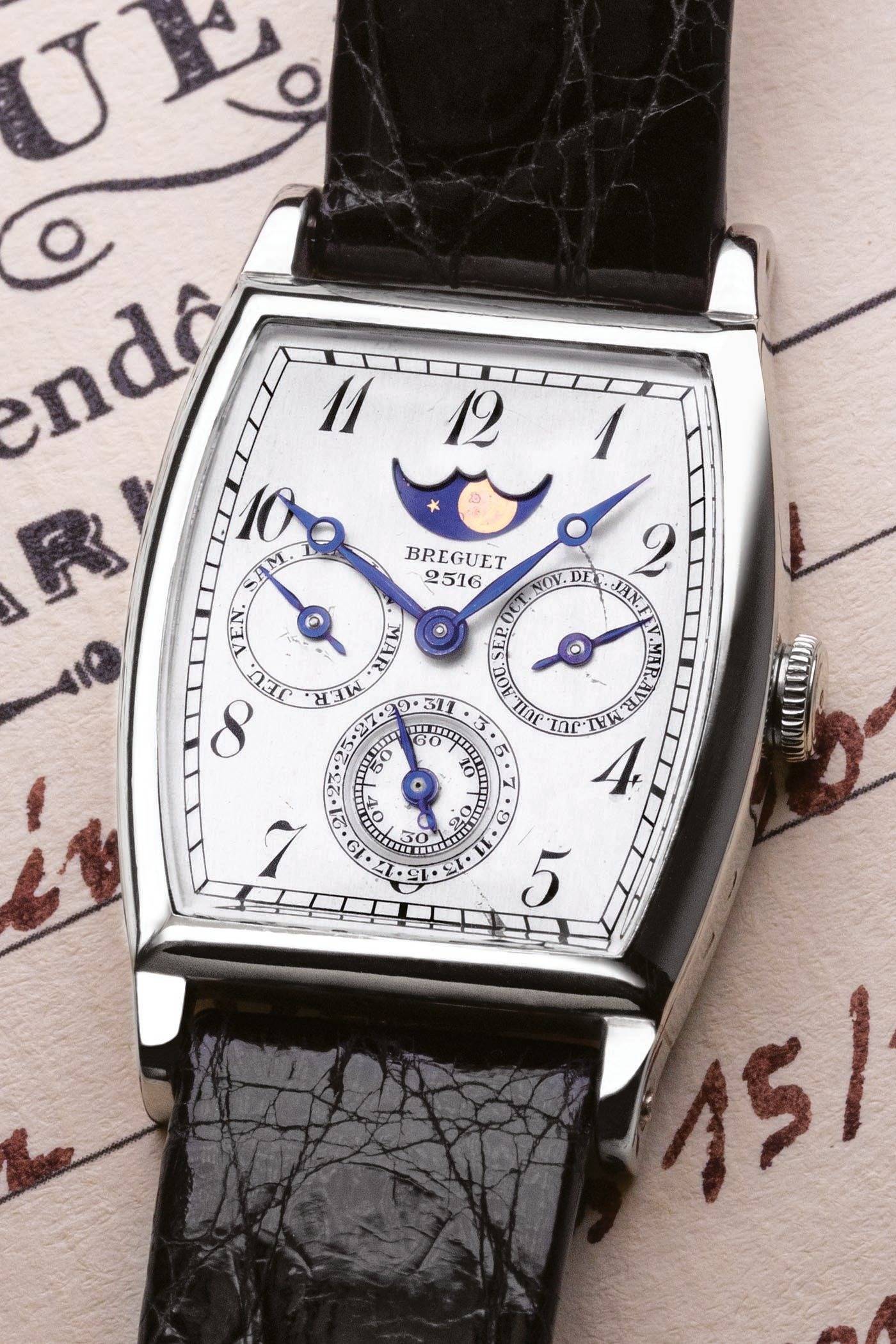
Breguet 2516 watch, 1929 (source: Monochrome Watches)
Unlike Patek Philippe's 1925 watch, this model was not made to fulfill a customer's commission. It grew out of a project undertaken by Breguet's watchmakers themselves.
It's tempting to wonder whether Breguet began developing this piece back in 1925, soon after Patek Philippe released the first perpetual calendar wristwatch. The answer remains unclear… What we do know is that the Breguet 2516 appeared in the midst of one of the world's worst economic crises: the Great Depression, also known as the “1929 financial crisis.”

A man looking for work on the streets of Detroit, 1930 (source: Who Built America)
Want to hear something surprising? Because they were so complex, every perpetual calendar watch was available exclusively by special order until the 1940s. In other words, you couldn't simply walk into a watch store and leave with one. You had to place a request with the brand, which would then assemble the watch specifically for its future owner.
It was only over the following decades that perpetual calendar watches became easier to obtain, provided, of course, that you could afford one! The 1960s also brought some rather unusual watches. At first glance, they appeared to have a perpetual calendar, but their style and the way their displays were read were very different…
Unlike the more traditional models discussed so far, these watches did not use hands to display the calendar. Instead, they featured an unusual layout, with the date, days and months shown through disks and markings visible directly on the dial.
It is worth noting, however, that these watches did not have a true perpetual calendar that updated automatically. Their calendars needed manual adjustment several times a year, creating something of an illusion of a perpetual calendar…
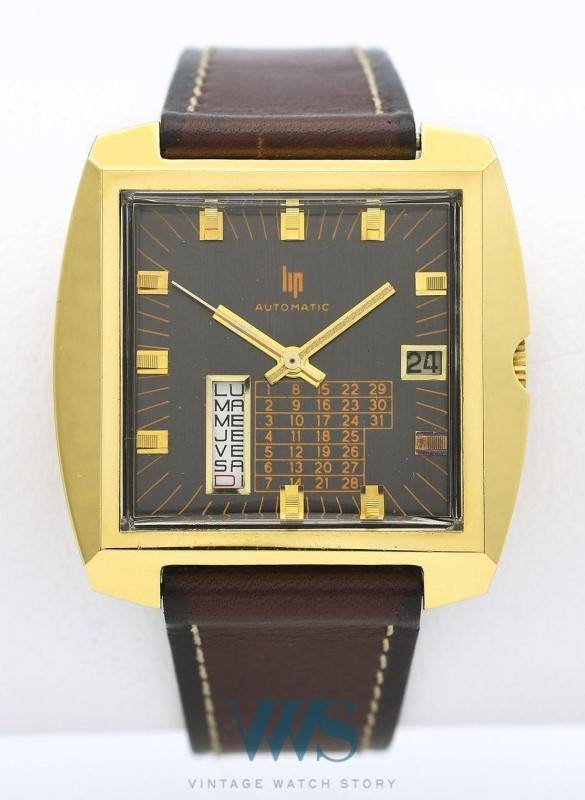
Lip “perpetual calendar” watch, ref. 43633, circa 1972 (source: vws.fr)
Thanks to their simpler mechanisms, these watches were priced far more reasonably than true perpetual calendars. No surprise there! It's also interesting that their displays varied from model to model, reflecting the creativity of watchmakers at the time.
Many brands have tried their hand at this type of watch, including Orient, Lip, Wittnauer and Raketa. Each comes from a different background and brings its own perspective. Orient holds a special place among them: the Japanese watchmaker has offered, and still offers, a wide range of models, from understated to exuberant.
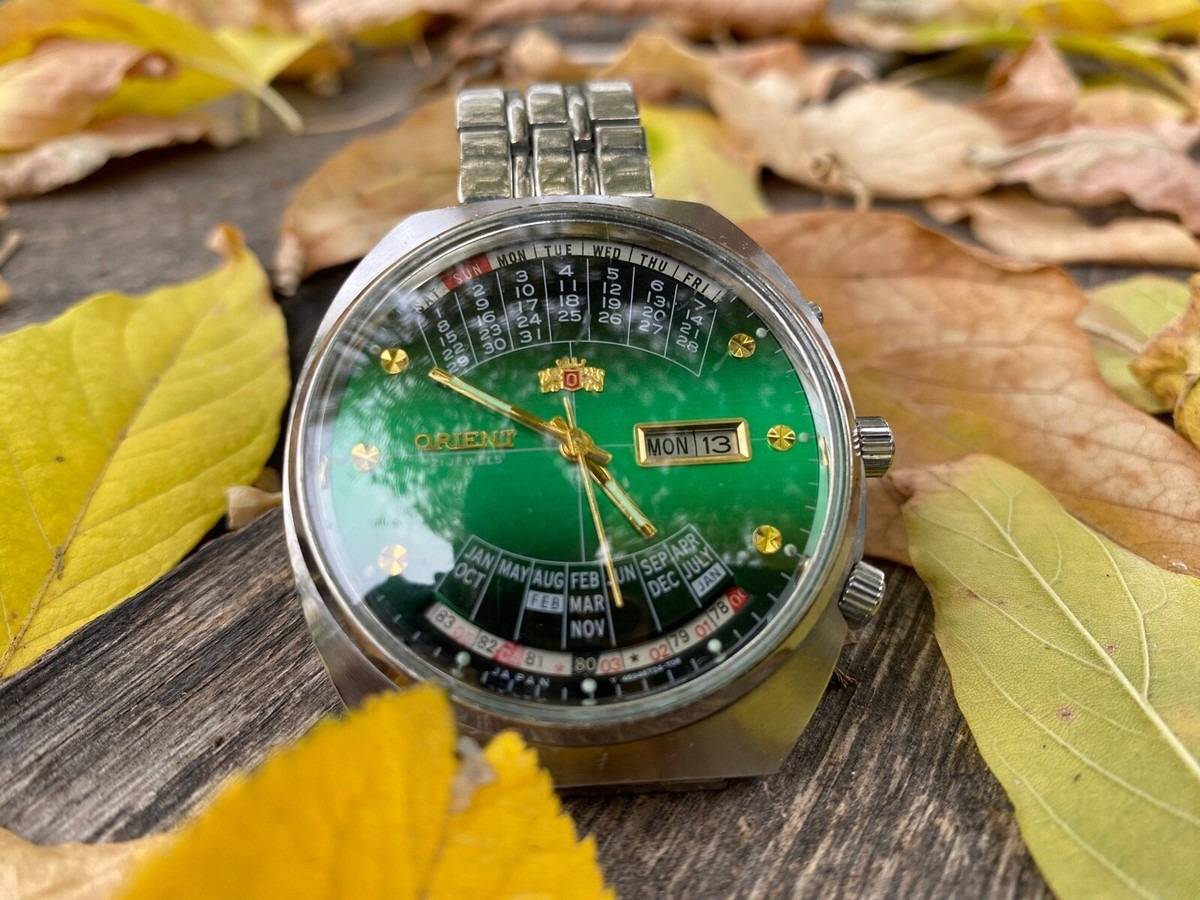
Vintage Orient “perpetual calendar” watch (source: eBay)
Some of these models stand out for their smoky green dials, reminiscent of casino gaming tables. If you'd like to explore further, you'll often find these watches listed as “Perpetual World Time,” “College Perpetual Multi-Year Calendar” or “Multiyear Calendar” on watch forums and retail sites.
As we noted in our guide to the history of watchmaking, the late 20th century saw a resurgence of grand complications. The perpetual calendar was no exception: in the 1980s and 1990s, several watchmakers unveiled models with inventive designs. One example is designer Gérald Genta, who created an octagonal quartz watch called “Success,” with a particularly bold yet refined design.
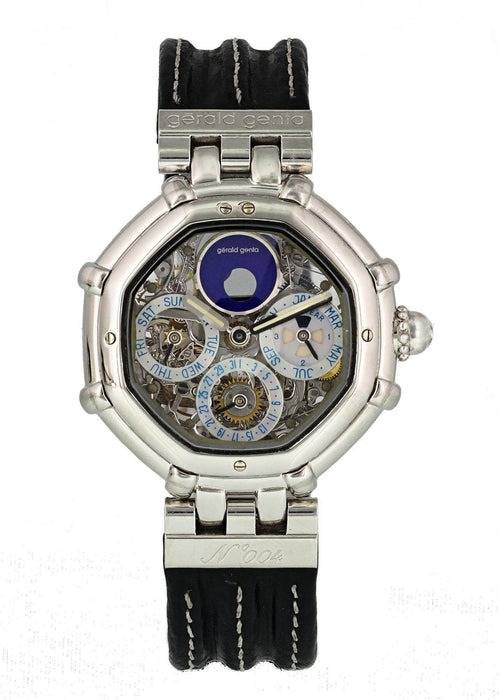
Gerald Genta Success Platinum Perpetual Calendar Watch, ref. 3359.4 (source: Phigora)
The Swiss watchmaker Ebel, then very much in vogue, offered solid gold pieces (yellow or white) with a sporty-chic style suited to everyday wear, whether at the office or on vacation with your shirt collar open by the sea.
At a more accessible price point, Seiko also drew attention with several quartz watches featuring this complication. One remains especially memorable to collectors: a piece from the “Age of Discovery” line, whose richly decorated case and overall look seemed inspired by old navigational instruments.
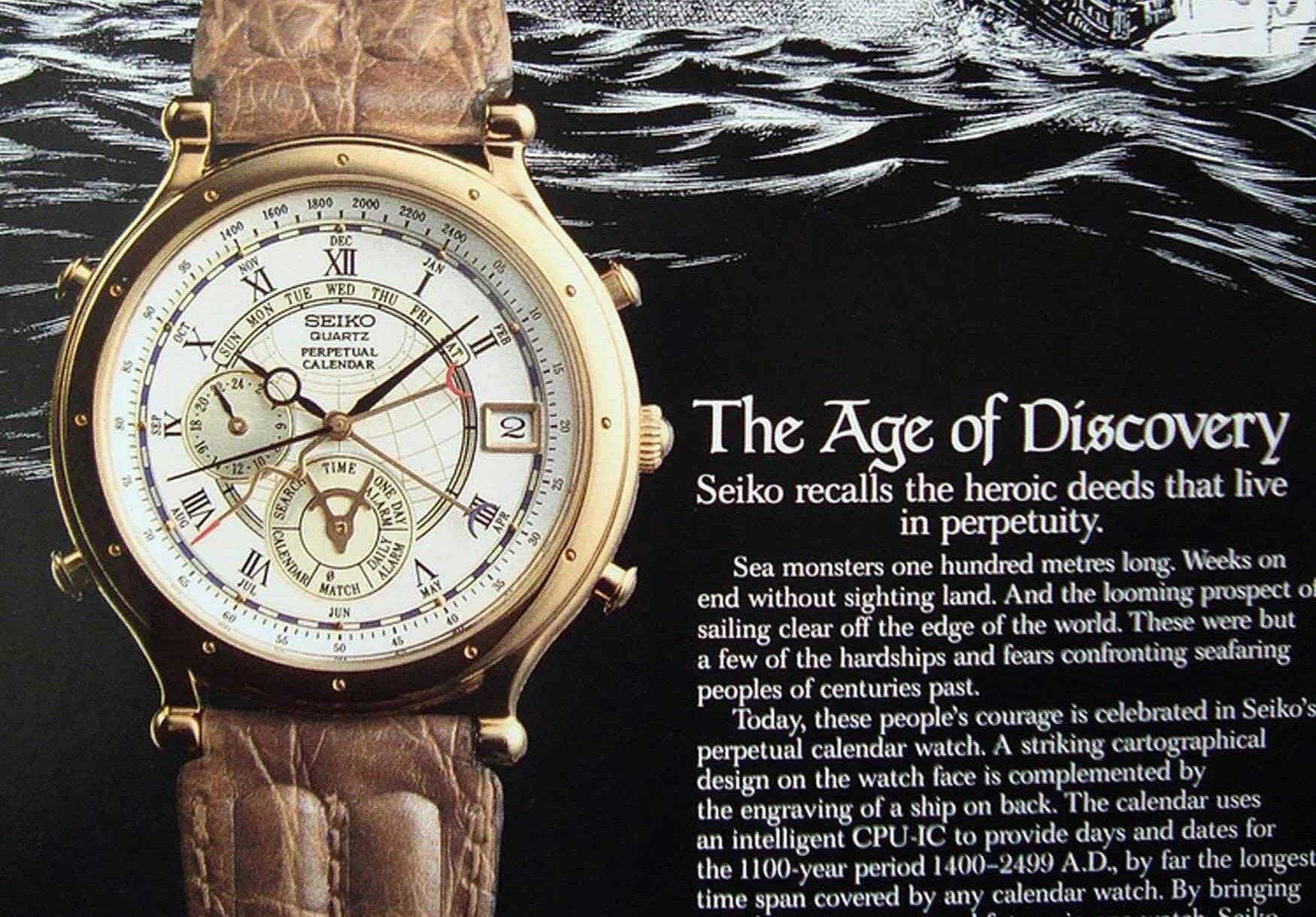
Seiko “The Age of Discovery” advertisement, ref. 6M13 0010 (source: Time+Tide Watches)
The model's release in 1992 was no coincidence: it marked the 500th anniversary of Christopher Columbus's discovery of America.
Up to the turn of the millennium (and even a little beyond), several watchmakers kept the mechanical perpetual calendar tradition alive with particularly interesting models. Some had a decidedly classic look, while bolder pieces stood out for their modern, unconventional designs.
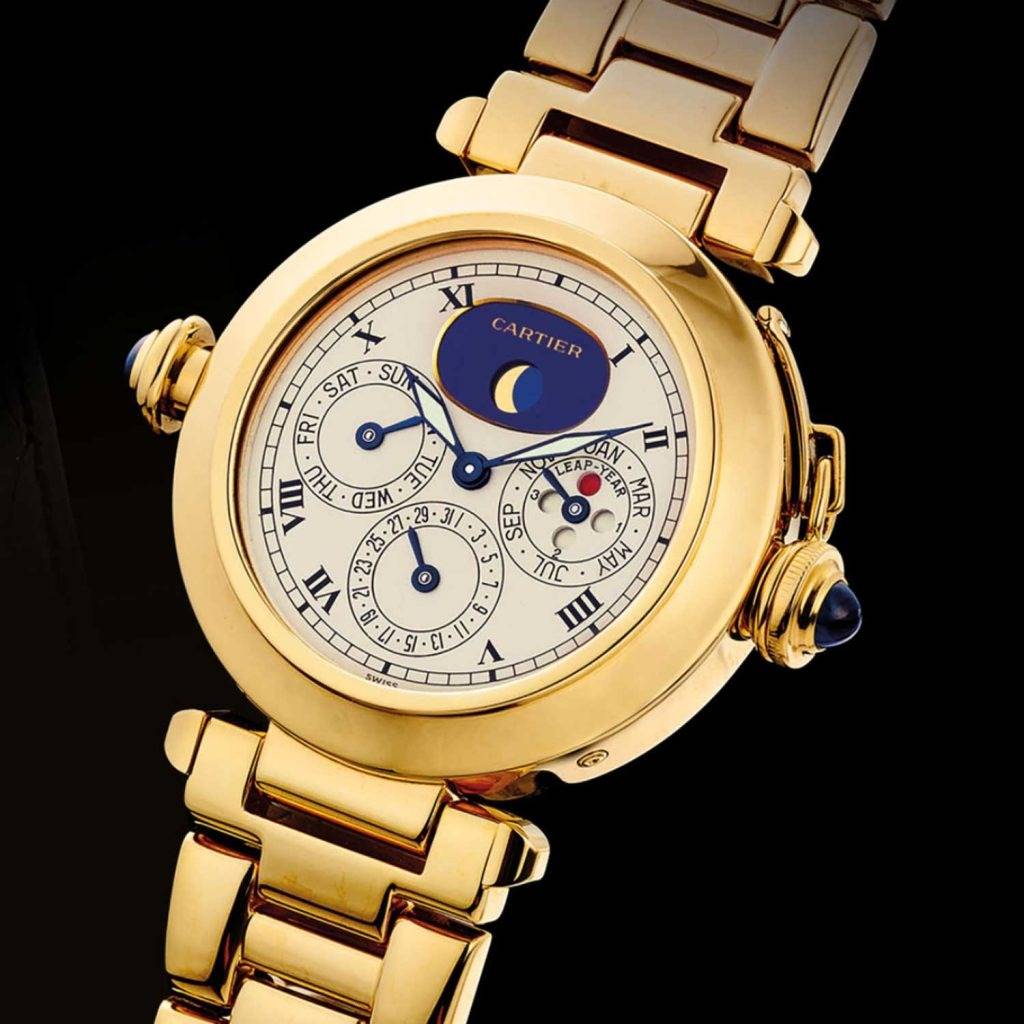
Cartier Pasha perpetual calendar watch, 1989 (source: Revolution watch)
Daniel Roth, Franck Muller, IWC, Cartier and Audemars Piguet all embraced this trend. Cartier's iconic Pasha, designed by the brilliant Gérald Genta, gained a perpetual calendar version, while Audemars Piguet impressed with its “Metropolis,” recognizable by the stylized numerals on its dial, which some would describe as Art Deco.
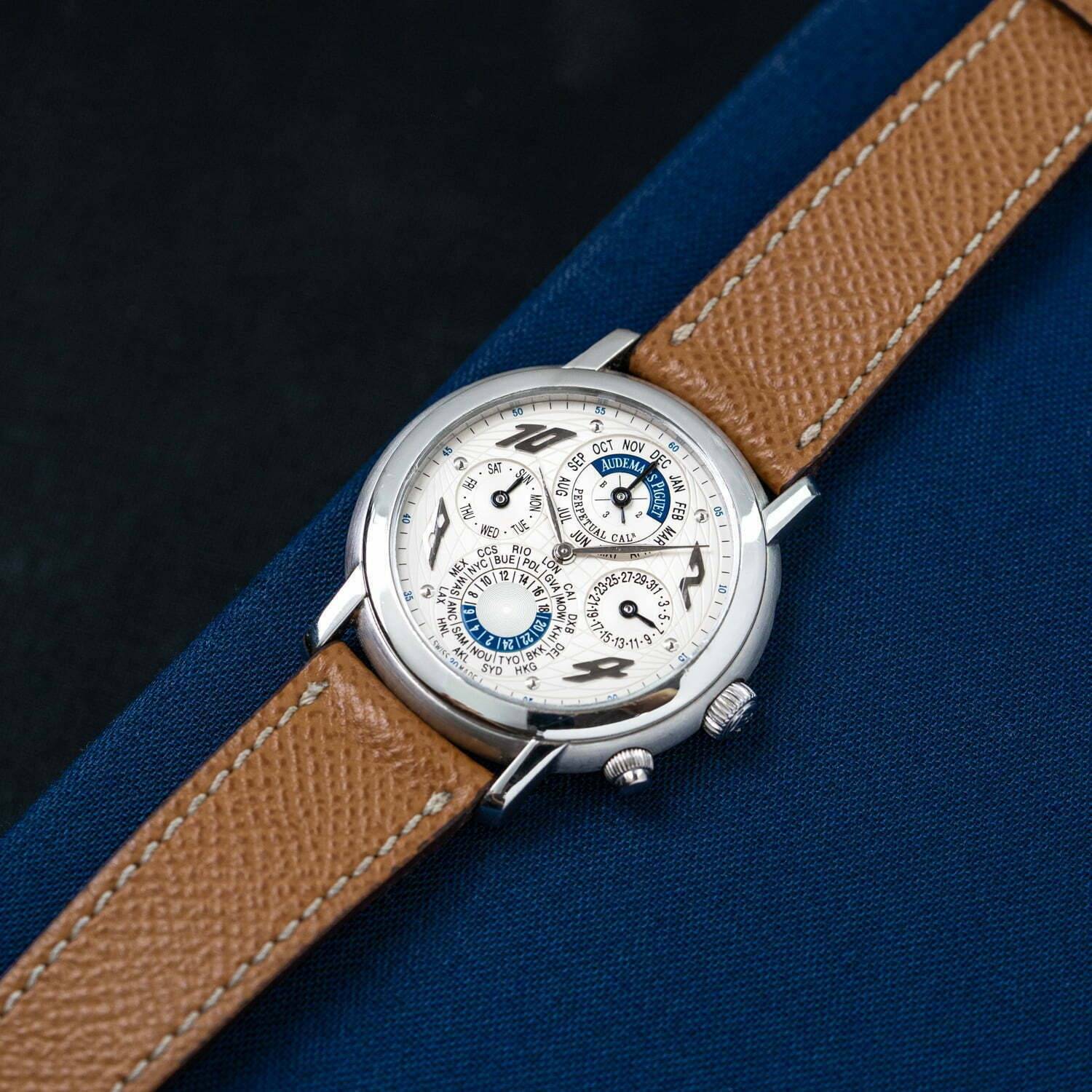
Audemars Piguet Metropolis, 2004 (source: Amsterdam Vintage Watches)
In the late 1990s, Seiko also made its mark, though in a different way, with perpetual-calendar watches (not to be confused with the perpetual calendar complication we've been discussing, remember?). These much simpler quartz models displayed the date, or sometimes the day and date, in a discreet window on the dial. Understated and versatile, they looked like the classic watches commonly worn every day at the time!
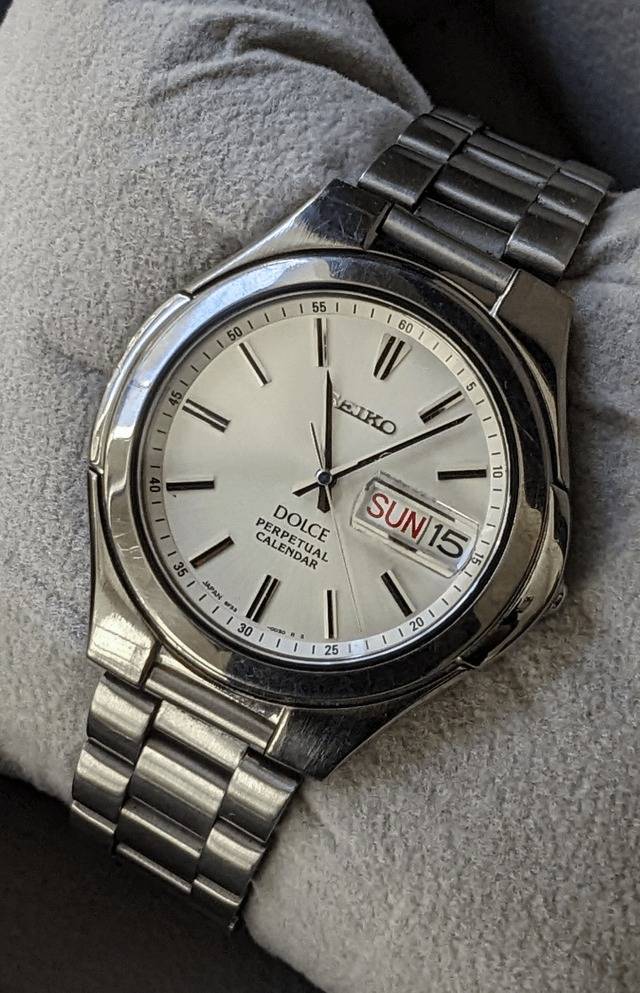
Seiko Dolce quartz perpetual-calendar watch, circa 1990 (source: Reddit @Strict_Lab7585)
As you can see, mechanical perpetual calendar watches have remained the domain of prestigious watchmakers and luxury brands. Little has changed today: realizing this watchmaking dream still takes a substantial budget. And quartz alternatives seem to have all but disappeared.
Ring! It's time to discover how the perpetual calendar complication works. Let's dive straight into the next section…
Despite its tremendous complexity, a perpetual calendar watch seems to operate effortlessly… Making the highly technical look simple: that's the magic of watchmaking!
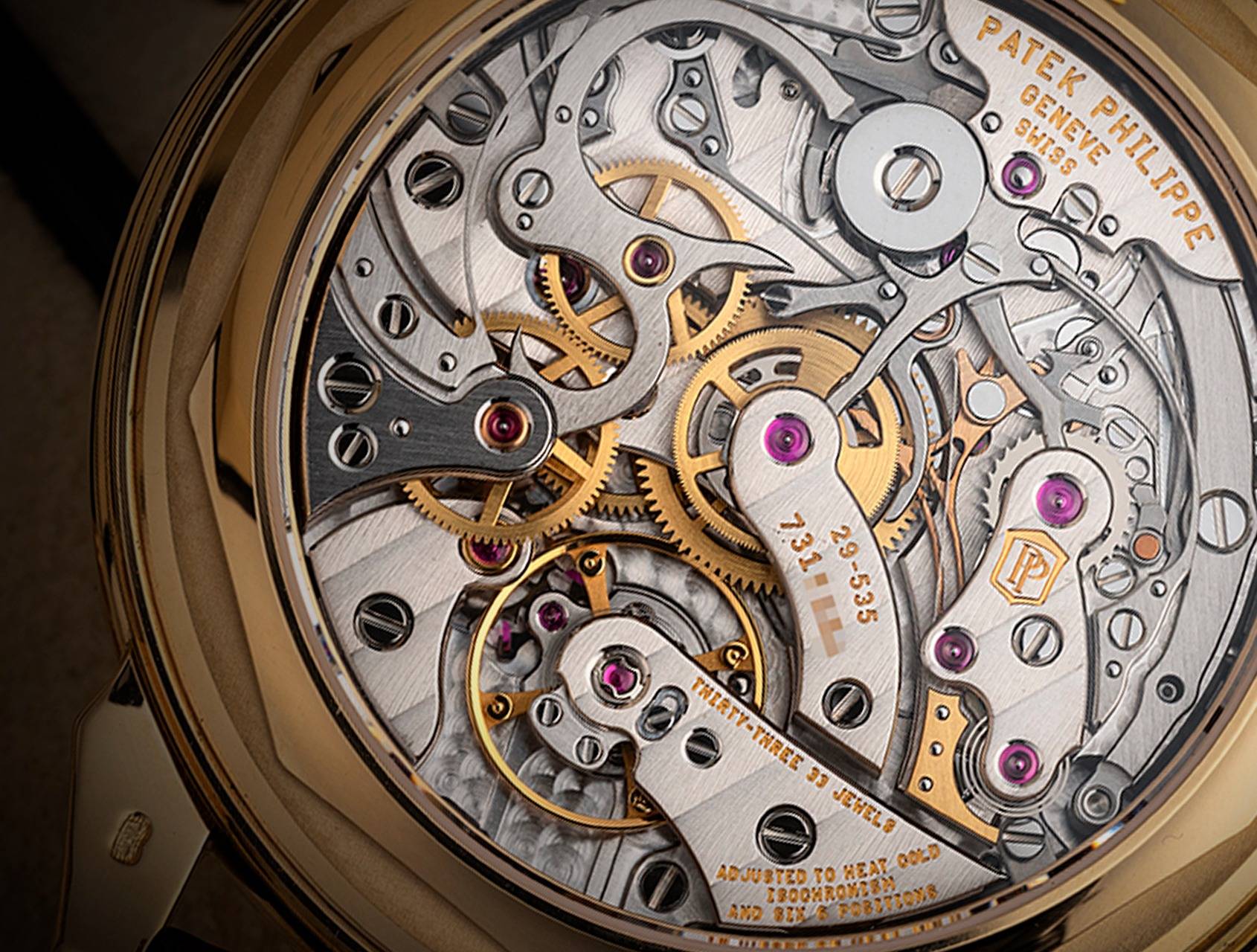
Patek Philippe CH 29-535 PS Q perpetual calendar movement (source: The Watch Club)
As we saw in the first part of this watchmaking guide, the perpetual calendar is a remarkable mechanical feat. This complication lets a watch automatically display the date, month and day of the week, distinguishing between months of 28, 29, 30 and 31 days without manual adjustment until 2100. By now, you've probably realized that the perpetual calendar is anything but a minor complication…
At the heart of the mechanism is a kind of mechanical memory: a calendar wheel that makes one revolution every four years, completing a 1,461-day cycle. Through a series of levers, it communicates the number of days in the current month (28, 30 or 31, or 29 for February in a leap year) to the display components.
That wheel is precisely what keeps your watch showing the correct date, leap year or not!
Inside a perpetual calendar watch, you'll find several distinct mechanical components:
Wheels to display the date, day and month.
Dedicated levers for each indication.
A large lever (or “grand bridge”) that spans the movement and coordinates it all like a conductor.
This guide lever moves the wheels according to the calendar wheel's distinctive profile (steps, notches and teeth), accounting for the month and leap years.
Perpetual calendar watches rank among the most complex ever made… They can contain hundreds of parts, including wheels, levers, springs and multiple disks, and take months of painstaking work to assemble.
Some modern versions go further still, incorporating a 400-year calendar cycle rather than a four-year one, accounting for century years that aren't leap years, such as 2100.
Despite their high price, perpetual calendar watches were traditionally delicate to adjust… Changing the settings during the date changeover (often between 21h and 2h) could seriously damage the movement.
Today, some contemporary models, such as Audemars Piguet's Royal Oak Perpetual Calendar, allow all functions to be adjusted safely through the crown at any time, thanks to a particularly slim (4.1 mm thick) and sophisticated movement.
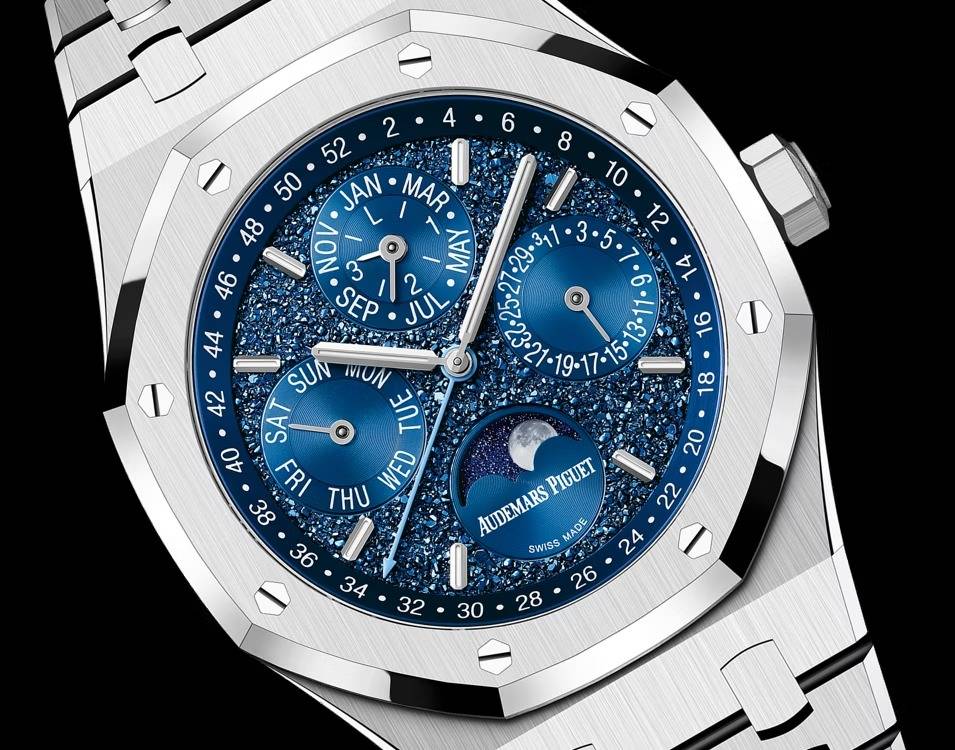
Audemars Piguet Royal Oak perpetual calendar (Source: official Audemars Piguet website)
In short, the perpetual calendar relies on a four-year mechanical memory coordinated by precisely crafted wheels and levers. It automatically adjusts for months of different lengths and for leap years. With hundreds of components that demand extraordinary care in assembly, these watches embody the art of fine watchmaking! Though the complication was once considered rather fragile, recent watchmaking innovations have greatly improved both its durability and ease of use.
Not all perpetual calendar watches are set the same way… Some are designed to be more intuitive, while others require extremely delicate handling. A mistake can seriously damage the movement. So the first rule is simple but essential: always read the manual that came with your watch before making any adjustments.
In practice, a perpetual calendar can be set in three ways:
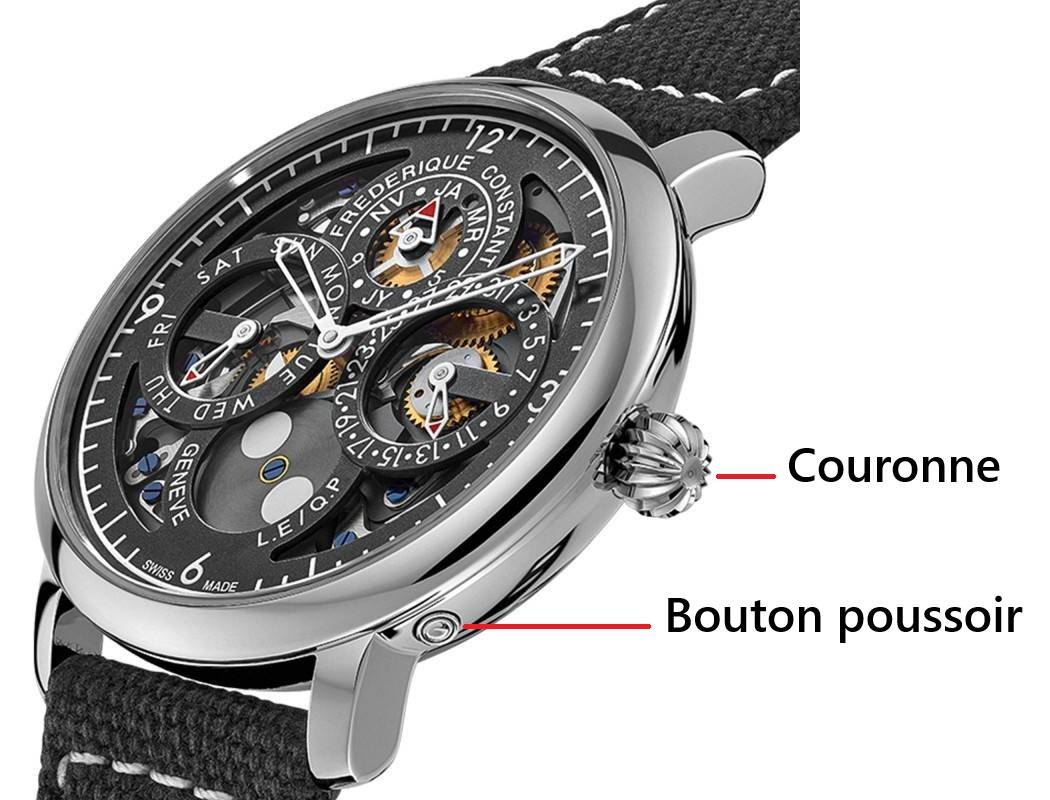
Crown and push button on a perpetual calendar watch
Each system has its quirks, but all call for the same precaution: proceed slowly, one step at a time. Some watches, for example, must not be adjusted between 20h and 2h, when the mechanism is already preparing to advance to the next day. Forcing an adjustment during that window can permanently damage the gears.
Another thing to watch out for: some perpetual calendars cannot be set backward. If you accidentally advance one by a day or two, your only option may be to contact the brand's service department. That's why it's so important never to rush and always to check the time and hand positions before using the push buttons or crown.
If the prospect of these sometimes lengthy, delicate adjustments gives you pause, you have two options:
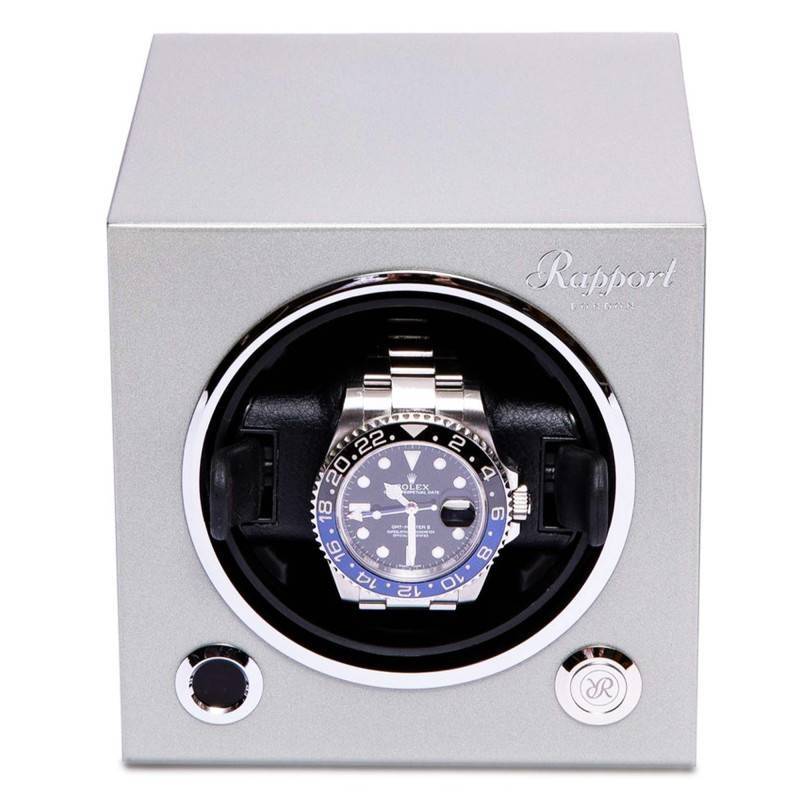
Rapport London Evolution MKIII Watch Winder for Automatic Watches
The perpetual calendar is a feat of watchmaking that tracks the Gregorian calendar, including leap years, without error. But that complexity calls for care: developing and setting one requires an attentive hand, almost a ritual. By taking time to set it properly, or using a watch winder, you help preserve both your watch's accuracy and its story.
The perpetual calendar complication has come a long way since it first appeared in the 1700s… Yet it has never lost its power to captivate watch enthusiasts. Its astonishingly intricate design makes everyday life simpler, and perhaps that's what gives it an almost mystical touch of magic. It's a feeling only the truly great complications can inspire!
Share :
Official European Union notice on your rights in the event of a product's lack of conformity.


