
0
Product added
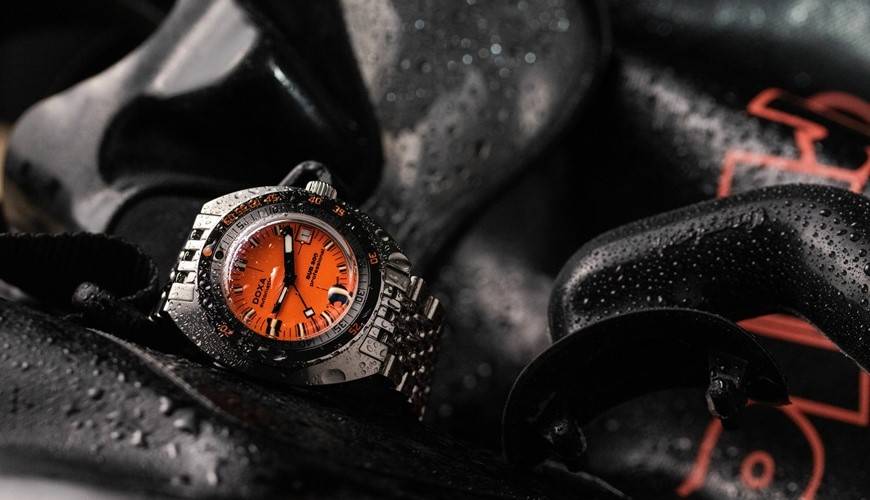
Born to accompany divers in the most demanding depths, dive watches have become one of the cornerstones of modern watchmaking. Engineered as genuine professional instruments, they combine legibility, reliability, and resistance to pressure, humidity, and shocks. Over time, these technical timepieces have far outgrown the ocean floor to conquer everyday wrists. Rotating bezel, luminescent indices, reassuring robustness… Their identity is instantly recognizable!
Behind that iconic aesthetic lies a rich story - one shaped by innovation and remarkable human challenges. The good news: this watch guide takes you through every dimension of it.
The dive watch was originally a tool engineered to meet the very real demands of professional divers. In an environment where every minute counts and conditions can turn extreme in an instant, reliability is non-negotiable. Waterproofing is therefore the central challenge: a timepiece built to operate underwater must withstand pressure, constant moisture, and temperature swings without ever compromising its performance.
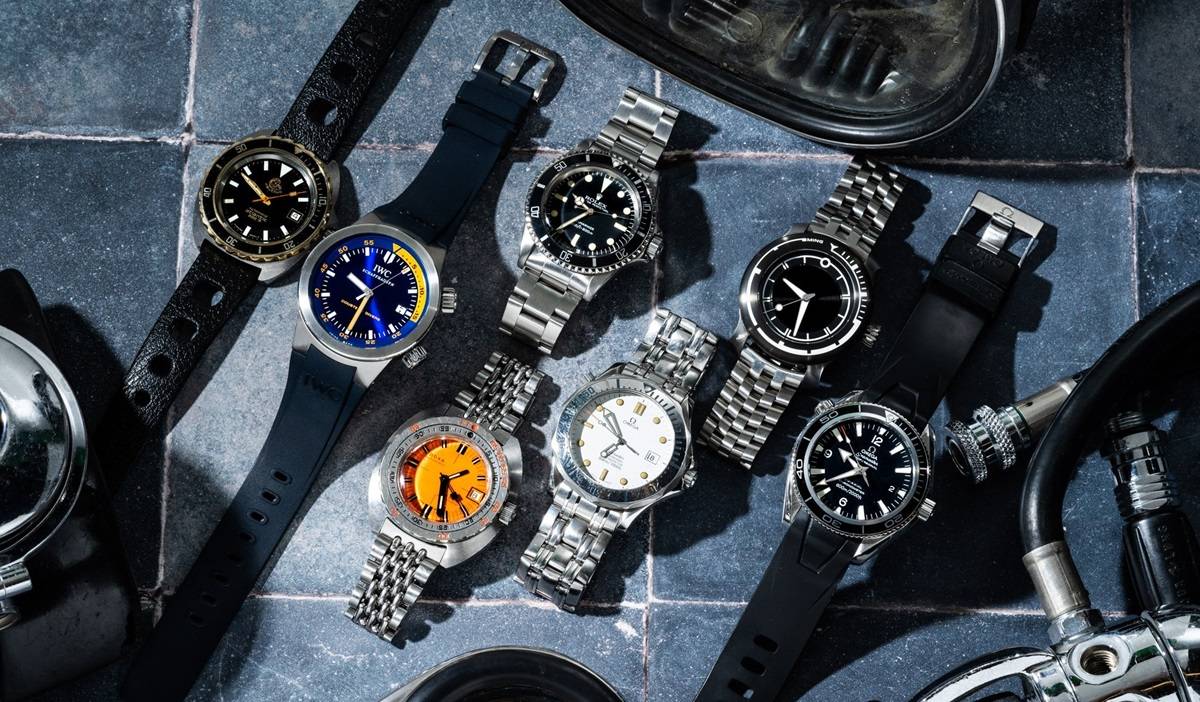
Various dive watches (source: Analog:Shift)
If you spend time talking with watch enthusiasts - whether in person or on a specialized forum - you've almost certainly come across the terms "plongeuse" or "diver's watch." The latter, an English expression widely embraced by French speakers, refers to watches specifically designed for underwater diving. It underscores their primary purpose: to be worn in real diving conditions, not merely to evoke a nautical aesthetic.
Dive watches also carry a set of intrinsic features that make them instantly recognizable: a rotating bezel for measuring immersion time, generously luminescent indices and hands for easy reading in the depths' darkness, a screw-down crown for enhanced water resistance, and a robust case built to take a beating. These are the attributes that define their identity - and the hallmarks by which watch enthusiasts can spot a true diver's watch at a glance.
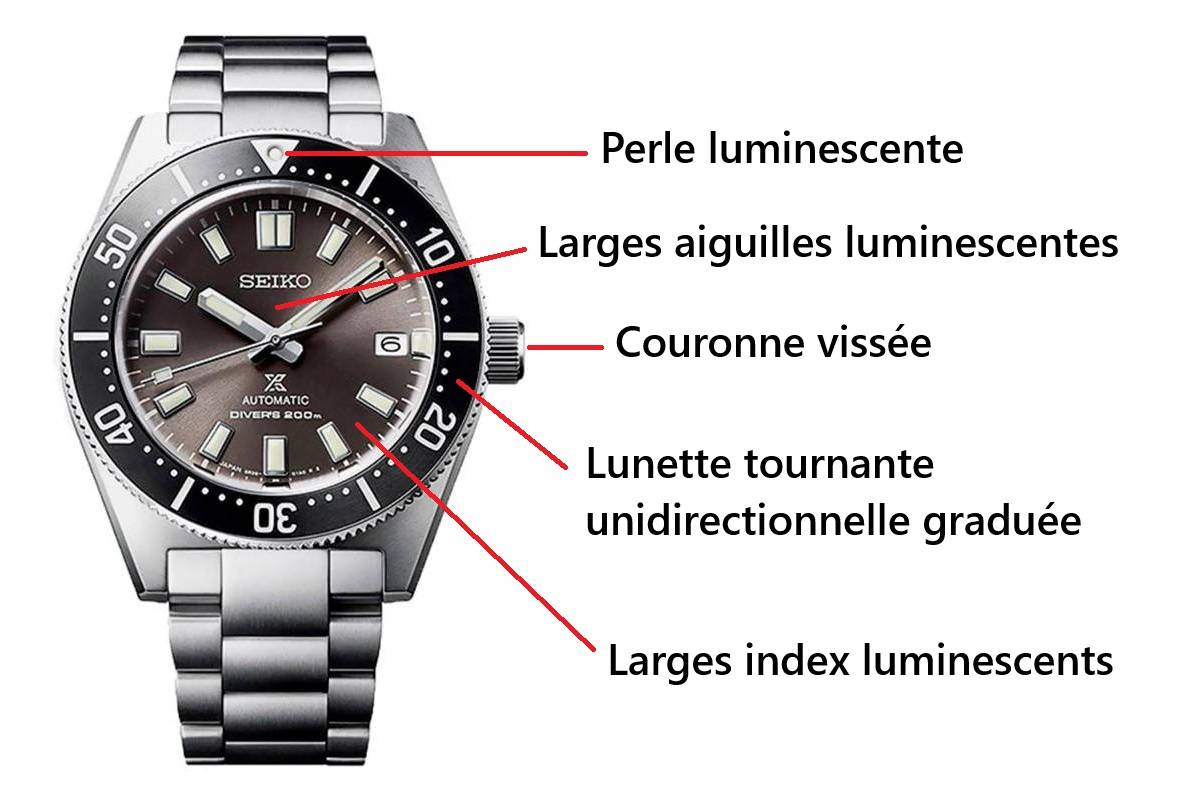
Characteristics of a Dive Watch
Today, dive watches are widely worn in everyday life - often far from any ocean. Yet they should never be reduced to mere fashion accessories. At their core, they are genuine professional instruments, engineered to keep divers safe underwater. But to understand how these timepieces became watchmaking icons, a brief look back at their origins is in order.
If you've read our guide on the history of watchmaking, you know that the world's first truly waterproof watch didn't appear until the 1930s: the Omega Marine, launched in 1932. First tested at 73 meters in the famous Lake Geneva, straddling the border between France and Switzerland, it later underwent rigorous laboratory trials confirming its water resistance to 135 meters. The foundation of the dive watch - waterproofing - had been laid.
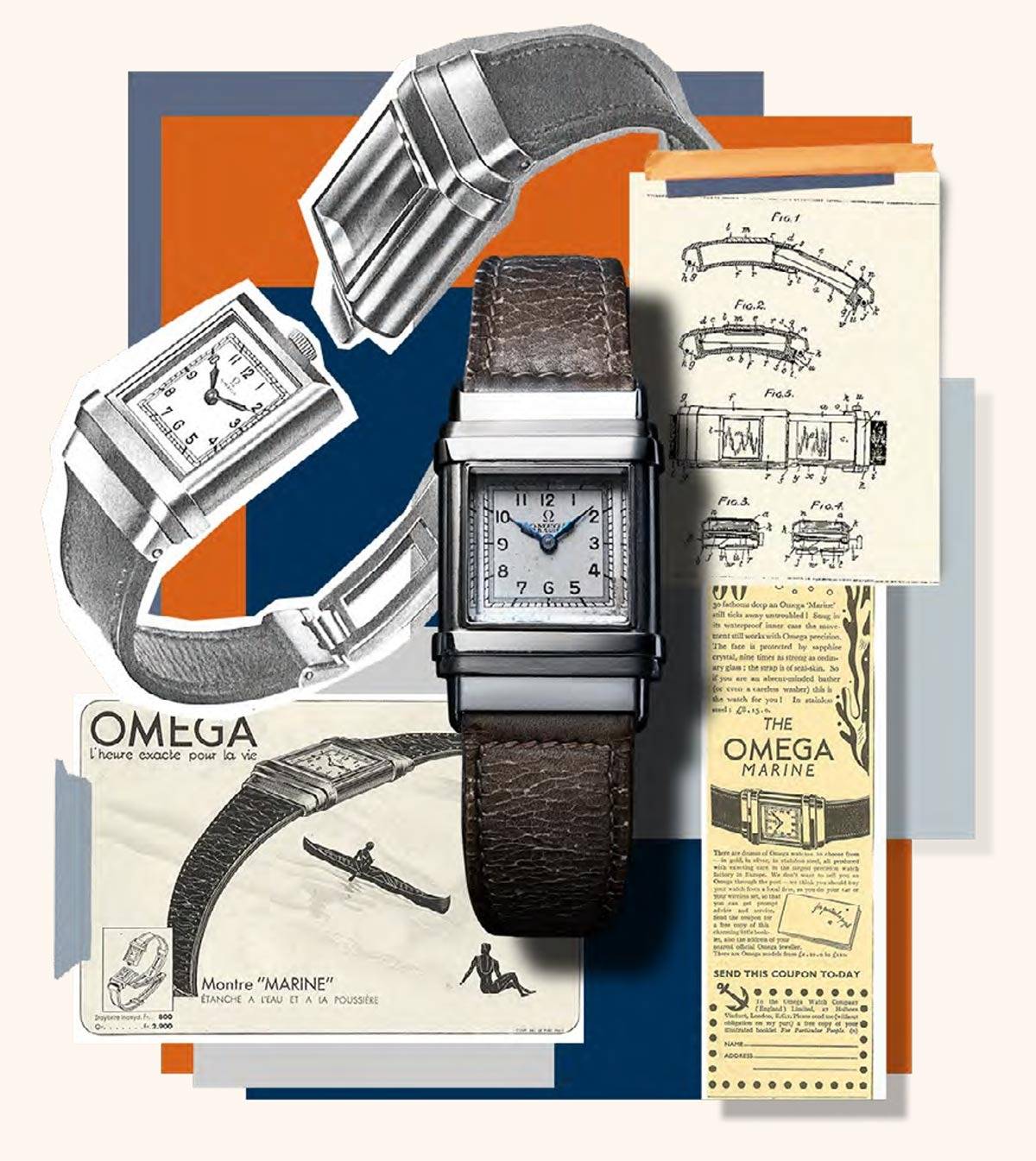
Omega Marine watch, 1932 (Source: La Cote des Montres)
Yet, despite this exceptional water resistance for its era, the Omega Marine was a far cry from what we picture as a dive watch today. Its flame-blued hands, rectilinear case, and highly conventional dial - devoid of luminescent indices - placed it firmly in the tradition of classic watches for the well-dressed gentlemen of the time. And yet, as we touched on earlier, what defines a dive watch is both its technical specifications and its appearance.
The real turning point came two decades later, in 1953, when Blancpain unveiled its iconic model, the "Fifty Fathoms" - literally "fifty fathoms." The name might seem unusual, but it had a precise purpose: to indicate that the watch was water-resistant to 50 fathoms, roughly 90 meters. In reality, it held up to 150 meters, but at the time, 90 meters represented the practical limit for divers using compressed-air tanks. "Fifty Fathoms" was a stroke of pure marketing genius - it embedded the watch's defining characteristic, its water resistance, directly into its name.
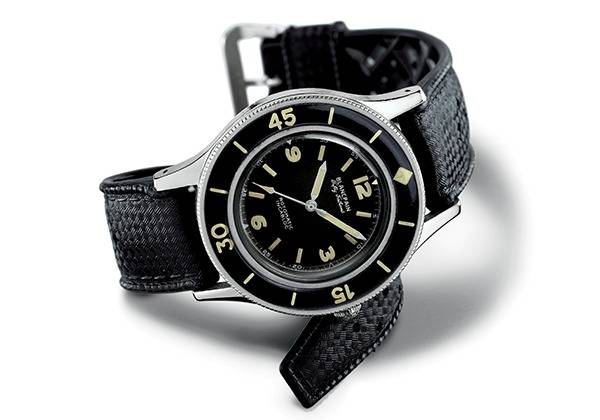
Blancpain Fifty Fathoms, 1953 (Source: Worldtempus)
The Blancpain Fifty Fathoms didn't break new ground through its water resistance alone - its real innovation lay in its now-iconic design: a rotating bezel, luminescent indices and hands, a dark dial, a substantial case. Every aesthetic standard of the modern dive watch was already in place. The model's case was even protected by a patent filed by Jean-Jacques Fiechter (Blancpain's CEO at the time) on 19/06/1954.
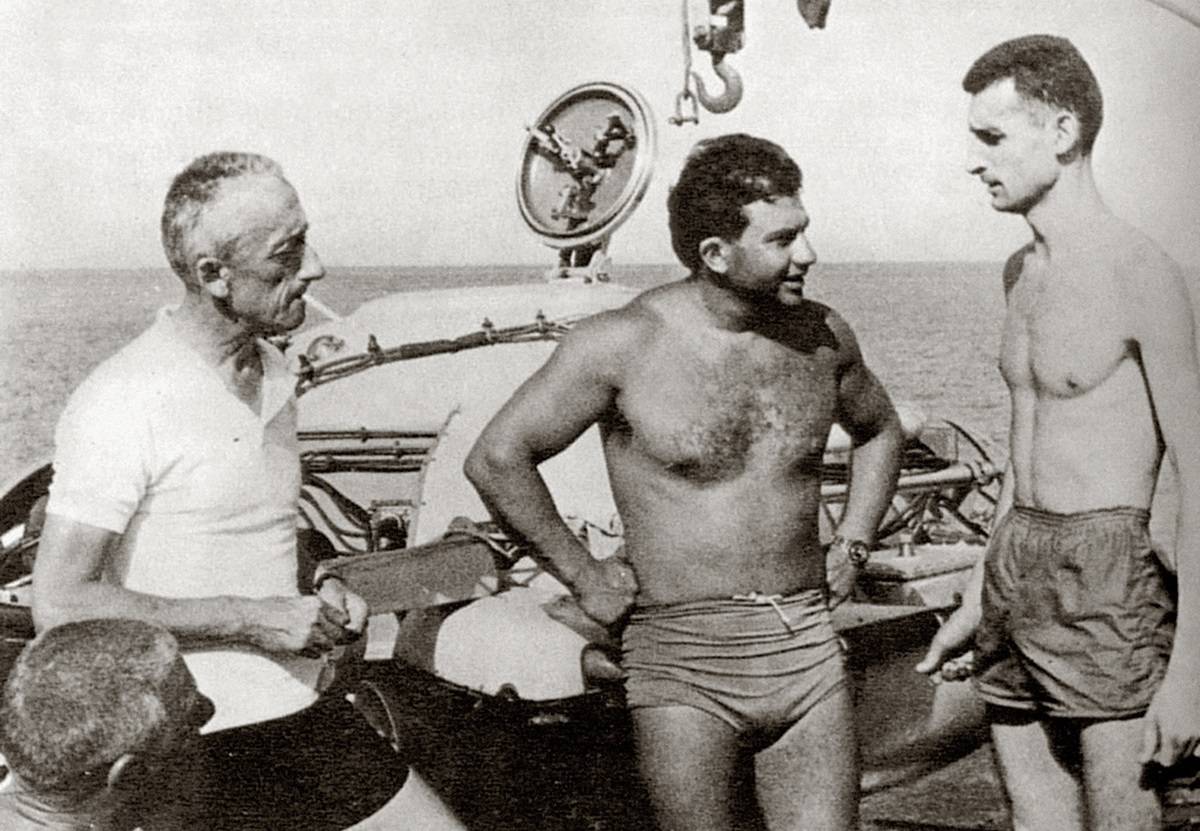
Photograph of a diver wearing a Blancpain Fifty Fathoms (Source: The Rake)
Another major innovation was the movement. Unlike most watches of the era, which relied on a manual-winding mechanical caliber, the Blancpain Fifty Fathoms featured an automatic mechanical movement, the R.570 - and that choice was far from arbitrary. According to Jean-Jacques Fiechter, it reduced wear on the crown and gaskets, since the watch no longer needed to be wound by hand as frequently.
The innovation did not go unnoticed! It quickly caught the attention of the French Navy, eager to equip its combat divers with a reliable watch capable of keeping pace with their most demanding missions. The Blancpain Fifty Fathoms thus secured a lasting place in history - and more specifically in that of military watches, designed to meet the specific needs of the armed forces. Divers of the US Navy also embraced this timepiece with pride.
The MILSPEC 1 version is easily distinguished from standard production models thanks to one clever feature. It has a small two-tone disc positioned at the bottom of the dial, capable of detecting and signaling the presence of moisture inside the watch.
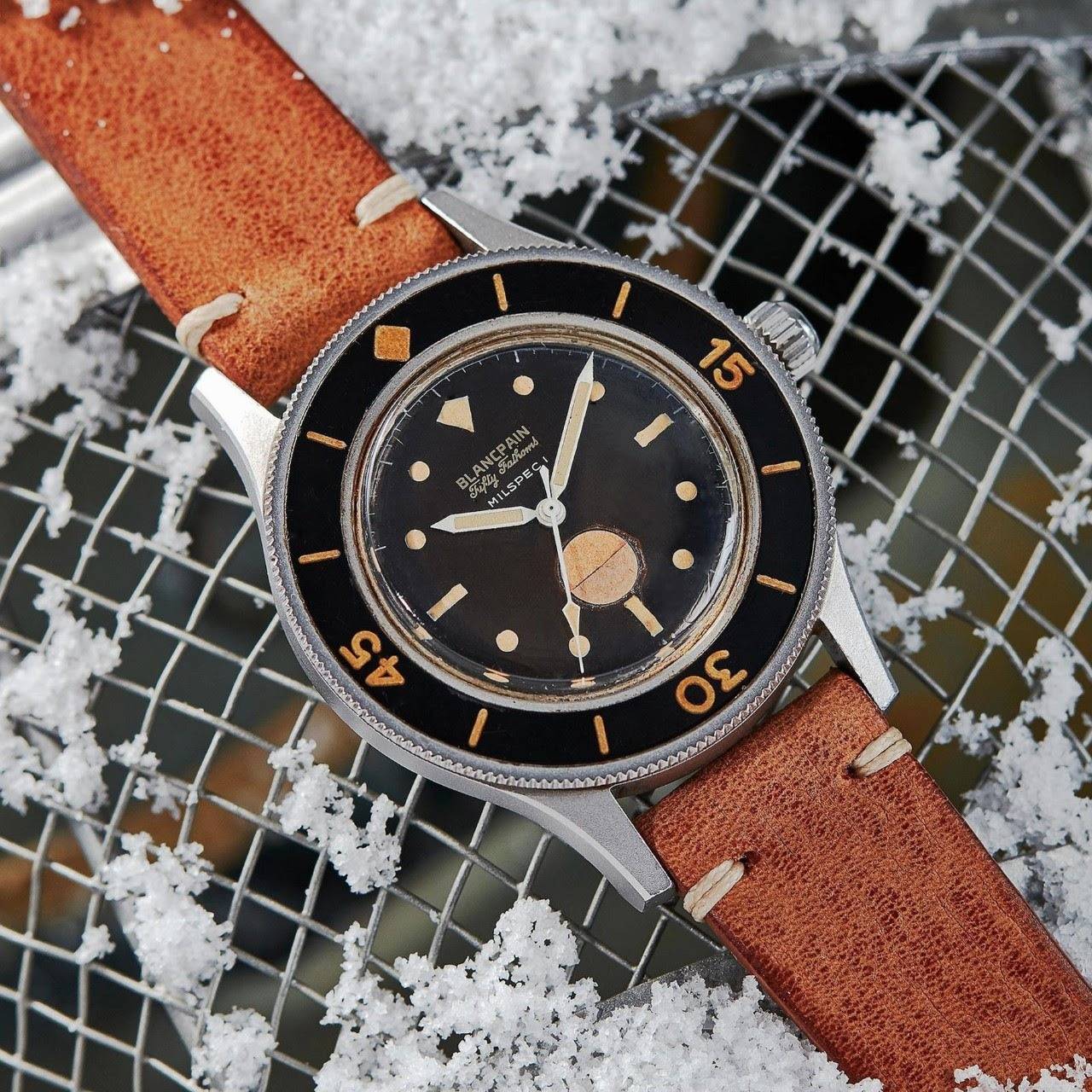
Blancpain Fifty Fathoms MILSPEC 1 (Source: WatchProSite - @amanico - Fortuna)
That same year, in 1953, another Swiss manufacture was already hard at work unveiling its own dive watch. After a year of development, the crown brand revealed its iconic Rolex Submariner, reference 6204.
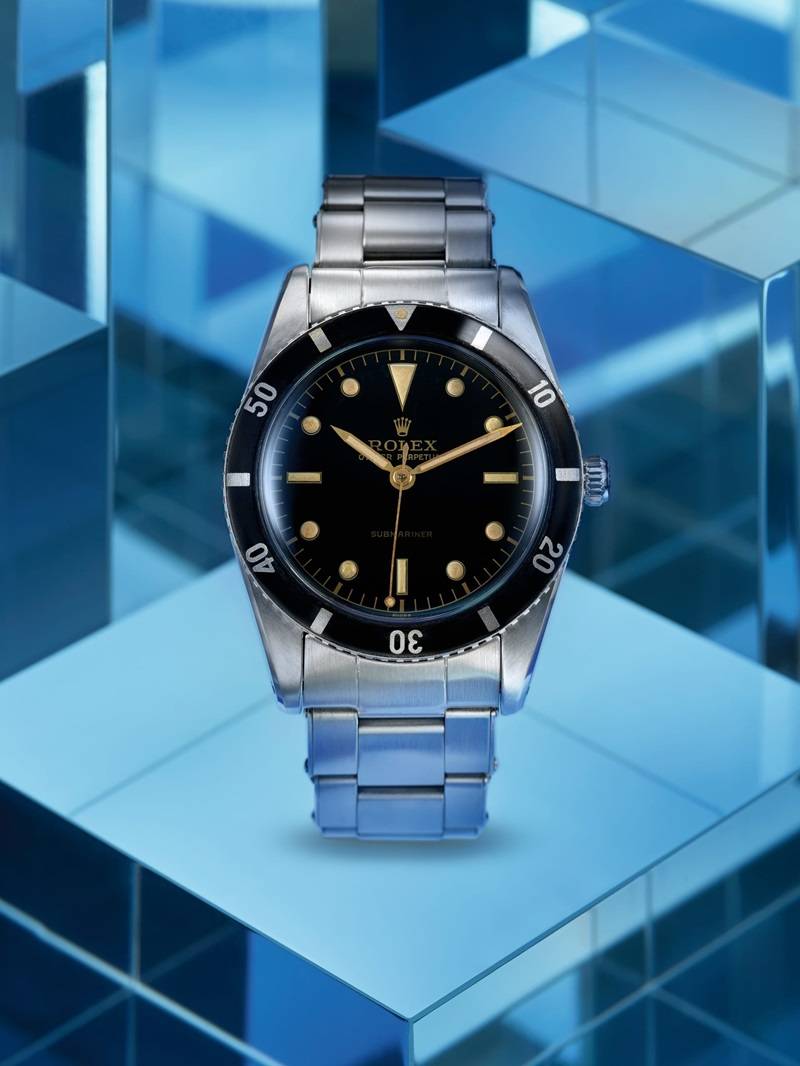
Rolex Submariner ref. 6204, 1953 (Source: Rolex official website)
Drawing inspiration from the style introduced by Blancpain, the original Submariner reworked it to carve out its own identity. It features a compact case water-resistant to 100 meters, a black dial with highly legible geometric indices, and a riveted stainless steel bracelet in the Oyster style, manufactured at the time by Gay Frères.
As early as 1953, Rolex was also working on a remarkable prototype watch, the Deep Sea Special N°1, fitted with a bubble-shaped crystal. Several iterations followed, including the famous Deep Sea Special N°3, which reached the floor of the Mariana Trench at 10,916 meters depth - a truly extraordinary achievement.
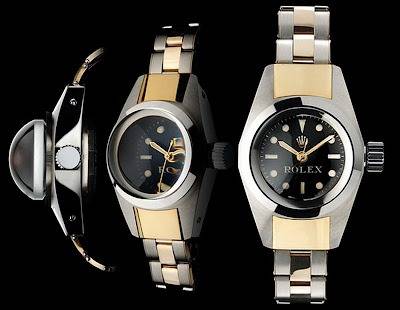
Rolex Deep Sea Special N°3 (Source: Monde et Montres)
That same year, a third player named Zodiac entered the market with the Sea Wolf, water-resistant to 200 meters, as its period advertising proudly proclaimed. With its bold style featuring triangular indices at 3, 6, 9, and 12 o'clock, wide luminescent hands, and a refined steel case, the Sea Wolf staked its claim as a genuine rival to Blancpain and Rolex.
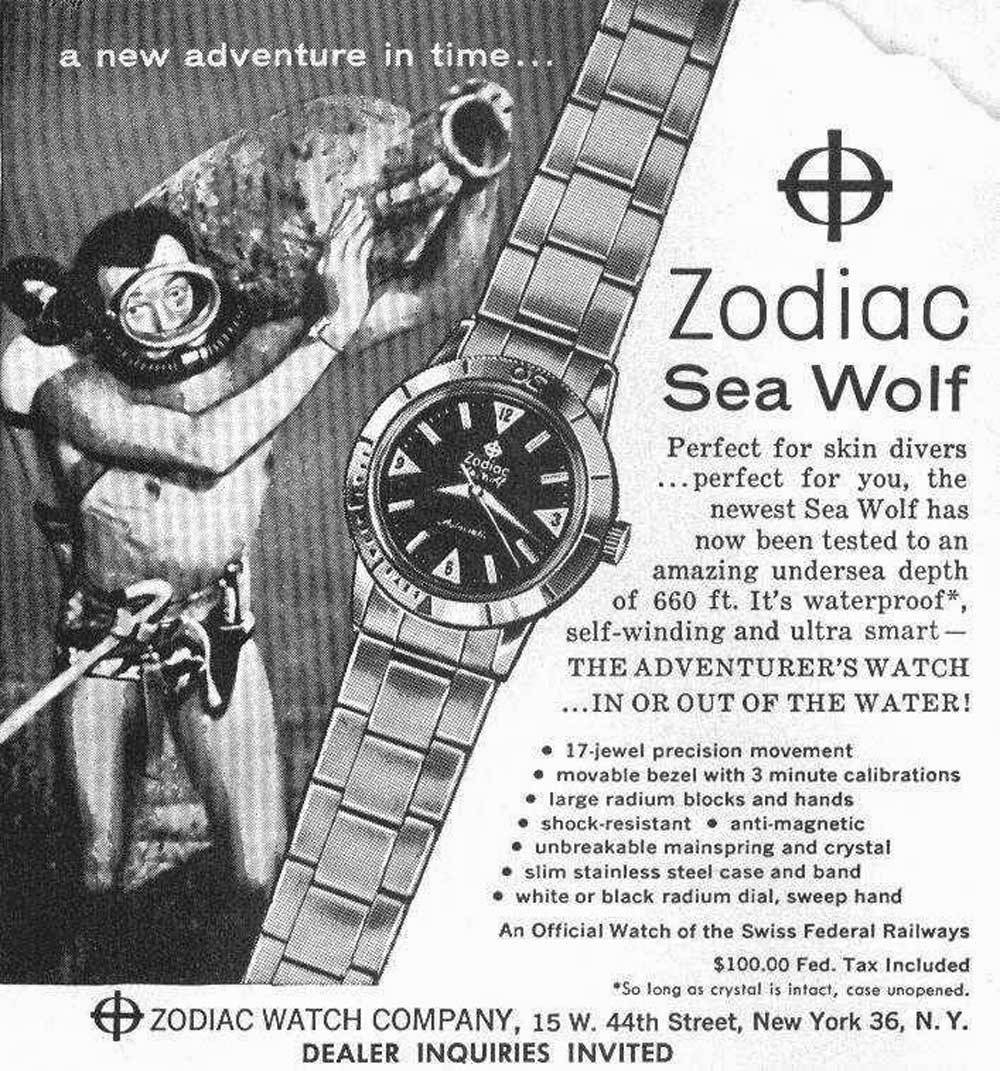
Vintage Zodiac Sea Wolf advertisement, circa 1953 (Source: Revolution Watch)
But Swiss brands weren't the only ones riding the dive watch wave. Several French manufacturers - starting with LIP, the iconic three-letter brand - also jumped into the adventure.
From the mid-1950s onward, so-called "Skindiver" watches began to appear - models designed for light diving and shallow depths. These pieces enjoyed genuine success throughout the 1960s, driven by brands such as Longines, Paul Lé Grandé, Electra, Vulcain, Wittnauer, and Lucerne, which flooded the market with watches of this style.
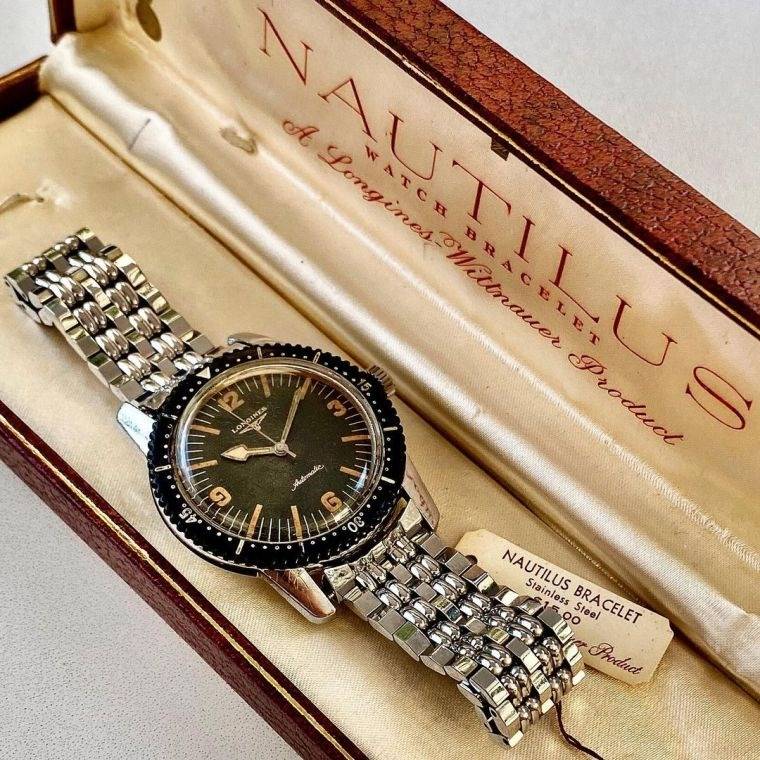
Vintage Longines Skindiver (Source: chronographes.net)
Skindiver watches stand out through their defining characteristics: a slim, compact case paired with wide luminescent indices and hands, along with a bidirectional rotating bezel (sometimes without clicks). But what truly sets them apart is their flat, refined profile - more elegant than that of a classic dive watch.
In 1967, LIP introduced the Nautic Ski, the first French watch water-resistant to 200 meters, showcased at the 1968 Grenoble Winter Olympics and featuring an additional innovation…
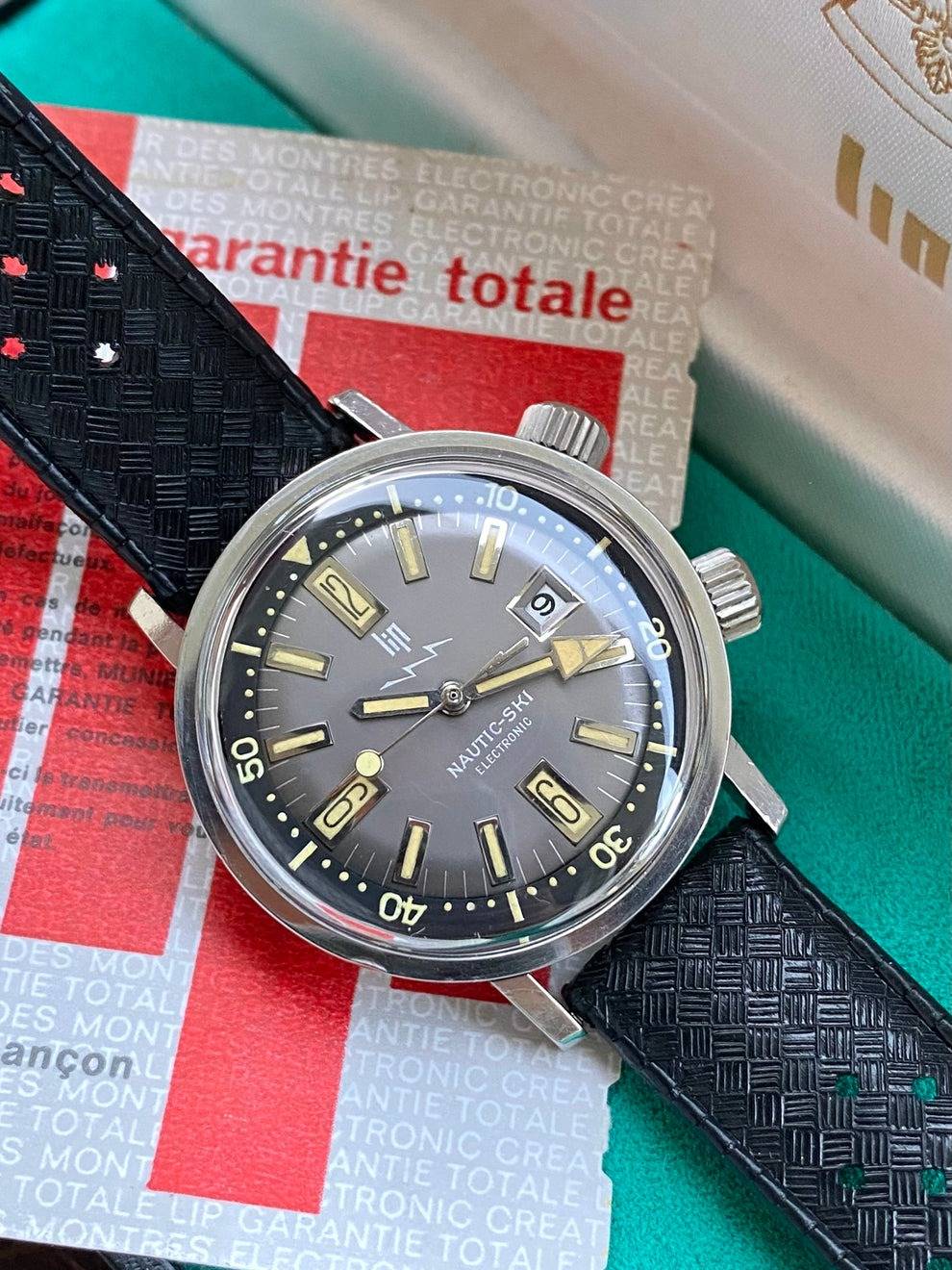
Lip Nautic Ski, 1968 (Source: L'Heure Des Montres)
Its Compressor case, manufactured in Switzerland by Ervin Piquerez S.A. (EPSA), housed a revolutionary electronic movement developed by Lip's engineers of the era: the caliber R184. A detail of the utmost importance, as it would earn the watch a place in the exclusive circle of electric watches.
The model quickly gained recognition among the general public, who came to know it as the watch worn by Commander Cousteau and navigator Éric Tabarly.

Éric Tabarly taking a sextant reading wearing a Lip Nautic-Ski (Source: bateaux.com)
But a rival brand would soon emerge with a model that set a new benchmark in the landscape of French watchmaking - that brand is Yema.
On 12/05/1967, the French manufacturer filed a patent to protect an ingenious invention allowing the rotating bezel of a dive watch to be locked in place. The goal? To prevent any accidental movement during underwater dives.
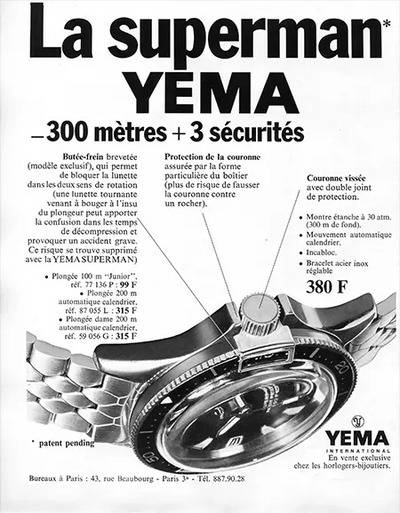
Vintage Yema Superman advertisement, circa 1968 (Source: Yema official website)
It was in 1968 that the Yema Superman was born - the first French dive watch water-resistant to 300 meters. Even more remarkably, it was the first diver's watch rated to 300 meters aimed at the general public. While its ETA 2452 automatic movement wasn't its most distinctive selling point, its celebrated bezel lock set it apart in a very real technical sense.
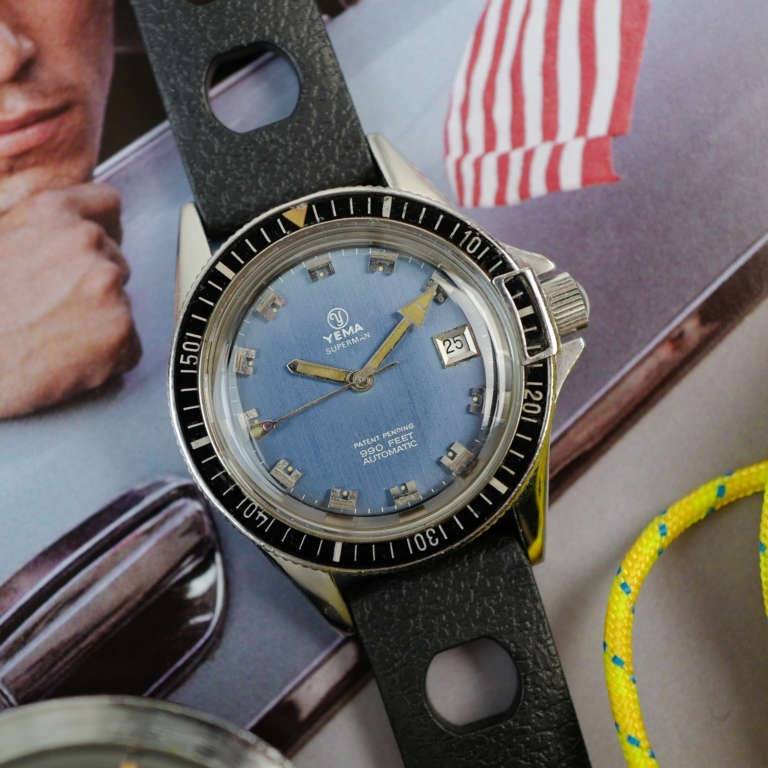
Yema Superman, circa 1970 (Source: Café Noir - Les Montres)
In the late 1960s, dive watches found a special place in the hearts of the French. The introduction of four weeks of paid vacation was a major social milestone: millions of people could now head to the seaside for their holidays. And with swimming and summer diving came the need for a suitable watch. Affordable divers and Skindiver models quickly became widely accessible.

People enjoying the Catalans beach in Marseille, 1970s (Source: Le Bonbon)
Let's go back to 1967 to highlight another pivotal milestone… That year saw the introduction of the Rolex Sea-Dweller Reference 1665, the first dive watch equipped with a helium escape valve. Discreetly positioned on the left side of the case, this innovation acts as a decompression valve. It allows pressure built up inside the watch during saturation dives to be safely released. Thanks to this mechanism, the Sea-Dweller 1665 achieves an impressive water resistance of 610 meters (2,000 feet).
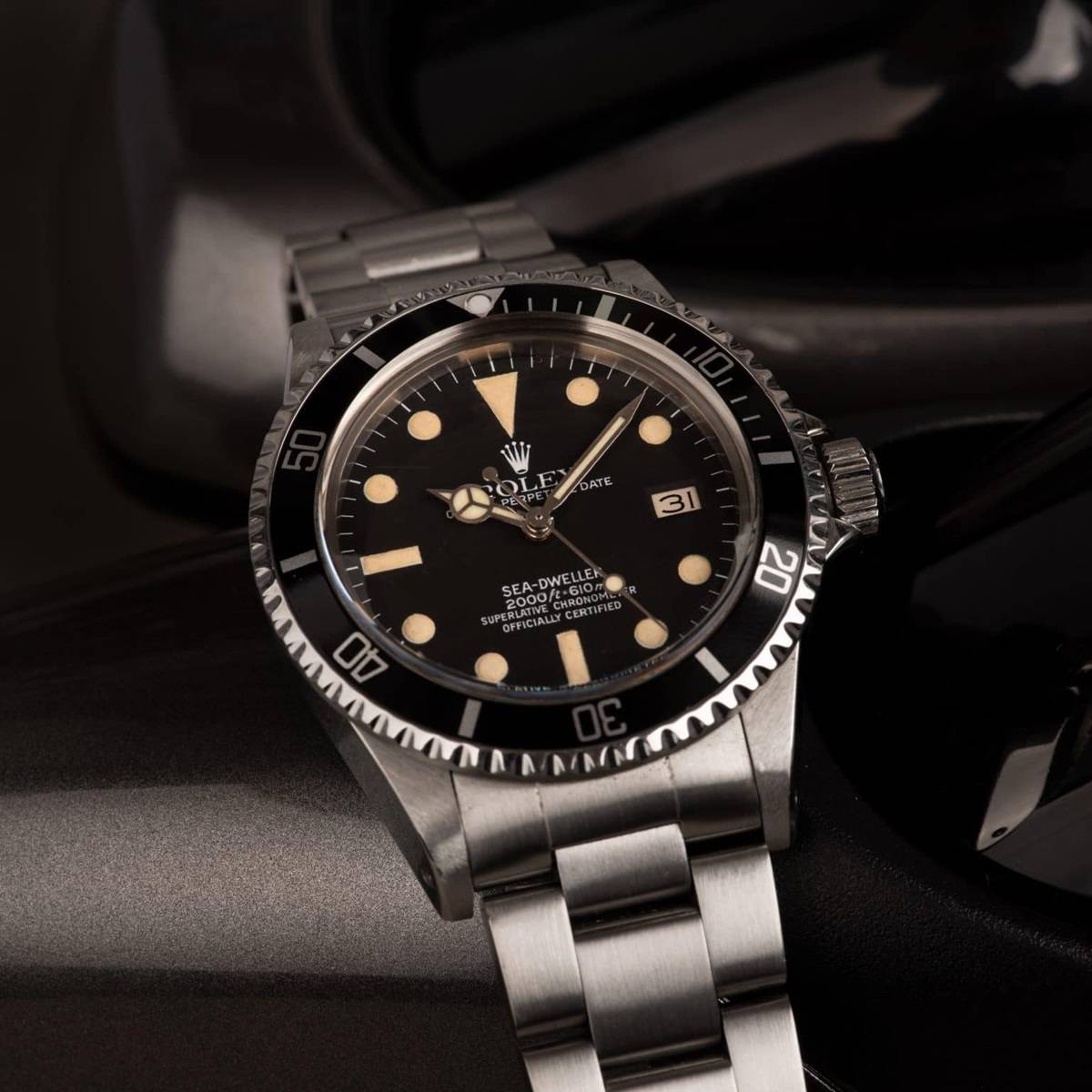
Rolex Sea-Dweller ref. 1665, 1978 (Source: Watches of Lancashire)
This model's performance was so exceptional that it remained in the catalog until 1983 - a continuous production run of 16 years. It was subsequently replaced by the Rolex Sea-Dweller 16600, water-resistant to 1,220 meters.
In the early 1970s, Rolex further cemented its reputation as a dive watch authority by partnering with COMEX (Compagnie Maritime d'Expertise). Founded in Marseille by Henri Germain Delauze, its mission was clear: to supply divers engaged in gas and oil extraction missions, as well as pipeline construction around the world, with instruments of absolute reliability. This partnership would prove instrumental in establishing the crown brand's technical prestige for years to come.

Henri Germain Delauze, founder of COMEX (Photo credit: Alexis Rosenfeld)
Over the years, watch brands continued to refine their models, pushing dive watches to ever higher levels of performance. While their aesthetics evolved relatively little - the design codes having long been established - their water resistance ratings steadily climbed.
In 2008, Rolex unveiled the Rolex Sea-Dweller Deepsea reference 116660, a watch engineered for extreme depths. A true deep-diving instrument, it boasts an impressive water resistance of 3,900 meters, or 12,800 feet. Reference 116660 would later be nicknamed "James Cameron" for a very specific reason…
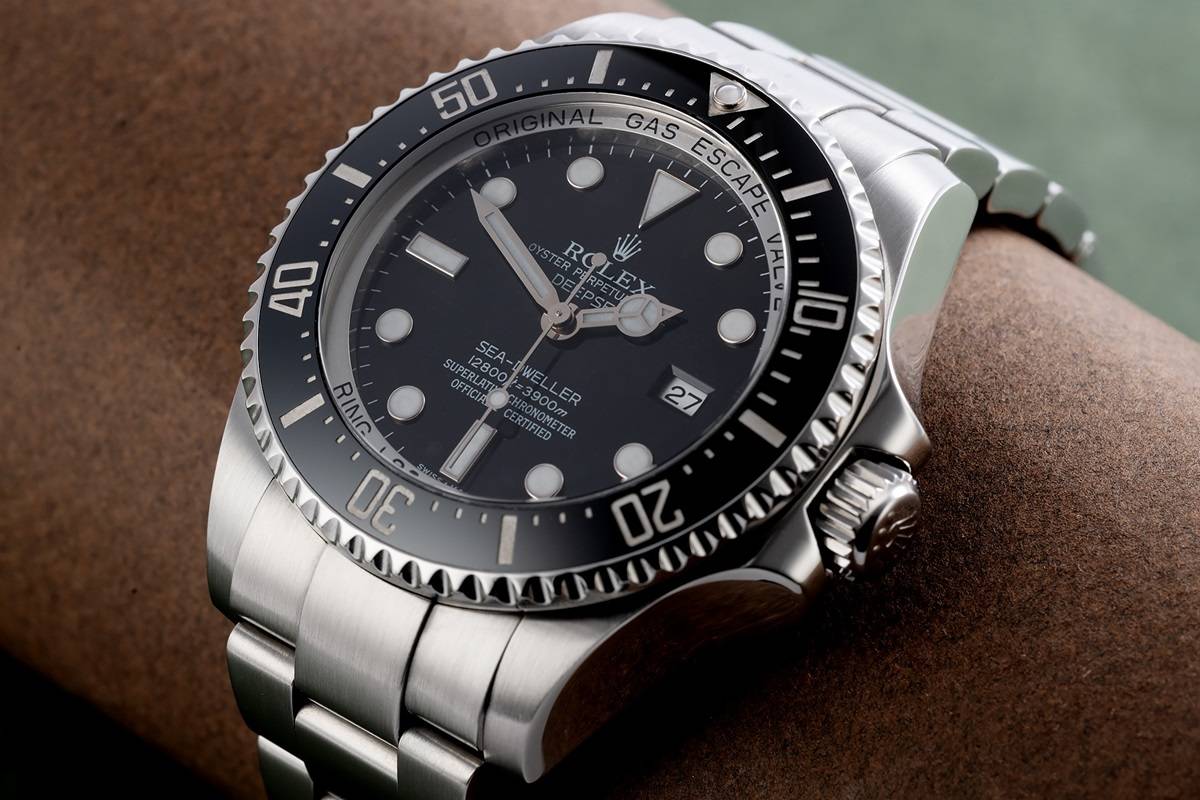
Rolex Deepsea Sea-Dweller ref. 116660, 2008 (Source: The Watch Club)
A master of watchmaking marketing, the crown brand chose to align itself with an extraordinary venture: the deepest solo dive ever attempted. Canadian filmmaker, screenwriter, and producer James Cameron boarded a 7.3-meter bathyscaphe named "Deepsea Challenger" with one goal in mind - to reach the deepest point in the ocean, at 10,900 meters. On 26/03/2012, he reached 10,898 meters and set a new world record.

James Cameron aboard the Deepsea Challenger (Source: AFP - National Geographic)
For this expedition, a specially developed Rolex Deepsea Challenge was attached to the submersible's articulated arm. It performed with remarkable precision throughout the entire descent and ascent. This exceptional feat would further reinforce the image of robustness and reliability associated with Rolex watches, among both the general public and professional divers alike.
This rich history - deeply tied to the great underwater exploits as well as recreational water sports - has given dive watches an enduring and well-earned reputation. For many enthusiasts, these tool watches (a term widely used even by French speakers) embody the ideal everyday timepiece: practical, functional, and sporty without going overboard.
Now that you know the history of these models, it's time to examine exactly what makes them tick - in other words, what truly makes a dive watch a dive watch.
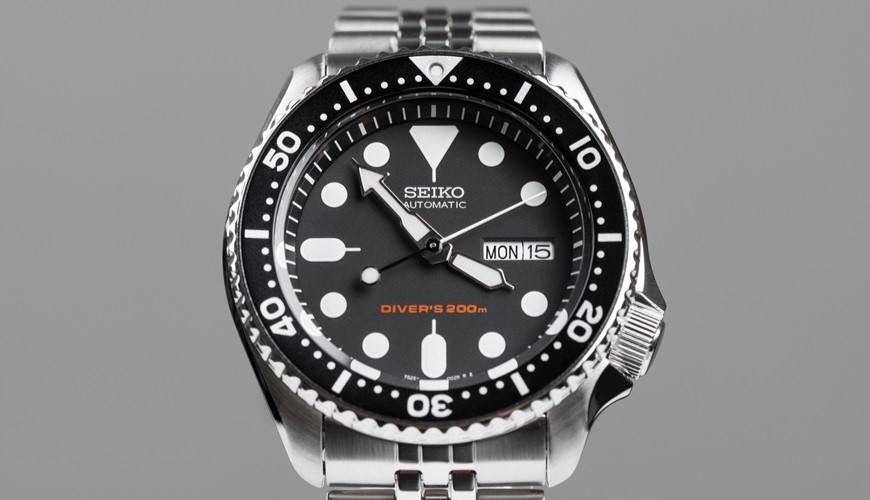
As we mentioned at the start of this watchmaking guide, a dive watch is first and foremost a tool. And by definition, a tool is designed to accomplish a specific task. As such, it must meet strict technical requirements (some of which are officially defined by ISO standard 6425):
On a dive watch, the bezel is typically knurled to ensure a secure grip, even with gloves on. It is complemented by a graduated bezel insert, most commonly spanning 60 minutes, used to measure elapsed time. Traditionally made of aluminum, this insert can be found in bakelite on certain vintage models, or in ceramic on contemporary versions. Ceramic offers a key advantage: it is highly scratch-resistant and retains its appearance over time.
In most cases, the bezel sits directly on the case, surrounding the crystal. But it can also be positioned beneath the crystal, around the dial. In this configuration, it is generally bidirectional and is adjusted via a dedicated crown on the side of the case. This design is inherited from the so-called "compressor" dive watches of the previous century, such as the Lip Nautic Ski, recognizable by its two crowns. Regardless of the configuration, however, the operating principle remains exactly the same.
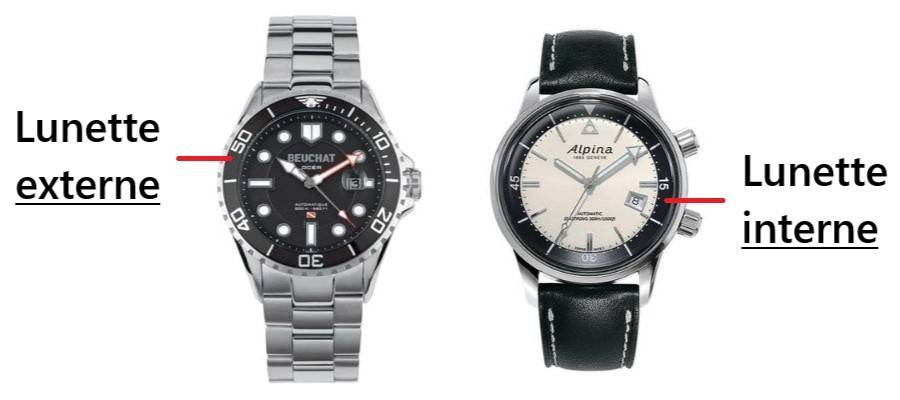
Dive Watches with External Bezel vs. Internal Bezel
In practice, the bezel is used to measure elapsed time from the start of a dive. Before submerging, align the triangle on the bezel insert with the minute hand. This marker then serves as the starting point. As the minute hand advances, the graduation indicates how many minutes have passed, allowing you to know when to ascend based on your remaining oxygen supply. It's a simple, immediately readable safety device.
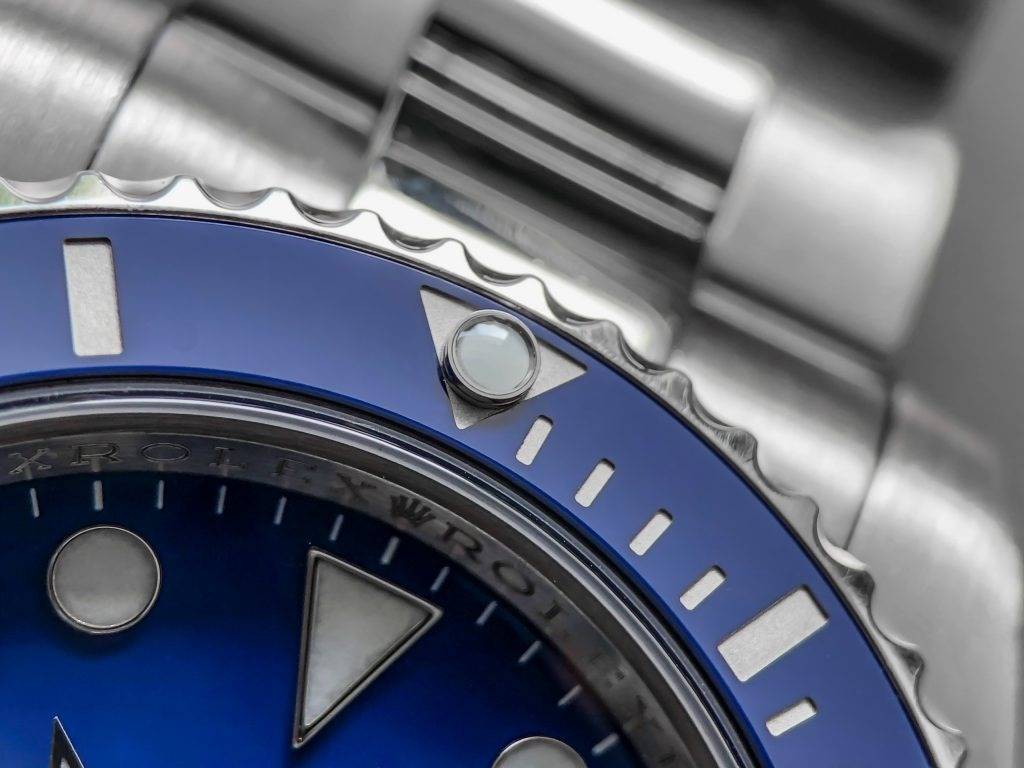
Luminescent triangle dot on a dive watch bezel (Source: atelier DE GRIF)
On models where the bezel sits directly on the case, it is unidirectional and rotates counterclockwise only. This is a built-in safety feature: if the bezel is accidentally moved during a dive, it can only indicate a shorter remaining time - never a longer one.
To make this concrete, let's walk through an example. You dive at 11:15 with a tank offering 20 minutes of air. You align the bezel's luminous triangle with the minute marker at 15 minutes. The watch then indicates a surfacing time of 11:35. If the bezel accidentally shifts by 5 minutes, it will now indicate a surfacing time of 11:30. You'll surface earlier than planned - but never too late. The very design of the bezel ensures that any accidental movement can only shorten the indicated time, never extend it.
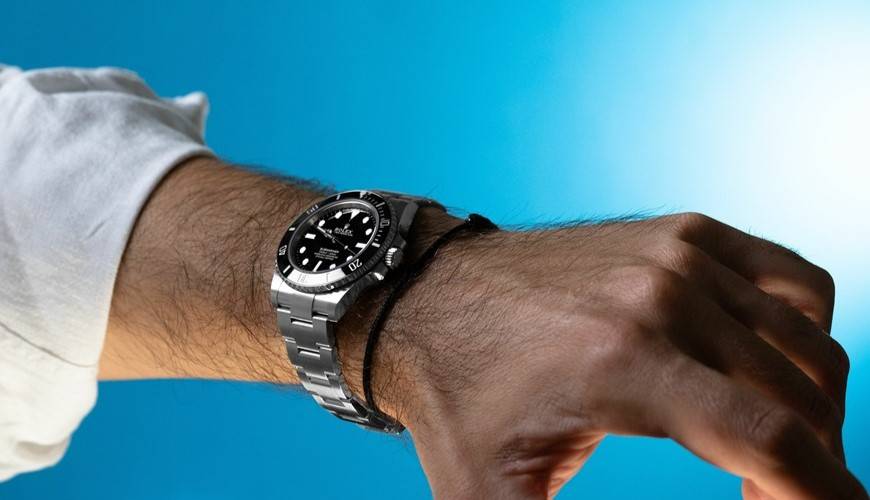
Now that we know dive watches are rugged, reliable, and backed by a fascinating history, it's worth asking what they actually bring to a watch collection.
As you've probably gathered, these timepieces are among the most practical watches for everyday wear. Their rugged build means you can take them swimming, hiking, or on any outdoor adventure without a second thought. But diver's watches are far more than functional tools. Their versatile design lets certain models pair just as well with a sharp suit at the office as with casual weekend wear. That's precisely why wearing a dive watch every day has become completely natural.
Designed to accompany every adventure - even the most perilous ones - these watches seamlessly blend utility and elegance. And after all, isn't that exactly why James Bond so often wore one on his wrist?
Share :
Official European Union notice on your rights in the event of a product's lack of conformity.