
0
Product added
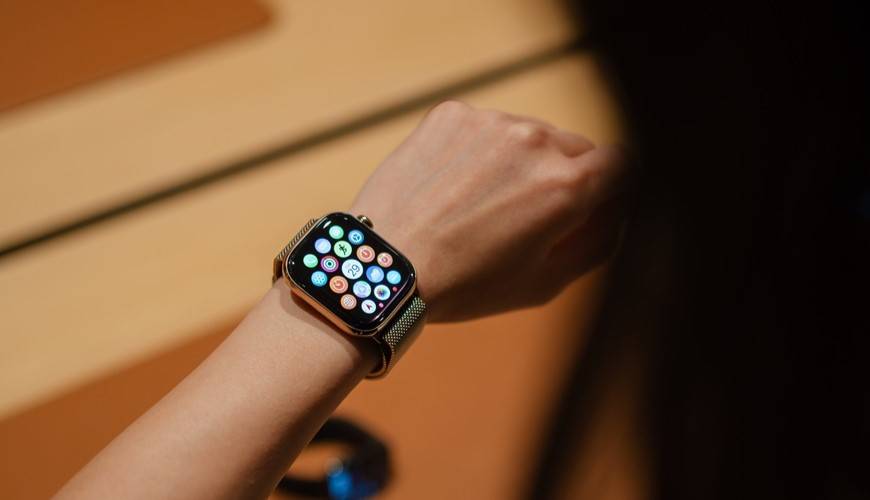
When color screens first appeared in the United States in the 1950s, on the earliest television sets, they felt almost like magic. Images stepped out of black and white and suddenly felt more vivid, more real, more alive. This visual breakthrough gradually made its way into countless fields - computing, mobile phones, and eventually watchmaking.
But don't be fooled into thinking color screen watches are a recent invention. They actually grew out of technical experiments that are relatively old - and largely overlooked. This 100% free watch guide tells you everything you need to know about color-display timepieces.
A color screen is a display device capable of rendering multiple colors simultaneously - not simply alternating between light and dark. Unlike the monochrome screens found on digital watches, which are limited to a single hue (typically black on a gray or light background), a color screen can display images, icons, or information zones differentiated by color. This capability relies on the combination of multiple elementary light-emitting points, commonly called "pixels," whose blending produces a broad color palette.
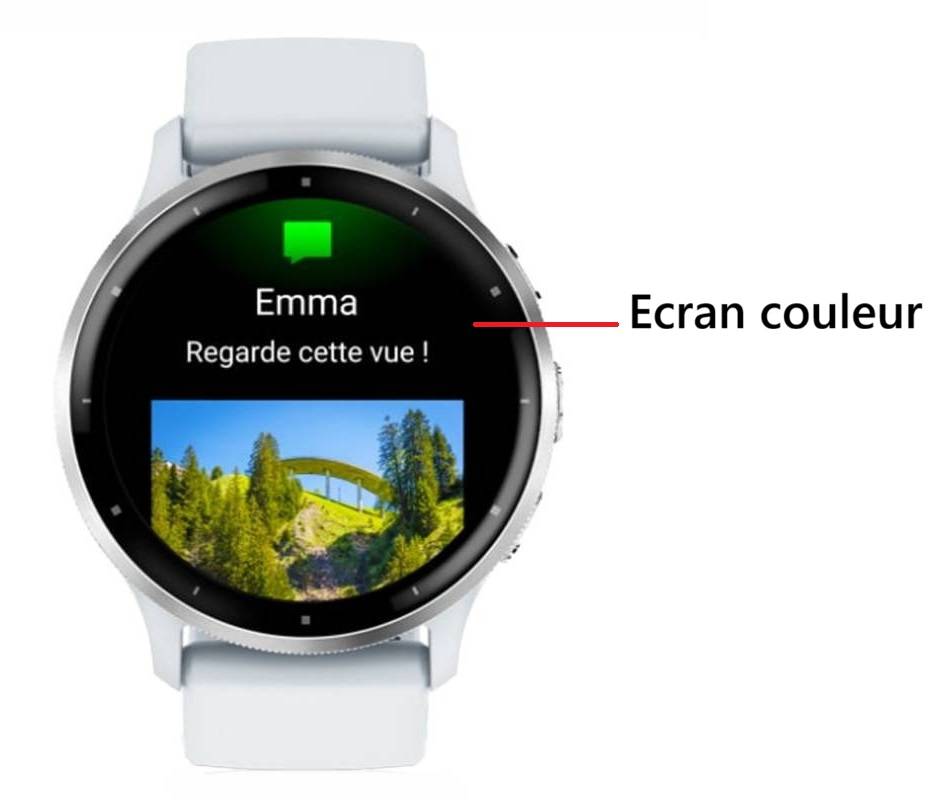
Garmin watch with color screen
In a watchmaking context, the color screen acts as the dial - and it's far more than a visual effect. Above all, it helps organize information in a more readable and intuitive way. Color is used to distinguish functions, prioritize data, or draw attention to a specific element, where a monochrome display would require a more linear read. The time, secondary features, and menus can all coexist on the same screen without getting in each other's way - a real plus!
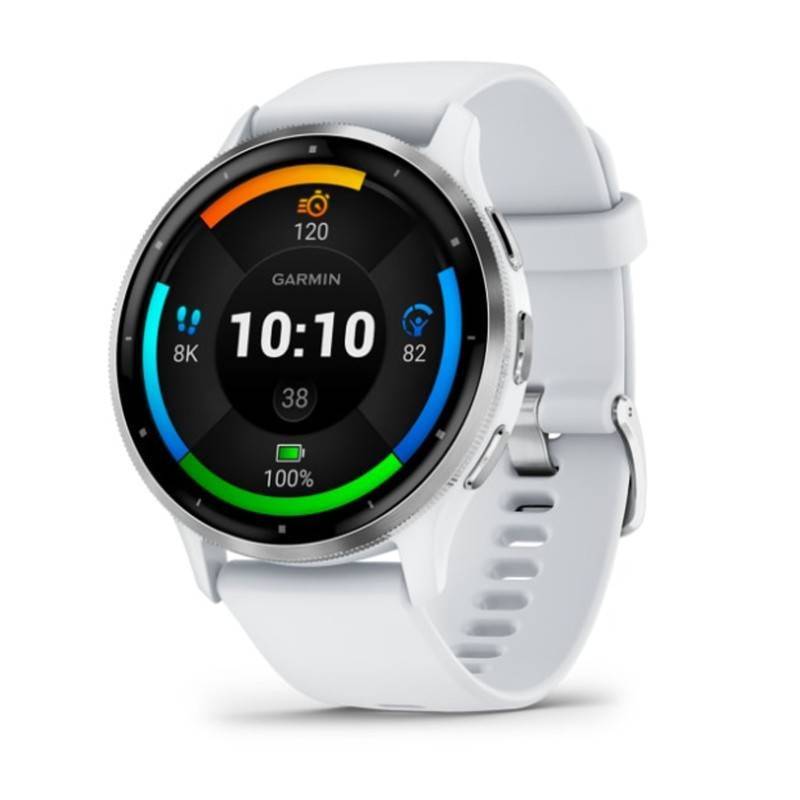
Garmin watch sorting different types of information through the use of colors
The type of screen can also vary from one model to the next. Some watches use a standard or transflective LCD screen to conserve energy and ensure good readability in sunlight, while others feature an OLED or AMOLED screen offering vivid colors and high contrast. Newer options such as MicroLED or Memory LCD combine durability, low energy consumption, and optimal readability.
That said, be careful not to confuse a true color screen with a simply tinted display. Older digital watches (including ana-digi watches) used colored backgrounds or multi-colored backlights without actually offering a true color display. A color screen in the strict sense of the term is capable of displaying multiple colors independently and simultaneously.
As we'll see, this is precisely why color screens appeared relatively late in watchmaking. They require more advanced technological mastery, as well as use cases that justify this visual richness. But this display technology has plenty going for it!
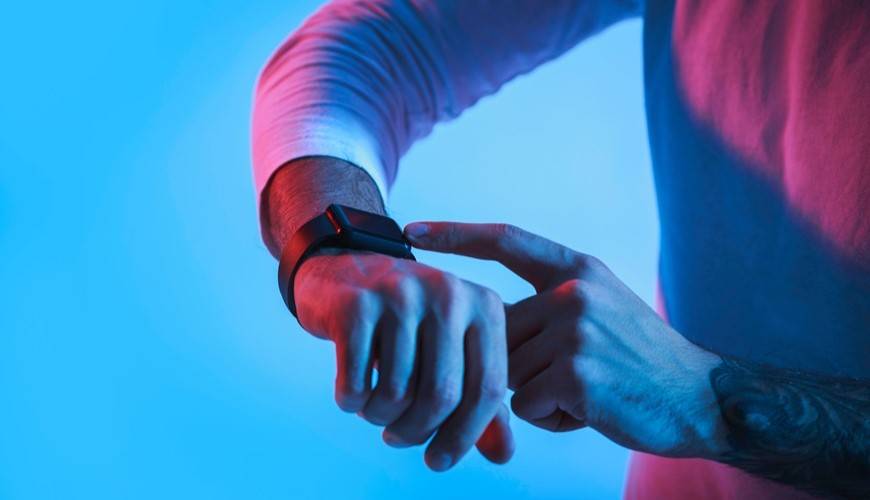
With their display reminiscent of our smartphones, color screen watches are packed with advantages:
As we've already covered in our guide to digital watches, timepieces equipped with a screen are nothing new. For many decades, however, these watches relied exclusively on so-called monochrome screens.
Some models did display a slight yellow, green, or brown background tint, but the information remained limited to a single display color. Digits almost always appeared in red or black, making the LCD screens found on digital watches sold in the 1970s, 1980s, and 1990s strictly single-color displays.
Even the most forward-thinking models of the era weren't immune to these technological constraints. In 1982, for example, Seiko turned heads by unveiling a remarkable television watch capable of displaying a TV program right on the wrist. Despite its distinctly futuristic and spectacular character, this watch was also equipped with only a monochrome screen - proof that color had yet to find its place in the world of digital watchmaking.
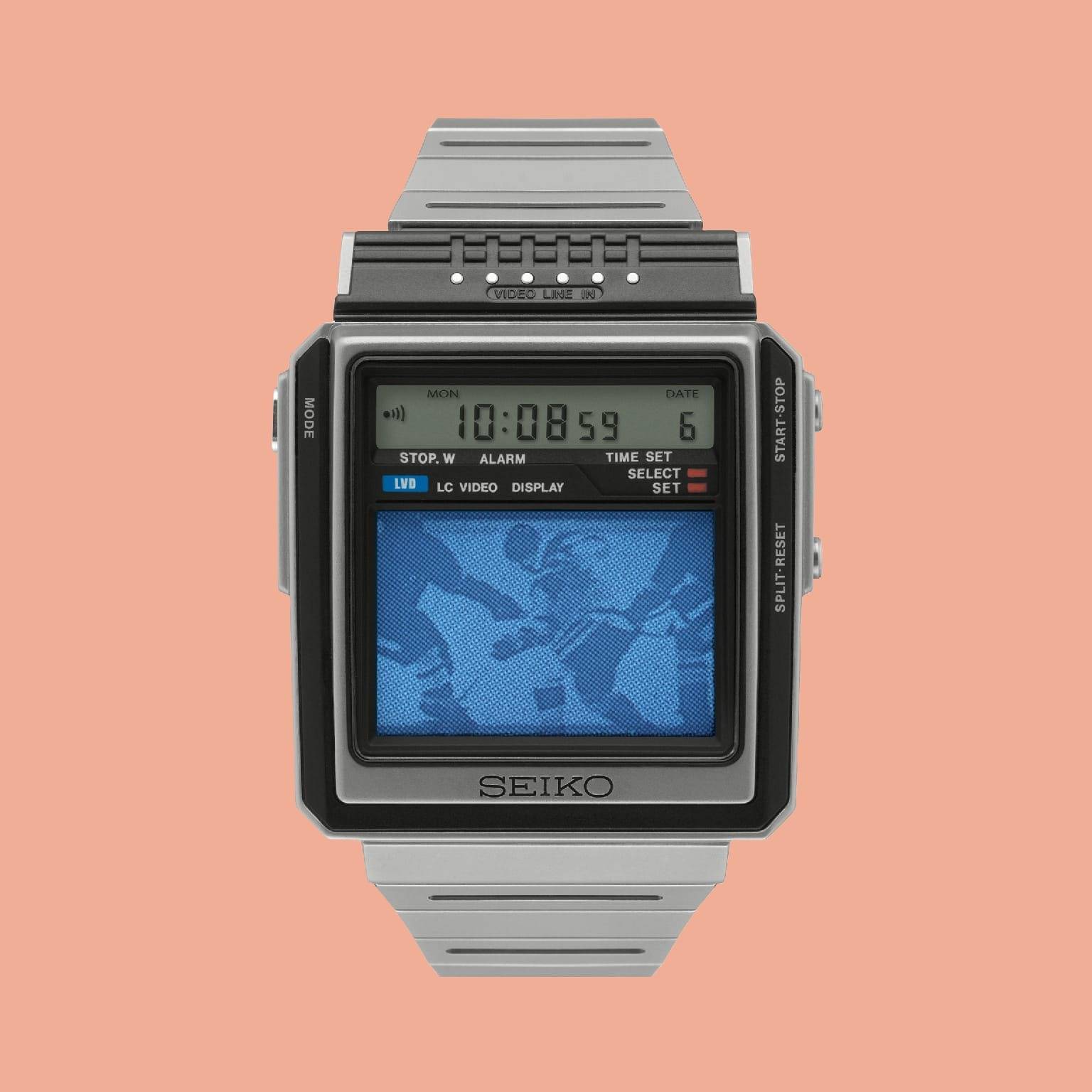
Seiko television watch, 1982 (Source: Seiko Design Center)
A few more years - and significant advances in miniaturization - were still needed before this would change. To fully understand this transition, it's worth taking a detour through the world of mobile phones. The emergence of color screen watches is, in fact, closely tied to the technological breakthroughs achieved in mobile phone displays, whose innovations had a major influence on the development of watch screens.
In 1983, the world's first mobile phone was released: the Motorola DynaTAC 8000X. "Portable" is a generous term, though - it was actually a behemoth weighing over a kilogram, had no screen, and could only hold a conversation for 25 minutes.

Motorola DynaTAC 8000X mobile phone, 1983 (Source: L'Eclaireur Fnac)
Over the years, mobile phones gradually shrank and began to integrate monochrome screens - most notably the iconic Nokia 3310, released at the end of 2000, whose simple, rugged display defined a whole generation. But a real turning point came the very next year, in 2001, when Sony Ericsson unveiled the T68i. This model made history as the very first mobile phone equipped with a color screen - capable of displaying no fewer than 256 colors!
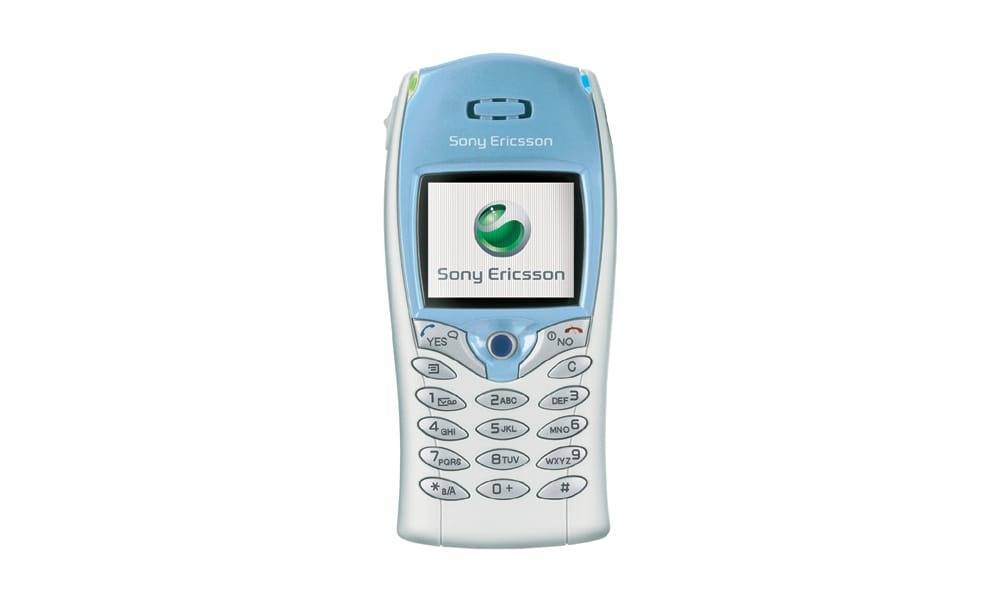
Sony Ericsson T68i mobile phone, 2001 (Source: Vintage Geek)
This is precisely when several technological breakthroughs emerged, initially reserved for the world of mobile phones:
These technological advances quickly had a ripple effect on the watchmaking world. Progress in display technology, miniaturization, and energy management opened up new possibilities for watch manufacturers. The idea of a wristwatch equipped with a true color screen was finally within reach. It was in this context that, in 2001, Casio made history by unveiling the very first wristwatch with a color screen: the WQV-10D.
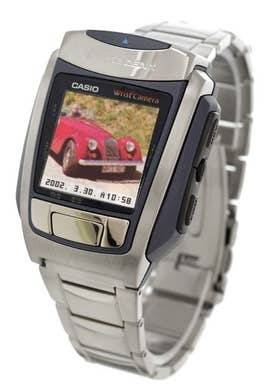
Casio WQV-10D watch, 2001 (Source: Watchuseek - @TimGodsil)
The screen built into this model measured 20 mm on each side and offered a relatively low resolution - but its ability to display 4,096 colors marked a historic turning point in watchmaking!
As if that weren't enough, this model also came equipped with a CMOS photo sensor of 25,377 pixels, enabling color photography. Once transferred to a computer, these images could be viewed in over 16 million colors - hence the "WristCamera" label visible in the upper right corner of the screen.
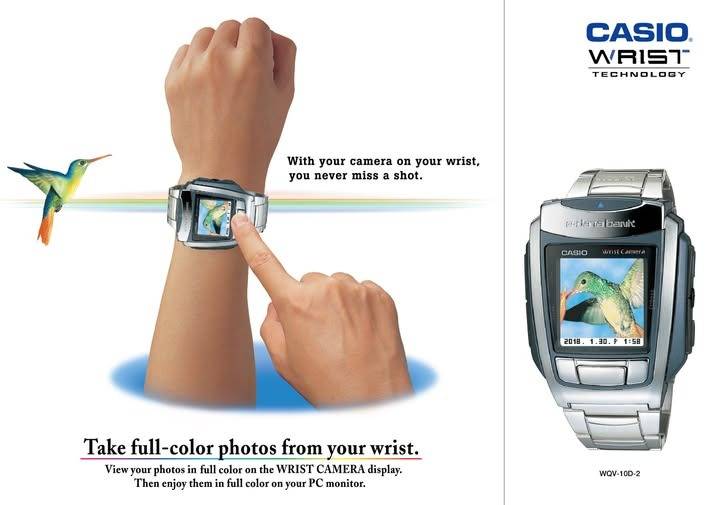
Casio WQV-10D-2 advertisement, circa 2001 (Source: Facebook - @Casio Watches Hong Kong - Javy's)
The Casio WQV-10 was an upgraded version of a model released shortly before: the Casio WQV-1. The two shared the same design and similar features, with the key difference being that the WQV-1 was equipped with a black-and-white screen.
In the early 2000s, Casio wasn't the only player exploring this market. Seiko and Citizen had also developed comparable models, but these were extremely low-profile pieces, sold exclusively in Japan. That's why these watches are often referred to as "JDM" (for "Japan Domestic Market"). Rather than targeting the general public, these models were more experimental in nature - which explains why so little information about them exists today.
In the fourth quarter of 2003, Samsung unveiled its "Watch Phone," a watch with a color screen capable of making calls. It featured a OLED screen of 94 × 64 pixels capable of displaying 256 colors.
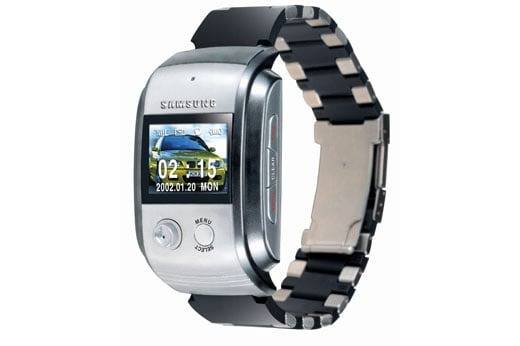
Samsung Watch Phone, 2003 (Source: ZDNET)
However, this project was ultimately abandoned and never came to fruition, depriving the public of what would have been the world's first color-screen phone watch. But it was only a matter of time - a few years later, the Korean brand would return with a more advanced model that would actually make it to market.
If you've already read our guide on smartwatches, you know that the first devices of this kind equipped with a color screen began to go mainstream around 2009. That year, LG with its GD910 and Samsung with its S9110 each launched their own take on the smartwatch.
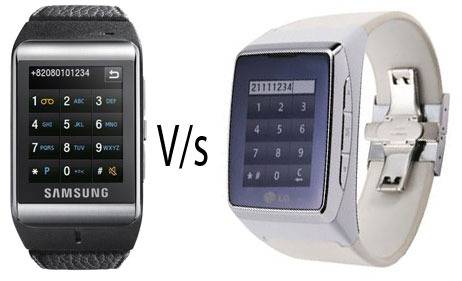
Samsung S9110 vs LG GD910, 2009 (Source: Sammy Hub)
These early models didn't really offer access to apps the way modern smartwatches do. They were limited to basic functions, such as making calls or sending text messages.
At the time, color screens were found almost exclusively in groundbreaking models like the Casio WQV-10 - true outliers in the watchmaking landscape. In fact, color screens would remain a rare exception in the world of watches for many years to come.
Today, the landscape has changed dramatically - and it's smartwatches that now drive this technology. The Apple Watch, launched in mid-2015, was a decisive turning point: it was the model that brought the modern smartwatch concept to the mainstream.
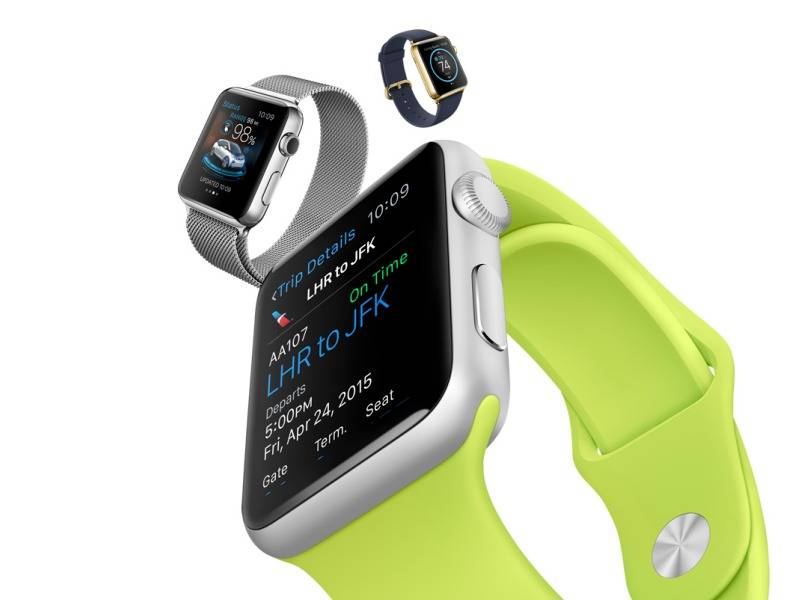
Apple Watch, 2015 (Source: Tom's Guide)
Before the Apple Watch, smartwatches were often seen as mere gadgets. Today, many brands have staked their claim in this market - including Google, Garmin, Lotus, and Festina. In recent years, some luxury houses have even offered their own take on the color screen smartwatch, with iconic models such as the Tag Heuer Connected, the Hublot Big Bang e, and the Montblanc Summit.
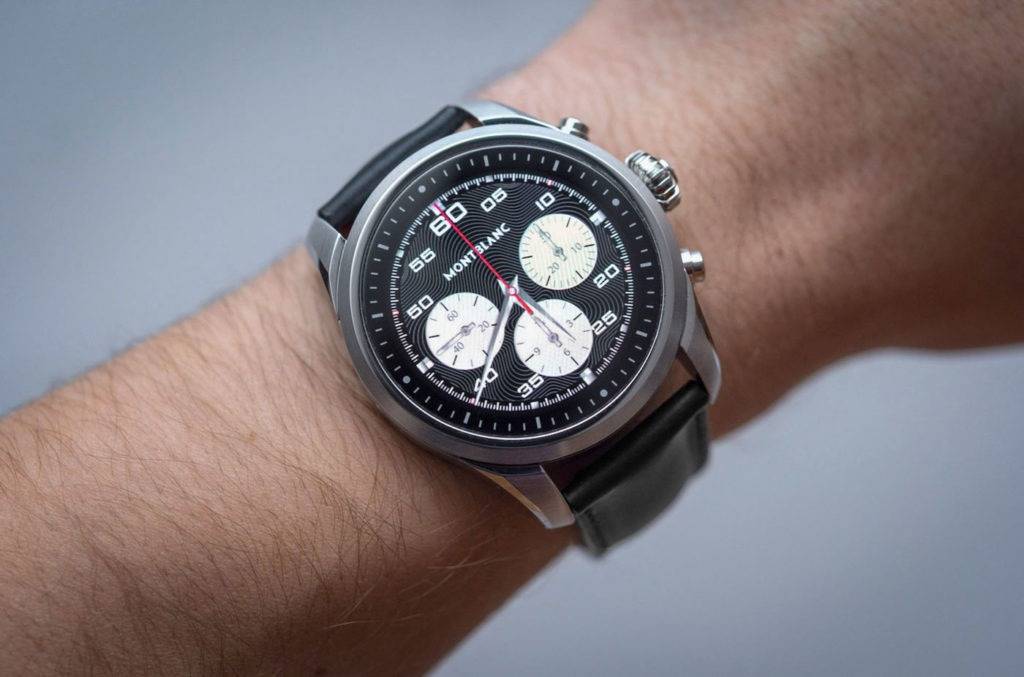
Montblanc Summit 2 watch (Source: aBlogtoWatch)
It's also worth noting that smartwatches generally fall into two broad categories:
These two categories serve very distinct markets. Apple, for example, focuses primarily on lifestyle-oriented models, while Garmin develops watches aimed first and foremost at athletes, with advanced features specifically tailored for sports use.
Beyond smartwatches, some alarm clocks and table or desk clocks (such as weather stations) can now also be equipped with a color screen. The variety of hues allows these models to clearly distinguish between different sections, making it easier to identify the information displayed on these often complex clocks.
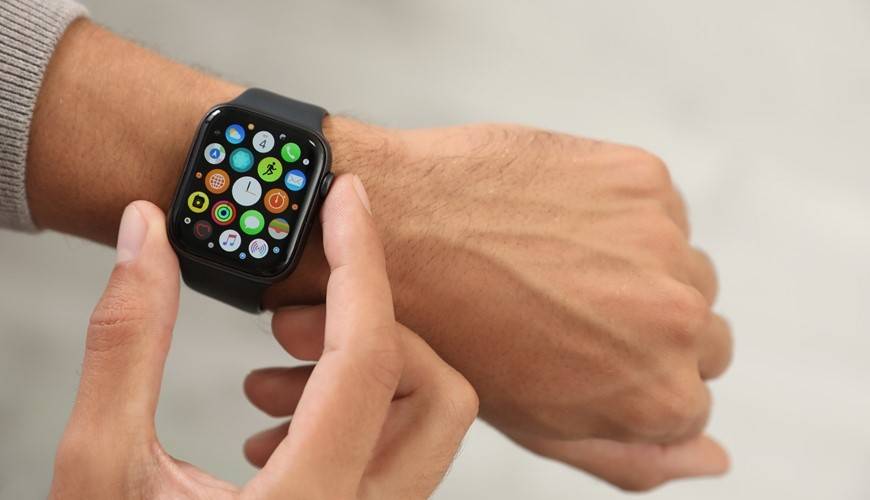
A color screen display works on a simple principle: presenting information through a multitude of tiny dots called "pixels." Each pixel can produce different colors, typically by combining three primary colors: red, green, and blue. By varying the intensity of each component, the screen can reproduce a wide range of colors and render images, digits, or icons.
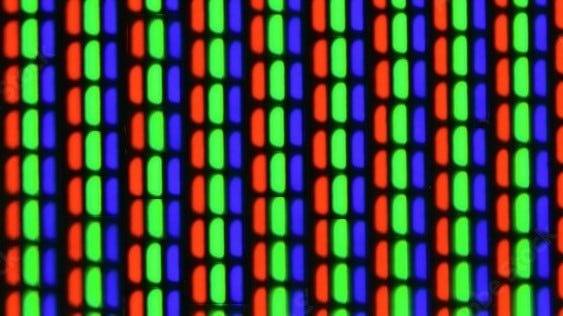
Close-up of screen pixels (Source: Medium)
Depending on the technology used, pixels don't all work the same way. In the case of LCD screens, pixels don't produce light themselves - they act as filters, allowing more or less light through from a backlight behind the screen. It's the combination of that light and the color filters that creates the colors you see on screen. Some LCD screens, known as "transflective," also make use of ambient light, improving outdoor readability while keeping energy consumption in check.
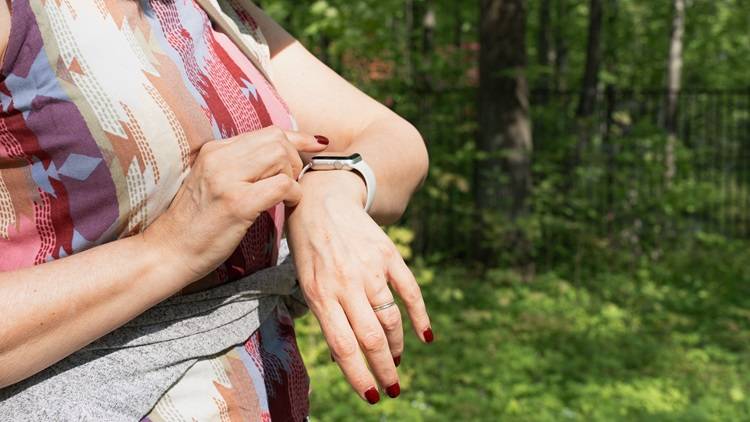
Smartwatch with color screen used outdoors
OLED and AMOLED screens work differently! Here, each pixel is self-luminous - it emits its own light directly when activated. This technology delivers very high contrast, more vivid colors, and deep blacks, since a pixel that's off produces no light at all. It's especially well suited to modern graphical interfaces, though it can be more demanding in terms of energy management.
Regardless of the screen type, everything is driven by an internal electronic circuit. It interprets the watch's data (time, information, menus) and determines which pixels should light up, in what color, and at what intensity. The screen becomes a visual interface, translating digital data into readable, instantly understandable information on the wrist.
Now that you know the advantages, the history, and how color screen watches work, why not go a little further and explore our other watchmaking guides dedicated to watch displays?
From Citizen to Tissot, dive into the history of ana-digi watches with this watchmaking guide and discover their unique definition and workings!
Share :
Official European Union notice on your rights in the event of a product's lack of conformity.