
0
Product added



| Reference Ocarat | #45816 |
| Brand | Daqi Concept |
| Product Type | wall clock |
| Gender | Men Women |
| Color | Black Brown Yellow |
| Material | Ceramic Steel Wood |
| Warranty | 2 Years |
| Labels and Certificates | Authorized Retailer |
The Bird
This entirely design-driven decorative object draws its inspiration from a legendary creature: the Phoenix. Its name comes from the ancient Greek φοῖνιξ, which can be loosely translated as "crimson" or "fabulous bird". Some legends speak of multiple Phoenixes, while others agree that it is the sole representative of its near-divine species. Whatever the truth about its existence or numbers, the stories that recount it describe a bird of magnificent plumage, living for several centuries (typically 500 years) and rising from its ashes after death. The creature would sense its end approaching and prepare for it by building a nest of aromatic branches, spices, and incense in which to be reborn. It would then smolder for several days before a new Phoenix emerged from the warm ashes.
Beyond its immortality, some cultures saw the Phoenix as a being of such pure flame that it could read the hearts of men and detect those whose intentions were impure. Conversely, its song was said to restore courage to the pure of heart. Finally, it was "hunted" for many centuries by believers of various cultures - some convinced that drinking its blood granted immortality, while its tears were said to heal any wound or illness.
Symbolically, the Phoenix embodies immortality and resurrection, which is why Rome - ever reborn - was compared to this legendary creature. The beast even appeared on coins of the Late Empire as an emblem of eternal life.
This legend of the immortal bird can also be read as an allegory of resurrection and the survival of the soul, two themes that frequently surfaced at the dawn of Christianity in Rome. This theory of the soul resonates even more with another legend, according to which the new Phoenix born from its father's seed would collect the corpse, place it in a hollow myrrh trunk, and carry it to Heliopolis in Egypt, where it would lay it on the altar of the Temple of the Sun. It was then solemnly burned by priests in a ritual - hence the bird's association with the element of fire. It is likely from Egypt that the first legend originated. The inhabitants of Heliopolis (mentioned above) venerated the Benu: a bird resembling a heron, associated with the solar god Ra. In legend, the Benu was the first being to emerge from the primordial ocean, perching on the very first piece of land. Time itself began with its first cry. From that day on, the Benu also guides the dead into the afterlife to Osiris, another sun-related deity. It was the Greek historian Herodotus who brought the legend of the Benu from Heliopolis to the wider world under the name of Phoenix.
Revered as a blessing - especially in Chinese mythology, where it heralds important events - the Phoenix is seen as a curse in other cultures. In Islamic mythology, the anqa (the Persian Sīmorgh) is portrayed as an enormous and mysterious bird (likely a heron) created by God and originally endowed with all perfections, but who later became a malevolent being and was slain by proud warriors.
In Japan, it is the elemental spirit of fire.
The creature is described in such extraordinary terms that the French language sometimes uses the word "Phoenix" as an adjective to describe a person of exceptional qualities, considered unique of their kind. It can also be applied to describe the perfection of an object.
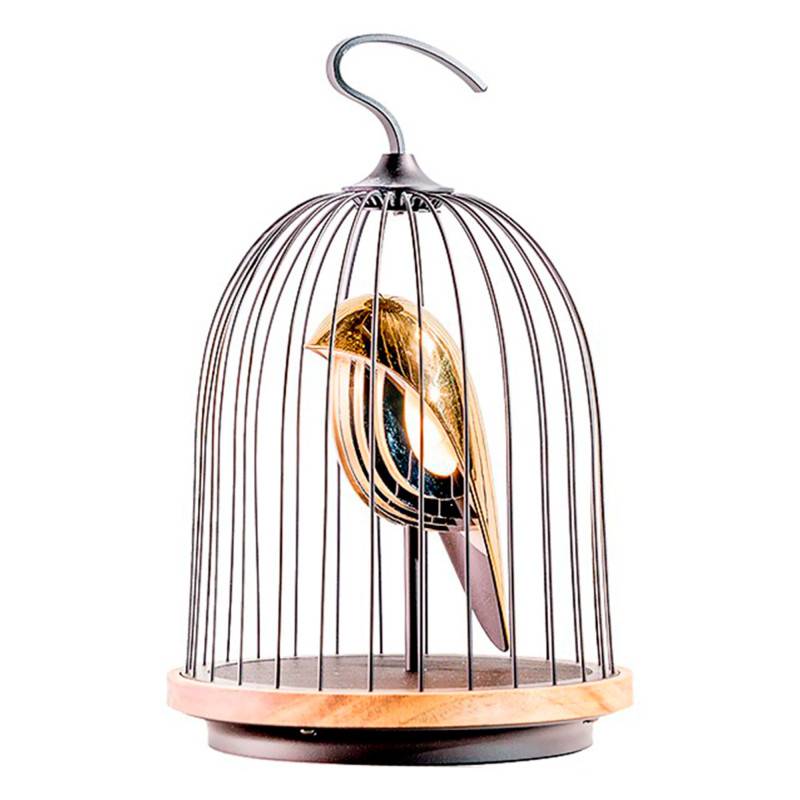
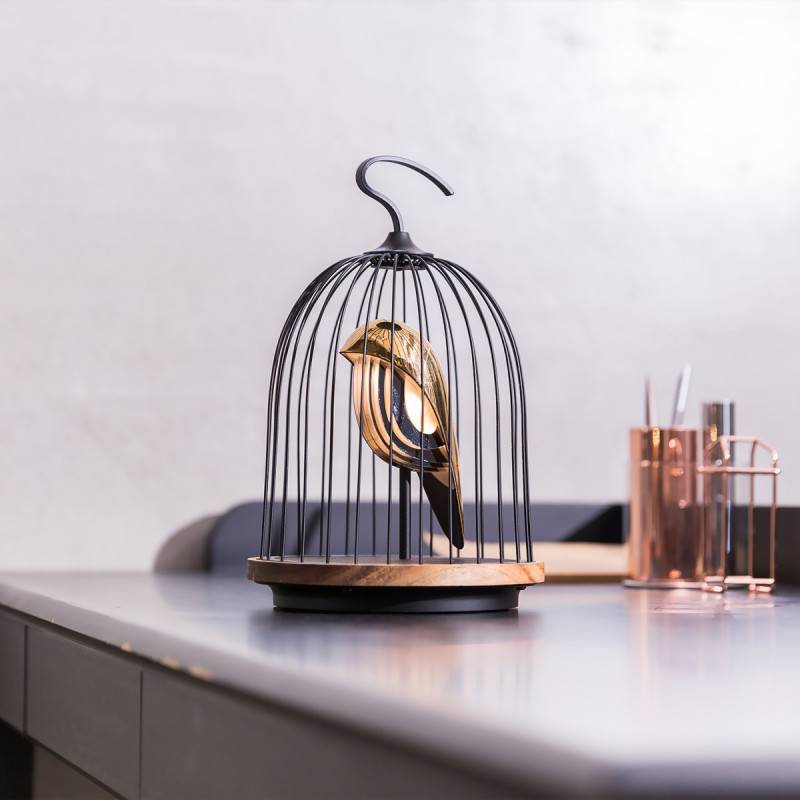
The Phoenix is represented here as a small domestic bird, but in golden hue. It is this color that gives the bird its name - mythology describes it as adorned with a blazing plumage (blue, red, and gold) with a strong connection to the sun, heat, and fire (especially in ancient Egypt and classical antiquity). That said, it is described as being of considerable size, resembling an eagle, whereas Daqi Concept gives it a form better suited to interior décor and design aesthetics.
Features
The Daqi Concept - Jingoo is the ultimate decorative accessory for your home. Easy to use, its music & alarm function is connected to an app (currently available on Apple only, with Android support in development).
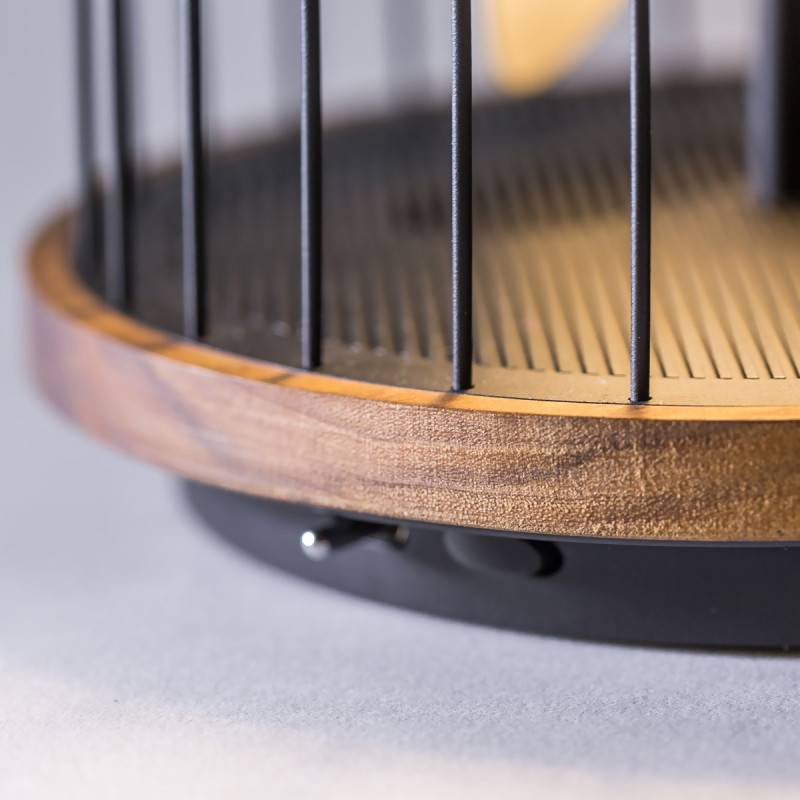
The Music: The Jingoo features two speakers designed to reproduce music as faithfully as possible. The bass is delivered by the speaker housed in the wooden base, with its sound waves reflected and amplified by the bird's ceramic tail. The highs are handled by the speaker placed inside the bird's body. Together, these two sound sources create a deep, immersive stereo effect. In its design, the Jingoo was engineered to optimize sound quality across all frequencies. The bird's shape allows frequencies to be blended at 1800Hz, effectively filtering out everything below the bass range or above the treble range. This eliminates any interference that might arise from the overlap and separation of bass and treble, allowing each to reach its full potential.
The Light: You'll notice that the Jingoo offers adjustable lighting - bright or dimmed, to suit whatever mood you're going for. Simply turn it on using the button on the base, then adjust the intensity with the dimmer switch located right next to it.
Technical Specifications:
Craftsmanship
With the design team based in Taiwan, it felt natural to source unique artisans and materials from the local market and culture for every component of the Jingoo. The Taiwanese city of Yingge is renowned as one of the cradles of ceramic craftsmanship and holds a significant place in the global ceramics market. Furthermore, as a subtropical island, Taiwan has been known for over a century for exporting high-quality wood. As a result, the base is made from a wooden disc sourced from the island, while the bird's body is crafted in ceramic from Yingge - shaped using precision molds and fired in traditional kilns by the city's master ceramicists. The patterns on certain Jingoo models are produced using a technique called "Ceramic Decal," which requires a complex, multi-step application process to ensure the designs adhere properly to the rounded surface of the bird's body.


Share :
Jingoo The Phoenix JG01-TP
(Ref. 45816)
Official European Union notice on your rights in the event of a product's lack of conformity.