
0
Product added
| Reference Ocarat | #20118 |
| Brand | Emanessence |
| Product Type | Cross Pendant |
| Gender | Child Men Women |
| Color | Yellow |
| Material | Yellow Gold |
| Material Quality | 750/1000 Gold (18K) |
| Warranty | 2 Years |
| Width (in mm) | 17,00 |
| Manufacturing | France |
| Metal Weight (g) | 0,95 |
| Height (in mm) | 17,00 |
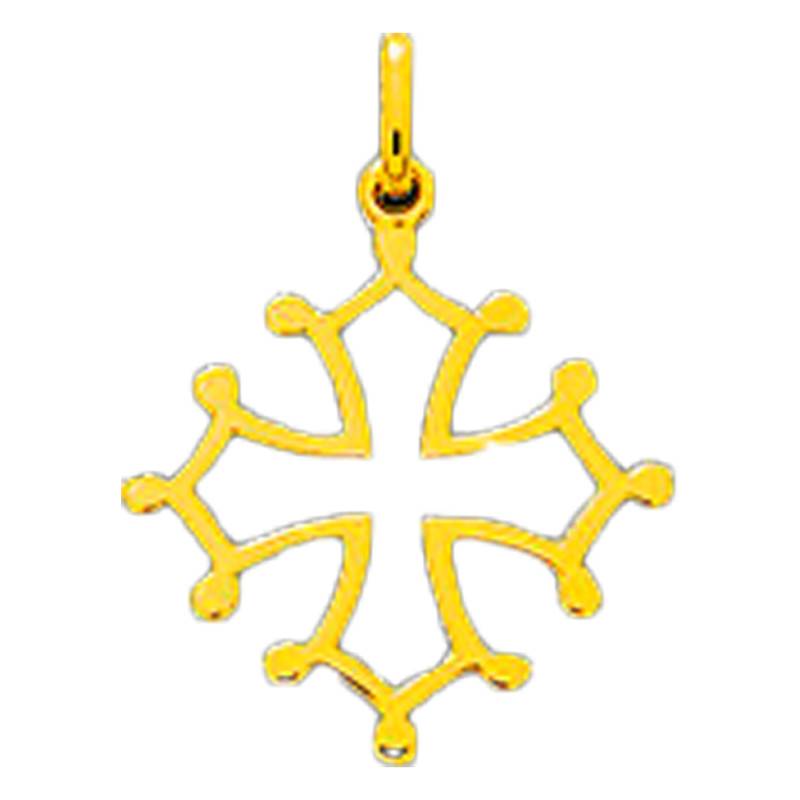
A 750/1000 (18K) yellow gold cross in the Occitan style.
We carefully selected this piece for its square wire construction - an unbeatable combination of quality, price, and size. The open-work design significantly reduces the weight while keeping the price highly attractive.
The Occitan cross (crotz occitana), also known as the Cross of Languedoc, is a type of cross that serves as the emblem of Occitania.
It is a four-armed cross with equal-length branches, bearing very little resemblance to the Latin cross, which symbolizes the crucifixion of Jesus and certain martyrs.
In heraldry, it is blazoned as a cross cléchée (branches shaped like the bit of a key), voided (the field is visible through the branches), and pommetée of twelve pieces (each point is topped with a "small ball" called a "pommette"). Its tincture is or (yellow) on a field of gules (red). As a symbol, interpretations abound: the twelve pommettes could represent the twelve apostles - themselves twelve in reference to the twelve tribes of Israel, which in turn may correspond to the twelve signs of the Zodiac, and so on.
Many historians today note that this cross first appeared in Provence - in Venasque in the 12th century according to Henri Rolland, in the circle of the Viscounts of Marseille as early as the 11th century according to Antoine de Rufi, and possibly with Guilhem I of Provence, known as Guilhem the Liberator, who defeated the Saracens at La Garde-Freinet in 972.
Dimensions: with bail 17x26 mm, without bail 17x17 mm.
Average gold weight: 0.95 grams.
PLEASE NOTE: As this product features open-work, engraving is not possible.


Share :
750/1000 Yellow Gold Open-Work Solid Wire Occitan Cross, 17 x 17 mm
(Ref. 20118)
Official European Union notice on your rights in the event of a product's lack of conformity.