
0
Product added
A highly energetic protective stone, spinel was long confused with certain precious gemstones - notably the ruby. Today, it is reclaiming its rightful place and winning hearts for its stunning color palette. Discover the fascinating history and full benefits of this remarkable fine stone right here.
Its name comes from the Latin "spinella," meaning "little thorn," referring to the pointed shape of its crystals. Another theory traces the name back to the Greek word "spinthes," meaning "spark."
Throughout history, red spinel has frequently been mistaken for ruby and labeled an impostor. Indeed, several famous "rubies" have turned out to be spinels. Notable examples include the famous Black Prince's Ruby set in the Crown of England, and the Timur Ruby, now belonging to Queen Elizabeth of England.
Spinel mining dates back to antiquity, when it was extracted from mines in Badakhshan, Afghanistan. Marco Polo (1254-1324) appears to reference it in his journal. The stone was first described in 1546 by scholar Georg Bauer (Georgius Agricola) and recognized as a gemstone in 1581.
In 1783, it was officially distinguished from ruby by French mineralogist Jean-Baptiste Romé de L'Isle, who gave it the name spinel. Since 2016, spinel has been the birthstone for August, alongside peridot. This stone also marks 22 years of wedding anniversary.
Widely used in jewelry, spinel forms in metamorphic rocks as well as in lunar rocks and meteorites. The main deposits are found in Afghanistan, Myanmar (Burma), India, Sri Lanka, Vietnam, Tajikistan, Pakistan, Madagascar, and Tanzania. It is also extracted more recently in Australia and Russia.
Spinel belongs to the aluminum-magnesium oxide family (MgAl2O4). Its crystal structure is cubic and its luster is vitreous. Spinel has a hardness of 7.5 to 8 on the Mohs scale and a density of 3.58 to 3.63. Some synthetic spinels are lab-created and appear in fashion jewelry.
Its color is determined by the presence of chrome, iron, and vanadium impurities. This gemstone naturally comes in a wide range of hues: red, blue, and black are the most well-known, but it can also be gray, violet, mauve, pink, orange, or brown. This variety of colors allows spinel to pair with all types of precious metals.
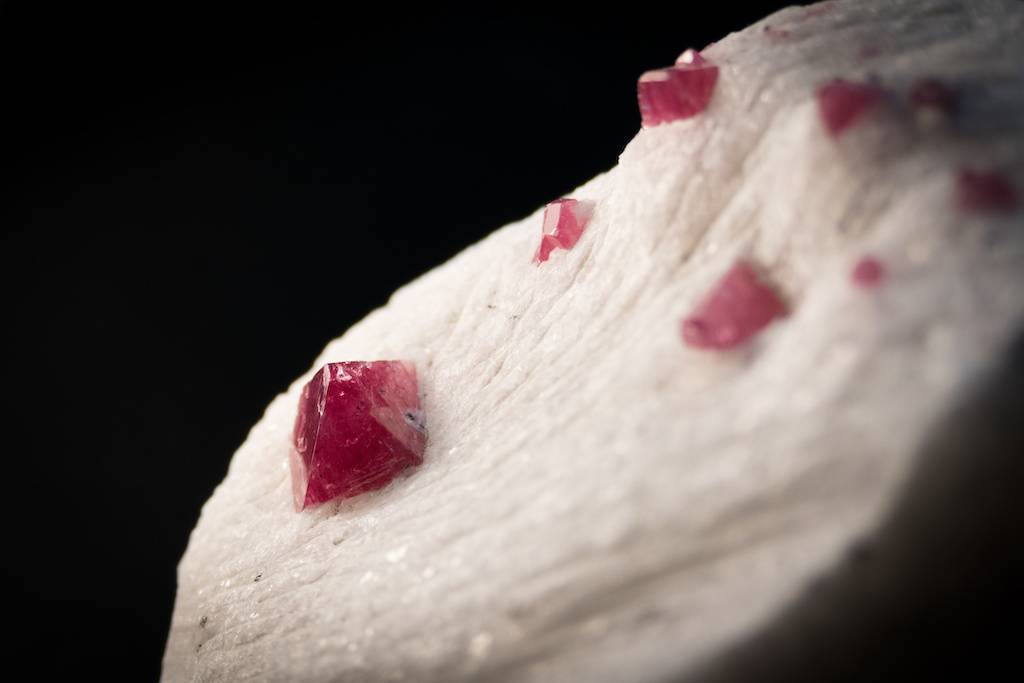
The benefits of this gemstone largely depend on the color of the spinel in question. In general, it is a protective stone, effective at releasing stress and anxiety. It boosts optimism and gives people the strength they need to overcome various obstacles. Spinel also helps break free from toxic relationships.
On a physical level, it boosts energy and revitalizes the body, making it a useful gemstone during periods of deep fatigue. It also soothes various types of inflammation and helps with joint, muscle, and bone issues. Spinel also has a highly stimulating effect on the metabolism.
Spinel is a hard stone with excellent scratch resistance. That said, watch out for intense heat and direct sun exposure, which can alter its color. Store your gemstone in a fabric pouch or a box, separate from other stones and jewelry.
A little water and dish soap or mild soap are all you need to clean it. Rinse well, then carefully dry the stone with a soft cloth to prevent limescale buildup.
The most prized spinels are those with a vivid, clear, and uniform color, along with excellent transparency. As a result, clear specimens with no inclusions visible to the naked eye command the highest value. That said, some of these gemstones can display interesting patterns that make them especially appealing - it all comes down to personal taste.
Red spinel is the most valuable, but sapphire-blue is also highly sought-after due to its extreme rarity. Be aware that synthetic spinels exist and are used to imitate other stones, such as aquamarine. Similarly, some yellow and green spinels are lab-created (as they are rare in nature), so extra vigilance is needed with these colors - always verify that you are buying a natural stone.
To ensure top quality across the board, Ocarat carefully selects leading brands and the finest pieces available. Browse our online store to find spinel jewelry that matches your exact criteria. Rings, necklaces, pendants, bracelets… explore Ocarat's full range of spinel jewelry and find the piece that's right for you.
Spinel's color depends on the presence of chrome, vanadium, and iron impurities. Depending on these elements, the stone's hue can vary considerably: blue, red, black, gray, violet, pink, mauve, orange, or brown. Identifying this type of stone and ensuring it is natural requires careful attention.
Thanks to its hardness, spinel offers excellent resistance to impacts and scratches. However, it remains sensitive to intense heat and direct sunlight. To keep your spinel-set jewelry in perfect condition, store your piece in a box separate from other jewelry. For cleaning, a little water and soap will restore your jewelry's full brilliance.
With its wide color palette, spinel can meet the needs of many customers. Choosing the right jewelry ultimately comes down to your personal taste and the hue you're looking for. Keep in mind that clear pieces with no inclusions visible to the naked eye are the most valuable.
To meet all your needs, Ocarat offers a wide range of spinel-set jewelry: earrings, necklaces, rings, bracelets… On our online store, every piece is guaranteed to meet the highest standards, thanks to our carefully curated selection of premium pieces.
Share :
Official European Union notice on your rights in the event of a product's lack of conformity.