
0
Product added
With its azure blue dotted with dark veins, turquoise is a highly sought-after stone, especially for ethnic jewelry. Its color makes it one of summer's favorites, evoking blue skies and the carefree spirit of vacation. It pairs beautifully with cool metals like white gold or silver, which best complement its blue hues. That said, turquoise-set gold jewelry in a bohemian ethnic style is becoming increasingly popular.
Regarding its etymology, the term "turquoise" means "Turkish stone" and comes from the eponymous country. When it was brought to Europe during the Crusades, it was believed to originate from Turkey, when in reality Turkey was merely a stopover and turquoises were actually mined in Persia.
Mined for thousands of years, this gemstone was particularly popular in ancient Egypt, Mesopotamia, China, and across North and South America. It was primarily used as a protective stone and as an ornament, appearing on numerous pieces of jewelry, masks, ritual objects, and adornments such as the turquoise ring.
Turquoise, which gave its name to the color, is a stone whose symbolism varies subtly across cultures around the world. It symbolizes wealth in Tibet, spiritual power among Muslims, regeneration in Egypt, and is considered a sacred stone and medium of exchange in the Americas. For most cultures, turquoise served as protection against evil spirits and as a good luck charm. It is also a gemstone symbolizing wisdom, luck, and happiness.
Finally, as the birthstone for December, turquoise also marks 18 years of wedding anniversary.
Today, turquoise remains a stone used in jewelry and fine jewelry, particularly in the creation of tribal and ethnic pieces. It is a gemstone most commonly seen in summer jewelry such as the men's turquoise ring. It can also be found on cufflinks and belt buckles. Finally, the world of decorative objects is no exception, offering a wide range of creations (statues, vases, boxes, etc.).
In terms of extraction, turquoise is found mainly in aluminous rocks located in arid and desert regions. The primary deposits are in Mexico and the United States, but the finest stones are mined in Iran. It is also found in Afghanistan, Israel, Brazil, China, Argentina, Australia, and Tanzania.
Turquoise is a semi-precious stone that is relatively fragile, with a hardness of 5 to 6 on the Mohs scale and a density of 2.6 to 2.9. Composed of aluminum phosphate and copper, it belongs to the aluminum phosphate group. It is a porous and brittle mineral with a triclinic crystal structure.
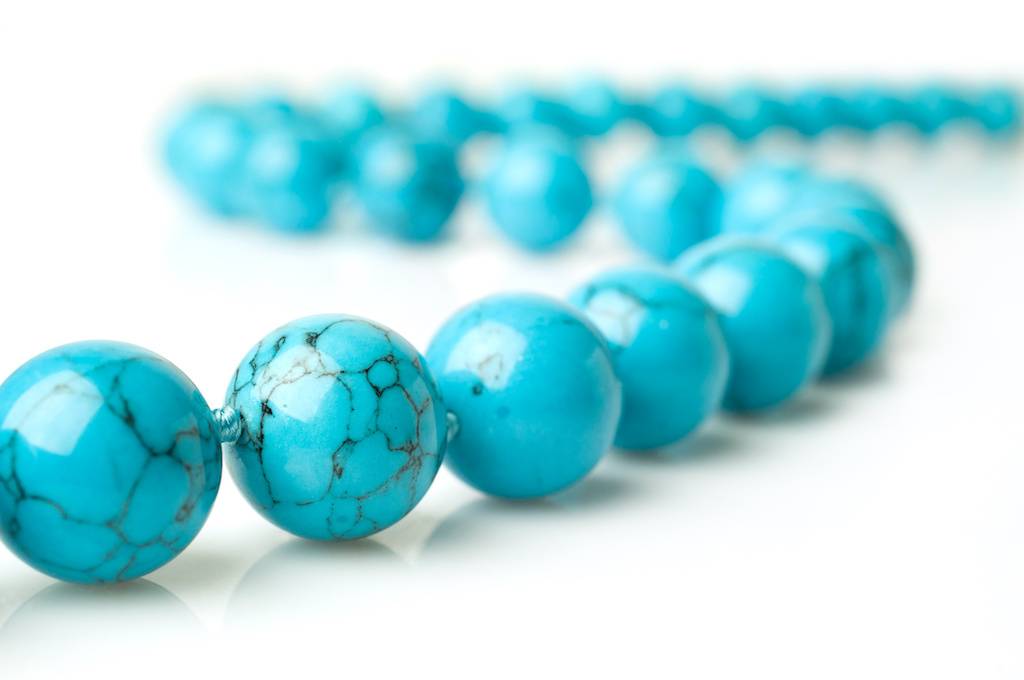
In terms of appearance, turquoise is an opaque gemstone with a waxy luster, displaying a wide range of shades from light blue to blue-green, and even apple green. This depends on the elements that compose it: copper intensifies the blue, while chromium and vanadium tend to enhance the green. Iron, for its part, produces shades of yellow and green. Additionally, this stone very often features veins of varying darkness (from beige to black or brown). Note that these veins are caused by the presence of other minerals that have settled into the grooves of the turquoise.
From a spiritual standpoint, turquoise is a stone that brings well-being and comfort, calming and rebalancing the mind. It transforms negative energy into positive energy and helps combat stress, anxiety, and nightmares. It builds self-confidence, encourages communication, and is believed to protect travelers - the turquoise bracelet is an easy jewelry piece to incorporate into everyday life.
From a physical standpoint, turquoise helps the body eliminate toxins and strengthens the immune system. It can help relieve respiratory issues, aid digestion, and soothe insect stings. It is a stone used to regulate the nervous system and ease migraines. It is also used to treat respiratory illnesses, viruses, and bacterial infections.
Turquoise is a delicate stone that does not hold up well under intense heat or strong light exposure. In fact, both of these factors can dull its color. You should also avoid contact with household products, cosmetics, perfumes, sweat, and oil. When you are not wearing your turquoise jewelry, it is recommended to store them safely in a fabric pouch or a box, away from other stones and jewelry.
To clean turquoise, simply soak it in warm soapy water, then rinse thoroughly to remove any residue. Finish by gently drying the stone with a soft cloth.
Whether you want to give a gift or simply treat yourself, Ocarat offers a vast selection of jewelry for men and women. Signet rings, necklaces, bracelets, and much more await you in our online jewelry store. Whatever your tastes and preferences, Ocarat ensures you will find the jewelry of your dreams.
When you shop at Ocarat, you also enjoy great perks like unbeatable prices and flexible payment options. Plus, you have up to 30 days to return any item that doesn't meet your expectations.
The distinctive color of turquoise, ranging from light blue to blue-green, sets it apart greatly from other gemstones and precious stones. However, caution is advised with gemstones that have undergone special treatment.
This delicate stone requires special care and, above all, protection from external damage - without it, your jewelry risks deteriorating quickly and losing its color. Furthermore, when not being worn, your turquoise-set jewelry should be kept away from light and stored separately from other jewelry and stones.
Azure blue and light blue are the most sought-after shades of turquoise, though the choice ultimately depends on personal taste. Note that it will also come down to the shape and color of the veins, which give the stone its distinctive character. You should also look for gemstones that have not undergone any treatment or enhancement.
Ocarat, the online jewelry store, offers you a wide selection of all kinds of turquoise-set jewelry. For each piece, Ocarat provides a detailed description to guide you through your purchase and give you all the information you need about the product.
Share :
Official European Union notice on your rights in the event of a product's lack of conformity.