
0
Product added
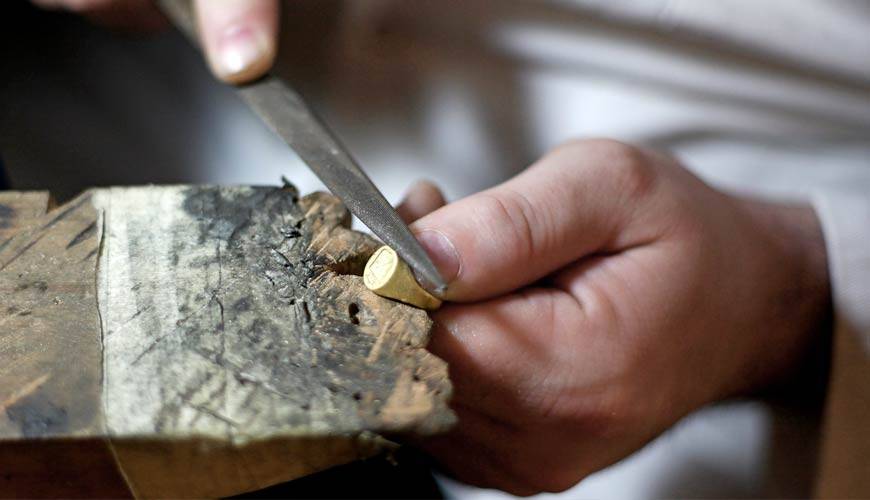
Also known as Electroforming or Plating, this electrolytic process applies a thin metallic layer - measured in microns - to protect jewelry from oxidation.
This surface treatment technique can be applied to various metals such as brass or tin, but above all to precious metals such as silver and of course gold, offering a wide range of available tones and protective finishes.
Discovered in 1803 by Wollaston alongside palladium, rhodium is found in nature associated with the five other elements of the platinum group. The first rhodium baths, intended for the arts and crafts industry, were introduced in the United States in 1932. The process spread across North America and England before reaching Europe somewhat later. South Africa is the largest producer of rhodium (10 tonnes), followed by Russia (8 tonnes), for a total production of 20 tonnes in 1997. The primary application of rhodium is as an automotive catalyst.
Rhodium, a noble metal, is unaffected by any known agent at room temperature and does not oxidize, meaning it undergoes no tarnishing over time. For these reasons, it is used in the form of an electrolytic deposit, most often as a decorative coating. It is widely recognized as the most effective material for hardening platinum group metals and gold. Rhodium plating is used in fine jewelry, jewelry, dental prosthetics, for finishing scientific instruments, and in various industrial applications.
It is well known that silver jewelry and silverware pieces tarnish under the effect of sulfides present in the atmosphere. For a long time, efforts have been made to prevent this tarnishing by depositing a thin layer of a white, air-resistant metal over silverware. Researchers ultimately settled on rhodium. Here is why:
Since Antiquity - most notably among the ancient Egyptians - it has been customary to enhance objects of art, worship, or great value by covering them in gold. This metal, unique at the time for its non-oxidizing properties, was a symbol of immortality and, by extension, the divine. Wooden statuettes, metal objects, and stone pieces were entirely or partially covered with a very thin gold leaf, thin enough not to obscure the fine details of the substrate. The practice evolved over the centuries, and gilding remains widespread today. Over time, new gilding techniques emerged.
Gold leaf gilding, the oldest technique, is still practiced today - particularly for bas-relief substrates that do not respond well to other methods, such as wood (mirror and picture frames), wrought iron, commemorative plaques, and more. It is also used on rooftops (the Dôme des Invalides), sculptures, and decorative elements (the Opéra Garnier) in Paris.
Gold being a highly ductile metal, it can be hammered into very thin (a few micrometers), flexible sheets without breaking the grain of the metal. A gold leaf is laid flat on a surface, then picked up using a wide brush called a "palette," to which it adheres by static electricity. The gold leaf is then applied to the surface to be gilded, sometimes prepared with egg white to ensure adhesion. A burnishing step provides the final appearance. In French gilding, the polishing is done using an agate stone shaped like a wolf's tooth, which was used for this purpose in the 18th century.
Gilding techniques have evolved over the centuries across different periods.
Water Gilding (Distemper Gilding)
This technique, used on carved wood, requires around twenty successive operations and produces a level of finesse and detail that is further enhanced by burnishing.
Oil Gilding (Size Gilding)
Water gilding on burnished areas, and oil gilding on matte areas. Combining the two techniques offers better relief definition on the profiles where ornaments are molded.
This process involves applying a liquid amalgam to the substrate - perfectly stripped with acids - gold having the unique property of dissolving in mercury. The piece is then heated, which causes the mercury to sublimate and evaporate, leaving the gold alone in even the finest details of the substrate.
This process produces a very strong and durable gilding, but can only be applied to small objects due to handling constraints, and only to those that can withstand fire testing. These are most often art or decorative bronzes, or other metals.
Once the gilding is applied, the surface is finished with burnishing - a technique that presses the gold layer into the pores of the substrate using a tool called a burnisher, consisting of a hard stone set in a handle: hematite or agate.
A finish can be achieved using various formulas to alter the tone of the gilding.
This process produces a high-quality, long-lasting gilding that was applied to most gilded bronze sculptures from the Renaissance onward. It has since been largely abandoned, as the process releases highly toxic mercury vapors that are harmful to both craftspeople and the environment.
This process is also known as ormolu, or "or moulu" in French.
This is the most technologically advanced process. It leverages Galvani's discovery, which involves immersing two metal electrodes in a salt bath to form an electric cell. By passing an electric current through the bath, metal molecules are driven from one electrode to the other - from the anode to the cathode. This process is called galvanization.
The object, made conductive beforehand using graphite powder (lead dust) if it was not already, is immersed in a conductive bath and serves as the cathode. The anode is made of stainless steel or platinum.
This process was mastered in the 19th century by the silversmith Christofle, whose reputation was built on the gilding of the famous large statue that crowns Notre-Dame de la Garde in Marseille, completed under Napoleon III.
This process is currently the most widely used at an industrial scale, particularly in electronics. It produces an even gilding with controlled thickness. For art bronzes, however, it has the drawback of tarnishing slightly, with a metallic sheen that can feel cold and uninviting - most often matte.
There are two main gilding techniques: water gilding and oil gilding (size gilding). Leaf gold, silver, copper, palladium, and other metals can all be applied. Water gilding, or distemper gilding, is the technique traditionally used on wood.
Silver plating is the process of depositing a layer of silver onto any given substrate.
The items to be treated undergo thorough cleaning - degreased and polished - before being immersed in an electrolytic bath of silver salts at low electrical current. The anode is a plate of pure silver, and the cathode consists of the pieces to be silver-plated.
Under the effect of the electric current, silver atoms dissolved in the bath deposit onto the pieces being treated (cathode). This physicochemical phenomenon requires constant maintenance of the bath and its silver salt content.
The thickness of the deposit depends on immersion time, the surface area to be treated, and its geometric shape. The quantity, however, is precise, and is most often expressed as deposited weight (e.g., 3.5 g of silver per dm² equals 33 µm in thickness).
The goal is to deposit a reflective layer by reducing a silver salt solution.
The surface of the glass to be silver-plated is brushed and degreased with a cerium oxide water solution to remove impurities, followed by rinsing with distilled water.
The surface is then subjected to a spray of stannous chloride, which enables the precipitation of silver.
Deposition of the silver film in the form of silver nitrate using a spray gun
Protection of this silver layer by copper plating, applied either by spraying or electrolysis, followed - after drying - by a protective anti-oxidation varnish for the copper.
Passivation is an electrolytic degreasing process followed by immersion in a passivation bath and hot-air drying, which leaves a colorless varnish. This varnish protects the metal from oxidation and gives it a brilliant shine.
Share :