
0
Product added
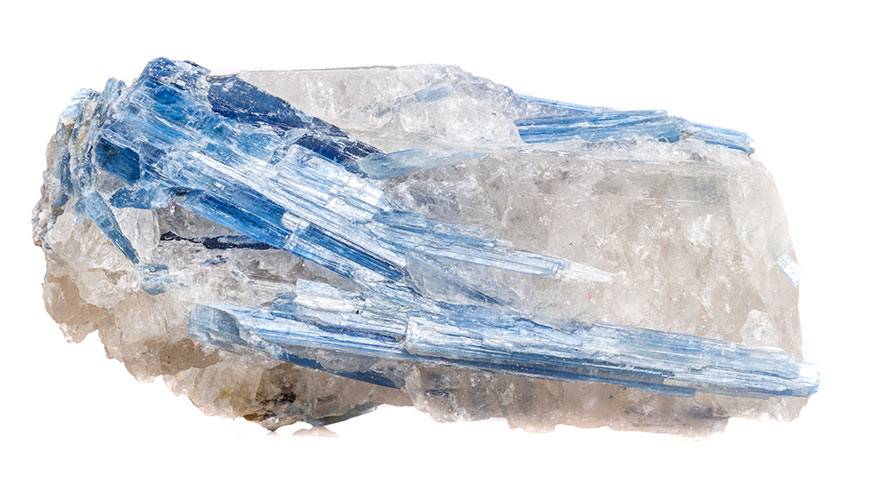
Related to sapphire, kyanite is now recognized as a mineral in its own right. Due to its fragility, it sees limited use in the world of fine jewelry, yet it can still be found in certain pieces. To learn more about the properties and characteristics of this exceptional gem, you'll find all the key information about kyanite right here.
The name kyanite (or cyanite) comes from the Greek "kuanos," meaning "blue brilliance" or "deep blue," a reference to its most common color (cyan). The name was given by mineralogist Abraham Gottlob Werner in 1789. Later, in 1801, French mineralogist René-Just Haüy gave it the name "disthene," meaning "double strength" in Greek ("di" and "destenos") - a term reflecting the stone's distinct electrical properties along different axes.
Kyanite was long confused with sapphire, and it wasn't until the 20th century that it was recognized as a mineral in its own right - which is one of the reasons why tracing its exact history is so difficult. It appears, however, that this gem was used in antiquity to track the Earth's magnetic force by suspending it from a hair, much like a compass needle. Travelers would carry it with them when venturing into unknown lands.
Today, kyanite sees limited use in fine jewelry due to its fragility. It does, however, serve as an alternative to sapphire, being far less rare and considerably more affordable. It is primarily used in earrings and pendants. Collectors are particularly fond of this stone. It also appears in industrial applications and the ceramics industry.
Kyanite is primarily found in medium-temperature, high-pressure metamorphic rocks. This gem is commonly found in Brazil, the United States, Austria, France, Kenya, South Africa, Tanzania, and Sri Lanka. Very high-quality specimens were also discovered between Nepal and Tibet in the 1990s.
Kyanite is composed of aluminum silicate (Al2SiO5) and has a triclinic crystal structure. It is classified as an allochromatic stone, meaning its various hues are caused by the infiltration of external elements into the gem. Although it is colorless in its purest form, it is most commonly found in various shades of blue, owing to the presence of iron and chromium within the stone. It can also display other hues, including green, white, gray, yellow, brown, and orange.
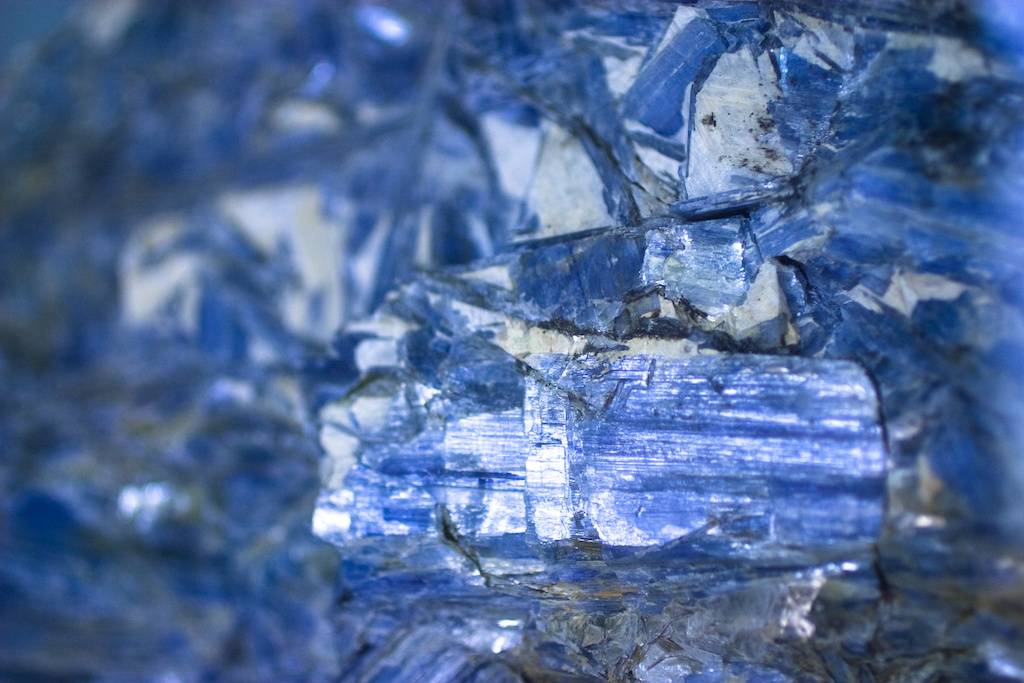
For most specimens, the color is not uniform throughout the stone - it tends to display lighter and darker zones, along with white veining or patches. Kyanite is a polymorphic gem, meaning it can take on different forms. It features two degrees of hardness, which is in itself a unique characteristic. Its hardness ranges from 6 to 7, or 4 to 5 on the Mohs scale (depending on the axis), and its density is 3.5 to 3.6. Kyanite is translucent to transparent with a vitreous to pearly luster. Being insoluble in acids, it is frequently used in the manufacture of technical ceramics.
Much like sapphire, with which it can easily be confused, kyanite with its icy blue hue pairs effortlessly with cool metals such as white gold or silver.
On an emotional level, kyanite is a positive stone that builds self-confidence, enhances intuition, and supports communication. Its calming properties are recommended for people prone to stress and anger. It promotes restful sleep, encourages self-expression, and amplifies and harmonizes energies - making it a particularly useful stone for meditation.
On a physical level, kyanite promotes healing and helps lower blood pressure. It also has antiseptic properties and plays a supportive role in recovery from various types of infections. It may also be beneficial for bone fractures and conditions affecting the throat and larynx.
This is a stone that is particularly sensitive to shocks and scratches. It is important to avoid friction with harder materials. The best approach is to store your kyanite in a separate box or pouch away from other stones and jewelry to avoid damage. Also avoid any contact with chemical products.
For cleaning, a little warm water and soap is all you need. Gently scrub with a soft brush, then rinse. Dry the stone with a soft cloth to prevent limescale deposits.
As noted above, kyanite jewelry is quite rare. If you're looking to acquire a piece, the two most important criteria are the quality of the faceting and the intensity of the gem's blue color. A sapphire-like blue is the most prized, though the color is never uniform and almost always shows visible imperfections. This is a stone that is best appreciated in natural daylight.
Committed to the satisfaction of every customer, we carefully review every piece we offer in our online fine jewelry store. By selecting the finest brands on the market, we ensure you receive jewelry with quality stones whose origin and characteristics have been verified. At Ocarat, you can find the kyanite jewelry piece that perfectly matches what you're looking for. For personalized guidance, don't hesitate to reach out to our Ocarat experts.
Often mistaken for sapphire, kyanite is completely colorless in its purest form. It typically comes in various shades of blue, but can also take on other hues: green, white, gray, yellow, brown, and orange. Because it can appear in different forms, it's important to study this stone carefully to avoid confusing it with sapphire.
Since kyanite is a particularly fragile stone that is highly sensitive to impact, extra care is essential when handling kyanite jewelry. To keep your piece looking its best, cleaning with warm water and soap is recommended. To prevent scratches and water marks, dry the stone with a soft cloth.
Due to its fragility, kyanite is not the most common stone in the world of fine jewelry. That said, it can be found set in a variety of jewelry pieces. To choose the best possible stone, two key criteria are essential: the quality of the faceting and the intensity of the blue.
To guarantee quality jewelry, Ocarat only offers carefully selected pieces in its online store. If you're looking to purchase a kyanite jewelry piece, you can trust our curated collection. To help you find the piece that best matches your expectations, you're welcome to consult Ocarat's experts, who will guide you toward the jewelry that meets your exact criteria.
Share :
Official European Union notice on your rights in the event of a product's lack of conformity.