
0
Product added
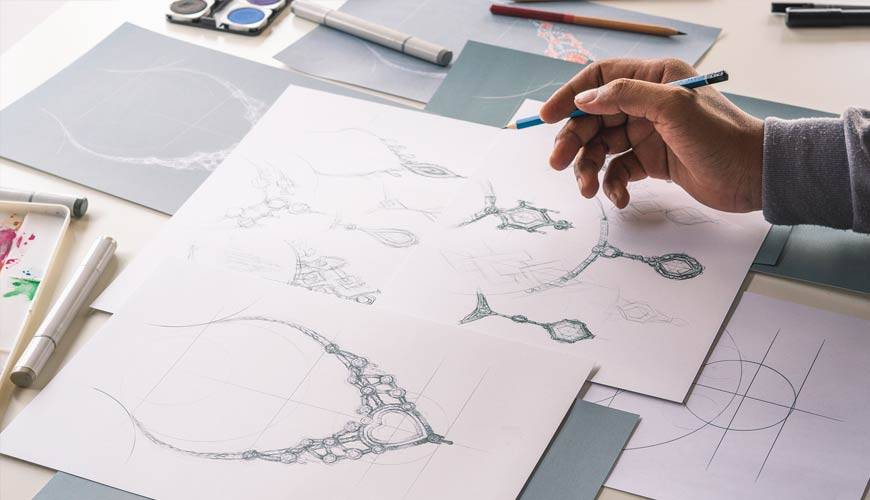
Explore the fascinating world of jewelry and fine jewelry through a comprehensive A-to-Z glossary packed with specialized terms.
Every field has its own language, and jewelry and fine jewelry are no exception. To help you navigate this "specialized" vocabulary, we've created a guide to the terms commonly used in the world of jewelry and fine jewelry.
This compilation, while not exhaustive, highlights the terms you will frequently encounter on our Ocarat website.
Refiner: the name given to a gold or silver smelter who starts with a soft 24-karat pure gold blend and refines it into a much harder 18-karat alloy.
Wedding Ring: A Wedding ring is a gold or silver ring, symbolizing the union formed by wedding.
Alpa: The ALPA clasp for pierced ears is a patented system consisting, on one side, of a notched post and, on the other, of a small circular, domed metal piece with a hole and two lateral tabs. These two tabs form a type of clamp that activates two springs inside the clasp, allowing them to either lock onto the notch of the post to hold it in place, or release it to open the clasp.
Amethyst: Amethyst is a variety of violet quartz (silicon dioxide), ranging from transparent to translucent, whose hue is caused by traces of iron. This mineral is used in fine jewelry and is classified as a semi-precious stone.
Setting Base: the gold component that supports the precious stone in fine jewelry.
Scale: Used to estimate the weight of precious metals used in the creation of a piece of jewelry.
Jewelry: the creation and craftsmanship of precious metals for the making of ornamental pieces.
Gold-Plated Jewelry: an ordinary material covered with a thin layer of gold to give the illusion of a precious metal. This gives the product a very short lifespan.
Children's Jewelry: Jewelry specially designed - in terms of size and safety (no sharp edges) - for our little ones.
Cufflinks: A cufflink is a decorative fastener used to secure the cuff of a shirt when it has no buttons but instead features two stitched slits on a French cuff.
Diamond Carat: A unit of measurement indicating the weight of a diamond. 1 carat equals 0.2 grams (not to be confused with gold karat).
Gold Karat: A unit of measurement indicating the purity of gold. Gold is considered pure at 24 karats, at which point the metal is soft. For jewelry, gold is mixed with an alloy.
Bezel: The head of a ring featuring a claw setting into which a stone is secured. This term is commonly used to refer to the entire unit formed by the setting and the stone.
Signet Ring: A ring with a wide bezel engraved with a coat of arms.
Citrine: Citrine is a variety of quartz whose yellow color is caused by trace amounts of iron oxides in the mineral. Natural citrine is relatively rare.
Crescent: A pendant symbolizing belonging to the Islamic faith.
Cross: A pendant symbolizing belonging to the Christian faith.
Jewelry Box: A hinged box containing a piece of jewelry or a fine jewelry item.
Star of David: A pendant symbolizing belonging to the Jewish faith.
Precious Metal Foundries and Laboratories: Places where gold and silver are melted to create raw silversmithing pieces.
Lost-wax casting: An ancient technique invented by the Egyptians. It allows objects in bronze, silver, or gold to be created and reproduced by pouring molten metal into a mold.
Hallmark Stamping: hallmarks are stamped on gold jewelry to identify their manufacturing origin and the quality of the gold used.
Engraving in jewelry, fine jewelry, and silversmithing: A technique used to personalize a piece of jewelry by engraving a message on it.
Garnet: Garnet refers to a family of minerals from the nesosilicate group that crystallize in the cubic (or isometric) crystal system. Gem-quality garnets are classified as semi-precious stones.
Fine Jewelry: the art of showcasing precious stones, as opposed to jewelry, which places the emphasis on the metal itself.
Lapidary: A specialist in precious stones.
Laser: A cutting or engraving system used on diamonds.
Mohs: An empirical scale of "hardness" used to rank the scratch resistance of materials and minerals in ascending order (1. talc; 2. gypsum; 3. calcite; 4. fluorite; 5. apatite; 6. orthoclase; 7. quartz; 8. topaz; 9. corundum; 10. diamond).
Mount: A fine jewelry setting designed to hold pearls and stones.
Mother-of-Pearl: The calcareous secretion from the mantle of mollusks, forming the inner lining of their shells.
Onyx: Onyx is a variety of chalcedony. It is composed of SiO2 (silicon dioxide).
White Gold: a jewelry metal made up of 75% gold, silver, copper, and sometimes palladium.
Yellow Gold: a jewelry metal made up of 75% gold, 12.5% silver, and 12.5% copper.
Rose Gold: a jewelry metal made up of 75% gold, 20% copper, and 5% silver.
Peridot: Peridot is the name given to olivine when it is used in fine jewelry as a gemstone.
Cultured pearl: A pearl produced by farmed oysters; it can be either freshwater or saltwater.
Natural Pearl: A pearl found in nature in its natural state, without any human intervention.
Polishing: The friction-based process applied to the surface of a precious metal to increase its brilliance.
Cleaning Product: A chemical product used to restore the brilliance and luster of a precious metal.
Rhodium Plating: the process of depositing a thin layer of rhodium through electrolysis to enhance the brilliance of white gold.
Prong Setting: The method of securing a faceted gemstone to a piece of jewelry using a few metal prongs that are bent over to grip ("claw") its girdle.
Grain Setting: The method of securing a very small gemstone to a piece of jewelry by raising metal from the surface of its support and folding it over the stone like a small granule.
Bezel Setting: The method of securing a faceted gemstone to a piece of jewelry using a metal collar that wraps around and grips its girdle.
Channel Setting: Channel setting involves sliding stones between two channels created with a milling cutter or needle file, then locking them in place with a mechanical hammer. Finishing is done with emery or a rubber polisher.
Setter: A craftsperson who sets a precious stone into a mount.
Solitaire: a piece of fine jewelry featuring a single precious stone.
Share :
Official European Union notice on your rights in the event of a product's lack of conformity.